| Pouteria polysepala | |
|---|---|
Scientific classification 
| |
| Kingdom: | Plantae |
| Clade: | Embryophytes |
| Clade: | Tracheophytes |
| Clade: | Spermatophytes |
| Clade: | Angiosperms |
| Clade: | Eudicots |
| Clade: | Asterids |
| Order: | Ericales |
| Family: | Sapotaceae |
| Genus: | Pouteria |
| Species: | P. polysepala
|
| Binomial name | |
| Pouteria polysepala T.D.Penn.
| |
| Synonyms2 | |
|
Calocarpum odoratum Ducke | |
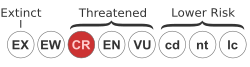
Pouteria polysepala is a rare species of plant in the family Sapotaceae. It is a tree native to the western Amazon Basin of northwestern Brazil and adjacent Ecuador, Peru, and Bolivia,2 and to northwestern Ecuador.3 It is threatened by habitat loss and is considered Critically Endangered (CR). It is known to reside only upon large trees in a forest that is not experiencing heavy flooding.1 In the 1998 IUCN Red List assessment the only known occurrence of Pouteria polysepala is at the mouth of the Javari River in the Brazilian state of Amazonas.41 As of March 2026 the GBIF has 23 georeferenced records covering a larger area across several countries.2
References
References
- Pires O'Brien, J. (1998). "Pouteria polysepala". IUCN Red List of Threatened Species. 1998 e.T35882A9958646. doi:10.2305/IUCN.UK.1998.RLTS.T35882A9958646.en.
- "Pouteria polysepala T.D.Penn". Plants of the World Online. Royal Botanic Gardens, Kew. Retrieved 18 March 2026.
- "Pouteria polysepala T.D.Penn". GBIF—the Global Biodiversity Information Facility. Retrieved 18 March 2026.
- Pires O' Brien, J. (6 January 2009). "Pouteria polysepala". Biodiversity.Mongabay.com. Archived from the original on 2 April 2012. Retrieved 6 September 2011.