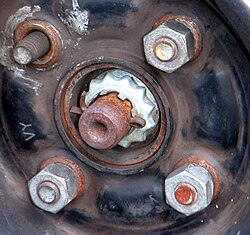
A positive locking device is a device used in conjunction with a fastener in order to positively lock the fastener. This means that the fastener cannot work loose from vibrations. The following is a list of positive locking devices:1
- A split beam nut
- A castellated nut and a split pin
- A hex nut or cap screw and a tab washer
- A hex nut or cap screw and a lock plate
- Safety wiring with various types of fasteners
7-122. GENERAL. The word safetying is a term universally used in the aircraft industry. Briefly, safetying is defined as: "Securing by various means any nut, bolt, turnbuckle etc., on the aircraft so that vibration will not cause it to loosen during operation." These practices are not a means of obtaining or maintaining torque, rather a safety device to prevent the disengagement of screws, nuts, bolts, snap rings, oil caps, drain cocks, valves, and parts. Three basic methods are used in safetying; safety-wire, cotter pins, and self-locking nuts. Retainer washers and pal nuts are also sometimes used.2
7-124d. Safety wire must be installed in a manner that will prevent the tendency of the part to loosen.3
-
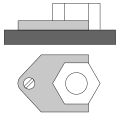 A locking plate
 -
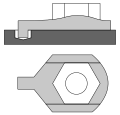 A tab washer
References
References
- Timings, Roger Leslie (2005), Newnes Mechanical Engineer's Pocket Book (3rd. ed.), Newnes, ISBN 978-0-7506-6508-7
- AC43.13 1998, p. 7–19.
- AC43.13 1998, p. 7–21.
- "7. Aircraft Hardware, Control Cables, and Turnbuckles" (PDF). AC 43.13-1B - Acceptable Methods, Techniques, and Practices - Aircraft Inspection and Repair. 8 September 1998. Retrieved 2012-12-11.