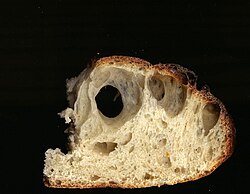
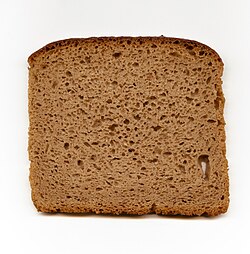
Pores are the air pockets found in leavened bread, where carbon dioxide from the fermentation process creates a network of primarily interconnected void structures.12 The degree to which pores form are a major determiner in the texture ("crumb") of the bread.34 Pore size varies between varieties of bread. Sourdough bread is a variety with larger pores. Rye bread has smaller pores and a denser crumb.5
References
References
- Wang, Shuo; Austin, Peter; Bell, Sumana (2011). "It's a maze: The pore structure of bread crumbs". Journal of Cereal Science. 54 (2): 203–210. doi:10.1016/j.jcs.2011.05.004.
- "From dough to bread: the setting up of a heterogeneous cellular structure" (PDF). insidefood.eu. Retrieved 2014-12-29.
- "Porous media characterization of breads baked using novel heating modes" (PDF). akademikpersonel.kocaeli.edu.tr. Retrieved 2014-12-29.
- "Controlling quality and texture through digitizing breads and doughs" (PDF). ioa.uwa.edu.au. Retrieved 2014-12-29.
- Brown, A. (2007). Understanding Food: Principles and Preparation. Cengage Learning. p. 397. ISBN 9780495107453. Retrieved 2014-12-29.