
A sodium-cooled fast reactor (SFR) is a fast neutron reactor cooled by liquid sodium. The use of sodium as a coolant enables high power density and low-pressure operation. Such reactors are capable of burning up transuranic waste products in the spent fuel of light-water reactors, significantly reducing the quantity and lifetime of radioactive waste.1 Some SFR designs are breeder reactors, and can produce more fissile nuclear fuel than they consume.
More than 20 SFRs have been operated globally, starting with EBR-I in 1950, and several commercial plants have been constructed starting with Fermi 1.1 As of 2026, China, Russia, and India have operational sodium-cooled fast reactors.2 The SFR was one of the six technologies selected by the Generation IV International Forum in 2003 for further development. The ability of the SFR to burn transuranic waste and close the nuclear fuel cycle were highlighted as particularly desirable features.3 Several SFR reactors are under construction as of 2026, including a CFR-600 in China and the Natrium and Aurora reactors in the United States.
History
The concept of a fast-neutron reactor cooled by liquid metal was first demonstrated at Los Alamos with the construction of the Clementine reactor in 1946.4 The first nuclear reactor to generate electricity was the Experimental Breeder Reactor I (EBR-I), which achieved criticality in 1950. EBR-I was a 0.2 MWe fast reactor cooled by liquid sodium-potassium alloy, and demonstrated the concept of nuclear breeding. It also established sodium as the coolant of choice for fast reactors.5 However, the reactor experienced a partial meltdown in 1955, which required the core to be removed and replaced.4
Following the success of EBR-I, several additional experimental SFRs were constructed. The United Kingdom Atomic Energy Authority built the Dounreay Fast Reactor (DFR), which achieved criticality in 1962, while the US Atomic Energy Commission (AEC) built a larger 20 MWe prototype SFR, the Experimental Breeder Reactor II (EBR-II). EBR-II is considered the most successful US fast reactor, and demonstrated the feasibility of an SFR power plant.4 The DFR, as well as the French Rapsodie and Japanese Jōyō test reactors all served as prototypes for larger commercial plants.
Commercial SFRs
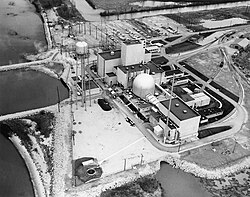
The first commercial SFR, and first commercial breeder reactor, was the 66 MWe Fermi 1 reactor built in 1963 under the Power Reactor Demonstration Program. This reactor was based on the design of EBR-I, and experienced a similar partial meltdown in 1966. Fermi 1 was shutdown for repairs until 1970, after which it operated until 1972.4
In the 1960s, the US AEC embarked on a significant program to build commercial liquid metal-cooled fast breeder reactors, eventually being declared the country's highest-priority energy program in 1969. This program culminated in the Clinch River Breeder Reactor Project (CRBRP), which aimed to build a 300 MWe demonstration SFR. The CRBRP experienced significant delays, and became the center of a large political battle of the future of nuclear energy leading to its cancellation in 1983. This decision effectively ended breeder research in the United States.4
Following the cancellation of the CRBRP, the US program was refocused on the concept of an Integral Fast Reactor (IFR), an inherently safe SFR that would incorporate on-site fuel reprocessing to close the nuclear fuel cycle. EBR-II was used to investigate the inherent safety characteristics of SFRs as part of the IFR program, and successfully demonstrated safe removal of decay heat via natural circulation in the sodium coolant.4 However, the IFR program was terminated in 1994 by the Clinton Administration before a demonstration plant could be constructed, and EBR-II was shut down as well.46
France constructed the Phénix demonstration SFR in 1973, and the larger commercial Superphénix in 1985. Superphénix was the largest SFR ever constructed, at 1242 MWe. It experienced technical issues and significant political opposition, and was closed in 1998 for political reasons.6 The closure of Superphénix led to the refocusing of the French nuclear program to light-water reactors instead of fast breeders.6 Germany constructed the 327 MW SNR-300 fast breeder reactor in 1985, however it suffered significant political backlash and was never taken online. The reactor was officially cancelled in 1991.5
The Monju Nuclear Power Plant was constructed in Japan between 1986 and 1994. After a sodium leak accident in 1995, the reactor was shut down for repairs until 2010.6 Shortly afterward, the plant's fuel handling machine fell into the reactor vessel and could not be retrieved, and the reactor was closed permanently in 2016.7

The Soviet Union constructed multiple commercial SFRs at the Beloyarsk Nuclear Power Station, starting with the BN-350 reactor. The BN-350 operated between 1972 and 1999 and produced both electricity and process heat for desalination. Two additional SFRs, BN-600 and BN-800, came online in 1980 and 2014, and are considered commercially successful. As of 2024, the BN-800 reactor has a capacity factor above 80% and has successfully demonstrated the burning of surplus plutonium.6
Strong interest in the breeder cycle was driven primarily by an expected shortage of uranium resources. However, this shortage never materialized and the light-water reactor eventually dominated the market while the construction of SFRs stalled.5 An exception is India, which lacks significant uranium resources and has pursued breeder reactors as part of India's three-stage nuclear power programme. The second stage of this plan calls for the construction of commercial SFR plants that can breed fissile plutonium and uranium-233 for use in heavy-water reactors. The experimental Fast Breeder Test Reactor, based on the French Rapsodie design, was constructed starting in 1972 and has remained operational since 1985.6
TerraPower - Natrium
In 2020, Natrium received an $80M grant from the US Department of Energy for development of its SFR. The program plans to use High-Assay, Low Enriched Uranium fuel containing 5-20% uranium. The reactor was expected to be sited underground and have gravity-inserted control rods. Because it operates at atmospheric pressure, a large containment shield is not necessary. Because of its large heat storage capacity, it was expected to be able to produce surge power of 500 MWe for 5+ hours, beyond its continuous power of 345 MWe.8
In the United States, TerraPower (using its Traveling Wave technology) is building its own reactor along with molten salt energy storage in partnership with GEHitachi's PRISM integral fast reactor design, under the Natrium appellation in Kemmerer, Wyoming.9101112
Non-nuclear construction began in 2024, while the work on the nuclear island is expected to begin in 2026.1314 The NRC issued the construction permit for Kemmerer Unit 1 on March 4, 2026.15
Canada
In 2023, ARC Clean Technology Canada signed a memorandum of understanding with the Government of Alberta according to which Invest Alberta entity will support ARC's ARC-100 sodium-cooled 100 MWe reactor (based on Experimental Breeder Reactor II). ARC said that ARC-100 could become operational in 2029. ARC-100 project is a pool type reactor.16
Fuel cycle
The nuclear fuel cycle employs a full actinide recycle with two major options: One is an intermediate-size (150–600 MWe) sodium-cooled reactor with uranium-plutonium-minor-actinide-zirconium metal alloy fuel, supported by a fuel cycle based on pyrometallurgical reprocessing in facilities integrated with the reactor. The second is a medium to large (500–1,500 MWe) sodium-cooled reactor with mixed uranium-plutonium oxide fuel, supported by a fuel cycle based upon advanced aqueous processing at a central location serving multiple reactors. The outlet temperature is approximately 510–550 degrees C for both.
Sodium coolant
A sodium-cooled fast reactor uses liquid metallic sodium to carry heat from the core. Sodium is an excellent heat-transfer fluid, and features a low melting point and high boiling point, allowing a sodium-cooled reactor to operate at high temperature while remaining at atmospheric pressure.17 The elimination of pressurized coolant effectively eliminates the risk of a loss-of-coolant accident, while the higher-temperature operation provides better thermal efficiency than light-water reactors.18
Sodium boils at 892 °C (1,638 °F), which provides a margin-to-boiling of approximately 400 °C (752 °F), compared to 15 °C (59 °F) in a pressurized water reactor (PWR).19 At the same time, the difference in inlet and outlet temperatures is approximately 150 °C (302 °F) for an SFR and 30 °C (86 °F) in an LWR. The higher outlet temperature allows for a thermal efficiency around 40%, while the much larger temperature difference enables SFRs to easily rely on natural circulation for decay heat removal.18
Sodium has a small neutron cross section compared to water, and is a poor neutron moderator. Water is a much stronger neutron moderator because the hydrogen atoms found in water are much lighter than metal atoms, and therefore neutrons lose more energy in collisions with hydrogen atoms. This makes it difficult to use water as a coolant for a fast reactor because the water tends to slow (moderate) the fast neutrons into thermal neutrons (although concepts for reduced moderation water reactors exist). The lack of moderation allows a sodium-cooled reactor to operate on a fast neutron spectrum, which provides significantly better neutron economy as well as higher core power density compared to a thermal reactor. The use of fast neutrons also enables the breeding of plutonium from uranium-238, as well as the transmutation of transuranic waste products from spent nuclear fuel.18 This reduces both the radiotoxicity and heat generation from nuclear waste, and significantly reduces its lifetime.1
The largest issue with sodium coolant is its highly exothermic reaction with water or atmospheric oxygen. For this reason, the reactor vessel is filled with an inert gas, typically argon.20 Should a steam generator tube fail in a sodium-cooled reactor, pressurized steam would contact the hot sodium coolant and the resulting reaction could damage reactor components.21 Sodium has only one stable isotope, sodium-23, which is a weak neutron absorber. When it does absorb a neutron it produces sodium-24, which has a half-life of 15 hours and decays to stable isotope magnesium-24. This process emits penetrating gamma radiation, and means that the primary sodium coolant must be surrounded by shielding. While its short half-life means it is not an environmental pollutant, a leak of the primary cooling system and subsequent sodium fire would expose personnel to airborne radioactive sodium.20 To prevent a sodium-water reaction with the primary coolant, and to prevent radioactive sodium from entering the steam generation system, an intermediate loop must be used that uses a secondary sodium loop to transfer heat from the primary coolant to the steam generator.17
Pool or loop type

Because the primary sodium coolant will become radioactive during operation, an intermediate cooling loop is needed to separate radioactive sodium from the water in the power generation loop. There are therefore two main design approaches to sodium-cooled fast reactors, pool-type and loop-type.17
In a pool-type SFR, the intermediate heat exchanger (IHX) is contained in the primary reactor vessel, surrounded by liquid sodium. This means that the radioactive primary sodium never leaves the reactor vessel. Because the only sodium leaving the vessel is the intermediate coolant, a pool-type SFR eliminates the risk of a radioactive sodium fire.22 The large inventory of sodium surrounding the core also allows for easier passive cooling.17 However, because the primary sodium pump and intermediate heat exchanger are located within the sodium pool, maintenance becomes much more difficult than a loop-type reactor.22 The US EBR-II, French Phénix/Superphénix and others used this approach, and it is used by India's PFBR and China's CFR-600.
In a loop-type SFR, the intermediate heat exchanger is located outside the primary reactor vessel, and the primary sodium is pumped out of the reactor vessel into the IHX. Such a design is generally simpler than a pool-type SFR, and leads to a smaller reactor vessel. Maintenance is also easier on a loop-type SFR because the primary pump and IHX are located outside the sodium pool. However, a loop-type SFR allows primary sodium to leave the reactor vessel, which introduces the possibility of a radioactive sodium fire.22 A smaller reactor vessel also contains a smaller sodium inventory, which can also reduce the safety margin for emergency cooling.20 The American Fermi 1, French Rapsodie, British PFR, Japanese Monju plant, and others used this approach.
Advantages
All fast reactors have several advantages over the current fleet of light-water reactors in that the waste streams are significantly reduced. When a reactor runs on fast neutrons, the plutonium isotopes are far more likely to fission upon absorbing a neutron. Thus, fast neutrons have a smaller chance of being captured by the uranium and plutonium, but when they are captured, have a much bigger chance of causing a fission. Compared to a light-water reactor, SFRs can utilize 50 times as much energy from natural uranium fuel.5 This results in fewer neutron captures producing transuranic waste, and the transuranic isotopes produced can be fissioned by fast neutrons. The result is that the inventory of transuranic waste is nonexistent from fast reactors.20 Because the transuranic waste products are responsible for the several-thousand-year lifetime of nuclear waste, destroying these isotopes in an SFR allows the waste to decay down to natural levels after only a few hundred years.5
Another advantage of liquid sodium coolant is that sodium melts at 98 °C (208 °F) and boils above 892 °C (1,638 °F), while the reactor operating temperature is around 500 °C (932 °F). This results in a 400 °C (752 °F) margin until the coolant begins to boil. By comparison, the margin to boiling is only 15 °C (59 °F) in a PWR. Despite sodium's low specific heat relative to water, this enables the absorption of significant heat in the liquid phase, while maintaining large safety margins. The high thermal conductivity of sodium effectively creates a reservoir of heat capacity that provides thermal inertia against overheating.19 Combined with the much higher temperatures achieved in the reactor, this means that the reactor in shutdown mode can be passively cooled. This was demonstrated at EBR-II in April 1986, when the operators intentionally shut down the reactor's cooling systems with the reactor at full power, and the reactor successfully shut itself down via its inherent reactivity coefficient and maintained decay heat removal through natural circulation. A similar test was also performed at the larger Fast Flux Test Facility while at 50% power.20
Sodium need not be pressurized since its boiling point is much higher than the reactor's operating temperature, and sodium does not corrode steel reactor parts, and in fact, protects metals from corrosion.19 The high temperatures reached by the coolant (the Phénix reactor outlet temperature was 833K (560°C)) permit a higher thermodynamic efficiency than in water cooled reactors.23 The fact that the sodium is not pressurized implies that a much thinner reactor vessel can be used (e.g. 2 cm thick). A small leak of sodium will also drip down before disappearing in to the atmosphere, while at the high pressures used in light-water reactors, any leaking coolant will explosively flash to steam.20 The use of a liquid metal also enables the use of electromagnetic pumps to circulate the coolant, which contain no moving parts.1823
Reactors of this type are also self-controlling, as fast-neutron reactors typically have a negative temperature coefficient of reactivity due to their small core size. If the temperature of the core increases, the core will expand slightly, which means that more neutrons will escape the core, slowing down the reaction. Furthermore, Doppler broadening at higher temperatures results in fewer neutrons available for fission, further decreasing the reaction rate.20
Disadvantages
The primary disadvantage of sodium is its chemical reactivity, which requires special precautions to prevent and suppress fires. If sodium comes into contact with water it reacts to produce sodium hydroxide and hydrogen, and the hydrogen burns in contact with air. This was the case at the Monju Nuclear Power Plant in a 1995 accident. In addition, neutron capture causes it to become radioactive; albeit with a half-life of only 15 hours.19 The radioactivity of sodium requires the use of an intermediate sodium loop, while its chemical reactivity requires precautions such as lining the walls and floors of sodium-containing areas with stainless steel, and the use of double-wall tubes.18 Sodium at high temperatures ignites in contact with oxygen. Such sodium fires can be extinguished by powder, or by replacing the air with nitrogen. A Russian breeder reactor, the BN-600, reported 27 sodium leaks in a 17-year period, 14 of which led to sodium fires.24
Unlike water, sodium coolant is opaque, and thus visual inspections cannot be made under liquid sodium. Fuel handling in an SFR requires careful positioning, and the structural integrity of internal components is harder to verify. However, techniques such as ultrasonic imaging can be used to examine structures under sodium. The opacity of sodium coolant has not posed an issue to SFR operation.19 Maintenance on sodium-cooled reactors is also made more difficult by the need to keep the sodium molten at 200 °C (392 °F).
Unlike a light-water reactor, a fast-neutron reactor like an SFR is not in its most reactive configuration during normal operation. In the event of fuel melt, the fuel reactivity could increase. Furthermore, a large-core SFR can have a postive void coefficient in the center of its core. However, other design features can be used to produce a negative coolant temperature reactivity coefficient even in a large-sized reactor.520
Design goals
| Actinides25 by decay chain | Half-life range (a) |
Fission products of 235U by yield26 | ||||||
|---|---|---|---|---|---|---|---|---|
| 4n (Thorium) |
4n + 1 (Neptunium) |
4n + 2 (Radium) |
4n + 3 (Actinium) |
4.5–7% | 0.04–1.25% | <0.001% | ||
| 228Ra№ | 4–6 a | 155Euþ | ||||||
| 248Bk27 | > 9 a | |||||||
| 244Cmƒ | 241Puƒ | 250Cf | 227Ac№ | 10–29 a | 90Sr | 85Kr | 113mCdþ | |
| 232Uƒ | 238Puƒ | 243Cmƒ | 29–97 a | 137Cs | 151Smþ | 121mSn | ||
| 249Cfƒ | 242mAmƒ | 141–351 a |
No fission products have a half-life | |||||
| 241Amƒ | 251Cfƒ28 | 430–900 a | ||||||
| 226Ra№ | 247Bk | 1.3–1.6 ka | ||||||
| 240Pu | 229Th | 246Cmƒ | 243Amƒ | 4.7–7.4 ka | ||||
| 245Cmƒ | 250Cm | 8.3–8.5 ka | ||||||
| 239Puƒ | 24.1 ka | |||||||
| 230Th№ | 231Pa№ | 32–76 ka | ||||||
| 236Npƒ | 233Uƒ | 234U№ | 150–250 ka | 99Tc₡ | 126Sn | |||
| 248Cm | 242Pu | 327–375 ka | 79Se₡ | |||||
| 1.33 Ma | 135Cs₡ | |||||||
| 237Npƒ | 1.61–6.5 Ma | 93Zr | 107Pd | |||||
| 236U | 247Cmƒ | 15–24 Ma | 129I₡ | |||||
| 244Pu | 80 Ma |
... nor beyond 15.7 Ma29 | ||||||
| 232Th№ | 238U№ | 235Uƒ№ | 0.7–14.1 Ga | |||||
| ||||||||
The operating temperature must not exceed the fuel's boiling temperature. Fuel-to-cladding chemical interaction (FCCI) has to be accommodated. FCCI is eutectic melting between the fuel and the cladding; uranium, plutonium, and lanthanum (a fission product) inter-diffuse with the iron of the cladding. The alloy that forms has a low eutectic melting temperature. FCCI causes the cladding to reduce in strength and even rupture. The amount of transuranic transmutation is limited by the production of plutonium from uranium. One work-around is to have an inert matrix, using, e.g., magnesium oxide. Magnesium oxide has an order of magnitude lower probability of interacting with neutrons (thermal and fast) than elements such as iron.30
High-level wastes and, in particular, management of plutonium and other actinides must be handled. Safety features include a long thermal response time, a large margin to coolant boiling, a primary cooling system that operates near atmospheric pressure, and an intermediate sodium system between the radioactive sodium in the primary system and the water and steam in the power plant. Innovations can reduce capital cost, such as modular designs, removing a primary loop, integrating the pump and intermediate heat exchanger, and better materials.31
The SFR's fast spectrum makes it possible to use available fissile and fertile materials (including depleted uranium) considerably more efficiently than thermal spectrum reactors with once-through fuel cycles.
List of sodium-cooled fast reactors
| Model | Country | Thermal power (MW) | Electric power (MW) | Year of commission | Year of decommission | Notes |
|---|---|---|---|---|---|---|
| BN-350 |  Soviet Union Soviet Union
|
350 | 1973 | 1999 | BN-350 used to power a water desalination plant. | |
| BN-600 | Soviet Union
|
600 | 1980 | Operational | Expected to operate until 20403233 | |
| BN-800 |  Russia Russia
|
2100 | 880 | 2015 | Operational | |
| BN-1200M | Russia
|
2900 | 1220 | Under construction | ||
| CEFR |  China China
|
65 | 20 | 2012 | Operational | |
| CFR-600 | China
|
1500 | 600 | 2023 | Operational | Two reactors being constructed on Changbiao Island in Xiapu County. The second CFR-600 reactor will open in 2026.34 |
| CFR-1000 | China
|
1200 | After 2030 (est.) | Awaiting approval for construction3536 | ||
| EBR-1 |  United States United States
|
1.4 | 0.2 | 1950 | 1964 | |
| EBR-2 | United States
|
62.5 | 20 | 1965 | 1994 | |
| Fermi 1 | United States
|
200 | 69 | 1963 | 1975 | |
| Fast Flux Test Facility | United States
|
400 | 1978 | 1993 | Not for power generation | |
| CRBRP | United States
|
1000 | 350 | Never built | 1970-1983, cancelled after $8 billion spent | |
| Kemmerer 1 | United States
|
840 | 345 | Under construction37 | Incorporates a thermal energy storage system that can temporarily supply up to 500 MWe | |
| Aurora-INL | United States
|
75 | Under construction38 | |||
| DFR |  United Kingdom United Kingdom
|
60 | 14 | 1962 | 1977 | |
| PFR | United Kingdom
|
500 | 250 | 1974 | 1994 | |
| FBTR |  India India
|
40 | 13.2 | 1985 | Operational | |
| PFBR | India
|
500 | 2026 | Criticality achieved, awaiting connection to grid39 | ||
| Monju |  Japan Japan
|
714 | 280 | 1995/2010 | 2010 | Suspended for 15 years. Reactivated in 2010, then permanently closed |
| Jōyō | Japan
|
150 | 1971 | Under repair | Expected to be restarted at the end of 20264041 | |
| SNR-300 |  Germany Germany
|
327 | 1985 | 1991 | Never critical/operational | |
| Rapsodie |  France France
|
40 | 24 | 1967 | 1983 | |
| Phénix | France
|
590 | 250 | 1973 | 2010 | |
| Superphénix | France
|
3000 | 1242 | 1986 | 1997 | Largest SFR ever built. |
| ASTRID | France
|
600 | Never built | 2012–2019, cancelled after €735 million spent |
See also
See also
References
References
- "Sodium Fast Reactor (SFR)". Gen IV International Forum. Retrieved 2026-05-27.
- "Fast Neutron Reactors". World Nuclear Association. 2026-03-31. Retrieved 2026-05-27.
- Institut de Radioprotection et de Surete Nucleaire (2012-09-24). Overview of Generation IV (Gen IV) Reactor Designs: Safety and Radiological Protection Considerations (PDF) (Report). 2012/158. Retrieved 2026-05-27.
- Cochran, Thomas B.; Feiveson, Harold A.; Von Hippel, Frank (2009). "Fast Reactor Development in the United States". Science & Global Security. 17 (2–3): 109–131. doi:10.1080/08929880903445514.
- Ohshima, Hiroyuki; Kubo, Shigenobu (2023). "Chapter 5: Sodium-cooled Fast Reactors (SFRs)". In Pioro, Igor L. (ed.). Handbook of Generation IV Nuclear Reactors (2nd ed.). Woodhead Publishing. doi:10.1016/C2019-0-01219-8. ISBN 978-0-12-820588-4.
- Dunlap, Richard A. (2024). Generation IV Nuclear Reactors. Bristol, UK: IOP Publishing. doi:10.1088/978-0-7503-6069-2. ISBN 978-0-7503-6069-2.
- "Japanese government says Monju will be scrapped". World Nuclear News. 2016-12-22. Retrieved 2026-05-27.
- "Bill Gates's next-gen nuclear plant packs in grid-scale energy storage". New Atlas. 2021-03-09. Retrieved 2021-06-03.
- Patel, Sonal (2020-09-03). "GE Hitachi, TerraPower Team on Nuclear-Storage Hybrid SMR". POWER Magazine. Retrieved 2022-10-28.
- "Natrium". NRC Web. Retrieved 2022-10-28.
- Patel, Sonal (2022-10-27). "PacifiCorp, TerraPower Evaluating Deployment of Up to Five Additional Natrium Advanced Reactors". POWER Magazine. Retrieved 2022-10-28.
- Gardner, Timothy (August 28, 2020). "Bill Gates' nuclear venture plans reactor to complement solar, wind power boom". Reuters – via www.reuters.com.
- "TerraPower Begins Construction on Advanced Nuclear Project in Wyoming". terrapower.com. June 10, 2024.
- "Suppliers chosen for key components of Natrium demo plant". world-nuclear-news.org. December 19, 2024.
- Timmer, John (March 4, 2026). "TerraPower gets OK to start construction of its first nuclear plant". Ars Technica. Retrieved March 5, 2026.
- "The POWER Interview: How a Canadian Small Reactor Will Support Industrial Decarbonization". powermag.com. April 5, 2023.
- Mitchell, Walter, III; Turner, Stanley E. (1971). Breeder Reactors (PDF). Atomic Energy Commission. Retrieved 2026-05-28.
- Office of Nuclear Energy (2015-02-18). "Sodium-cooled Fast Reactor (SFR) Technology and Safety Overview" (PDF). US Department of Energy. Pacific Northwest National Laboratory. Retrieved 2026-05-28.
- Fanning, Thomas H. (May 3, 2007). "Sodium as a Fast Reactor Coolant" (PDF). Topical Seminar Series on Sodium Fast Reactors. Nuclear Engineering Division, U.S. Nuclear Regulatory Commission, U.S. Department of Energy. Archived from the original (PDF) on January 13, 2013.
- Till, Charles E.; Chang, Yoon Il (2011). Plentiful Energy: The Story of the Integral Fast Reactor. ISBN 978-1-4663-8460-6.
- Kikuchi, Shin; Seino, Hiroshi; Kurihara, Akikazu; Ohshima, Hiroyuki (2012). Kinetic Study of Sodium-Water Reaction Phenomena by Differential Thermal Analysis. 2012 20th International Conference on Nuclear Engineering and the ASME 2012 Power Conference. Anaheim, California, USA. pp. 281–289. doi:10.1115/ICONE20-POWER2012-54134. ISBN 978-0-7918-4496-0.
- Kouts, Herbert C. (1983). "The Development of Breeder Reactors in the United States". Annual Review of Energy. 8. Annual Reviews: 385–413. doi:10.1146/annurev.eg.08.110183.002125. ISSN 0362-1626.
- Bonin, Bernhard; Klein, Etienne (2012). Le nucléaire expliqué par des physiciens.
- Unusual occurrences during LMFR operation, Proceedings of a Technical Committee meeting held in Vienna, 9–13 November 1998, IAEA. Page 53, 122-123.
- Plus radium (element 88). While actually a sub-actinide, it immediately precedes actinium (89) and follows a three-element gap of instability after polonium (84) where no nuclides have half-lives of at least four years (the longest-lived nuclide in the gap is radon-222 with a half life of less than four days). Radium's longest lived isotope, at 1,600 years, thus merits the element's inclusion here.
- Specifically from thermal neutron fission of uranium-235, e.g. in a typical nuclear reactor.
- Milsted, J.; Friedman, A. M.; Stevens, C. M. (1965). "The alpha half-life of berkelium-247; a new long-lived isomer of berkelium-248". Nuclear Physics. 71 (2): 299. Bibcode:1965NucPh..71..299M. doi:10.1016/0029-5582(65)90719-4.
"The isotopic analyses disclosed a species of mass 248 in constant abundance in three samples analysed over a period of about 10 months. This was ascribed to an isomer of Bk248 with a half-life greater than 9 [years]. No growth of Cf248 was detected, and a lower limit for the β− half-life can be set at about 104 [years]. No alpha activity attributable to the new isomer has been detected; the alpha half-life is probably greater than 300 [years]." - This is the heaviest nuclide with a half-life of at least four years before the "sea of instability".
- Excluding those "classically stable" nuclides with half-lives significantly in excess of 232Th; e.g., while 113mCd has a half-life of only fourteen years, that of 113Cd is eight quadrillion years.
- Bays SE, Ferrer RM, Pope MA, Forget B (February 2008). "Neutronic Assessment of Transmutation Target Compositions in Heterogeneous Sodium Fast Reactor Geometries" (PDF). Idaho National Laboratory, U.S. Department of Energy. INL/EXT-07-13643 Rev. 1. Archived from the original (PDF) on 2012-02-12.
- Lineberry MJ, Allen TR (October 2002). "The Sodium-Cooled Fast Reactor (SFR)" (PDF). Argonne National Laboratory, US Department of Energy. ANL/NT/CP-108933. Archived from the original (PDF) on 2017-03-29. Retrieved 2012-05-01.
- "BN-600 reactor at Beloyarsk aims for further life extension". world-nuclear-news.org. 7 March 2024. Retrieved 1 September 2024.
- "Beloyarsk BN-600 fast neutron reactor gets 15-year extension". world-nuclear-news.org. 2 April 2025. Retrieved 2 April 2025.
- "China Fast Reactor 600 to be Launched in 2023, 2026 Draws International Attention". Tech Times. May 26, 2021.
- "China finalises design of CFR-1000 fast reactor". neimagazine.com. July 29, 2025.
- "China's next-generation nuclear plans take step forward with fast gigawatt reactor design". scmp.com. July 26, 2025.
- Hiller, Jennifer (2026-04-23). "America's First Commercial Nuclear-Power Projects in a Decade Just Broke Ground". The Wall Street Journal. Retrieved 2026-05-27.
- Patel, Sonal C. (2025-09-23). "Oklo Breaks Ground on INL Nuclear Fast Reactor Project, Launches Private Fuel Recycling Facility". POWER. Retrieved 2026-05-27.
- Rai, Anjali (7 April 2026). "Prototype Fast Breeder Reactor (PFBR) at Kalpakkam achieves first criticality: What it means for India's nuclear energy plans". DD News.
- "Japan's Joyo fast reactor prepares for restart". neimagazine.com. 10 September 2024. Retrieved 25 October 2025.
- "Japan's Experimental Fast Reactor "Joyo" to Be Utilized for Radioisotopes Production". jaif.or.jp. 22 August 2025. Retrieved 25 October 2025.
External links
External links
- INL SFR workshop summary
- ALMR/PRISM
- Richardson, J. H. (November 17, 2009). "Meet the Man Who Could End Global Warming". Esquire. Archived from the original on November 21, 2009.
... Eric Loewen is the evangelist of the sodium fast reactor, which burns nuclear waste, emits no CO2, ...