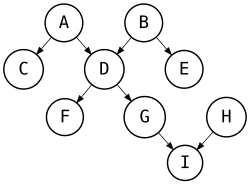
In mathematics, and more specifically in graph theory, a polytree1 (also called directed tree,2 oriented tree3 or singly connected network4) is a directed acyclic graph whose underlying undirected graph is a tree. In other words, a polytree is formed by assigning an orientation to each edge of a connected and acyclic undirected graph.
A polyforest (or directed forest or oriented forest) is a directed acyclic graph whose underlying undirected graph is a forest. In other words, if we replace its directed edges with undirected edges, we obtain an undirected graph that is acyclic.
A polytree is an example of an oriented graph.
The term polytree was coined in 1987 by Rebane and Pearl.5
Related structures
- An arborescence is a directed rooted tree, i.e. a directed acyclic graph in which there exists a single source node that has a unique path to every other node. Every arborescence is a polytree, but not every polytree is an arborescence.
- A multitree is a directed acyclic graph in which the subgraph reachable from any node forms a tree. Every polytree is a multitree.
- The reachability relationship among the nodes of a polytree forms a partial order that has order dimension at most three. If the order dimension is three, there must exist a subset of seven elements , , and (for ) such that, for each , either or , with these six inequalities defining the polytree structure on these seven elements.6
- A fence or zigzag poset is a special case of a polytree in which the underlying tree is a path and the edges have orientations that alternate along the path. The reachability ordering in a polytree has also been called a generalized fence.7
Enumeration
The number of distinct polytrees on unlabeled nodes, for , is
Sumner's conjecture
Sumner's conjecture, named after David Sumner, states that tournaments are universal graphs for polytrees, in the sense that every tournament with vertices contains every polytree with vertices as a subgraph. Although it remains unsolved, it has been proven for all sufficiently large values of .8
Applications
Polytrees have been used as a graphical model for probabilistic reasoning.1 If a Bayesian network has the structure of a polytree, then belief propagation may be used to perform inference efficiently on it.45
The contour tree of a real-valued function on a vector space is a polytree that describes the level sets of the function. The nodes of the contour tree are the level sets that pass through a critical point of the function and the edges describe contiguous sets of level sets without a critical point. The orientation of an edge is determined by the comparison between the function values on the corresponding two level sets.9
Notes
Notes
References
References
- Carr, Hamish; Snoeyink, Jack; Axen, Ulrike (2000), "Computing contour trees in all dimensions", Proc. 11th ACM-SIAM Symposium on Discrete Algorithms (SODA 2000), Association for Computing Machinery, pp. 918–926, ISBN 978-0-89871-453-1
- Dasgupta, Sanjoy (1999), "Learning polytrees" (PDF), Proc. 15th Conference on Uncertainty in Artificial Intelligence (UAI 1999), Stockholm, Sweden, July-August 1999, pp. 134–141.
- Deo, Narsingh (1974), Graph Theory with Applications to Engineering and Computer Science (PDF), Englewood, New Jersey: Prentice-Hall, ISBN 0-13-363473-6.
- Harary, Frank; Sumner, David (1980), "The dichromatic number of an oriented tree", Journal of Combinatorics, Information & System Sciences, 5 (3): 184–187, MR 0603363.
- Kim, Jin H.; Pearl, Judea (1983), "A computational model for causal and diagnostic reasoning in inference engines" (PDF), Proc. 8th International Joint Conference on Artificial Intelligence (IJCAI 1983), Karlsruhe, Germany, August 1983, pp. 190–193.
- Kühn, Daniela; Mycroft, Richard; Osthus, Deryk (2011), "A proof of Sumner's universal tournament conjecture for large tournaments", Proceedings of the London Mathematical Society, Third Series, 102 (4): 731–766, arXiv:1010.4430, doi:10.1112/plms/pdq035, MR 2793448.
- Rebane, George; Pearl, Judea (1987), "The recovery of causal poly-trees from statistical data" (PDF), Proc. 3rd Annual Conference on Uncertainty in Artificial Intelligence (UAI 1987), Seattle, WA, USA, July 1987, pp. 222–228.
- Ruskey, Frank (1989), "Transposition generation of alternating permutations", Order, 6 (3): 227–233, doi:10.1007/BF00563523, MR 1048093.
- Simion, Rodica (1991), "Trees with 1-factors and oriented trees", Discrete Mathematics, 88 (1): 93–104, doi:10.1016/0012-365X(91)90061-6, MR 1099270.
- Trotter, William T. Jr.; Moore, John I. Jr. (1977), "The dimension of planar posets", Journal of Combinatorial Theory, Series B, 22 (1): 54–67, doi:10.1016/0095-8956(77)90048-X.