| Polyscias murrayi | |
|---|---|
| |
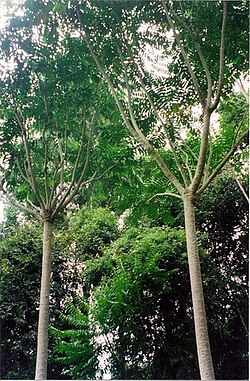
| Pencil cedar at Berrico Trig, Barrington Tops | |
Scientific classification 
| |
| Kingdom: | Plantae |
| Clade: | Embryophytes |
| Clade: | Tracheophytes |
| Clade: | Spermatophytes |
| Clade: | Angiosperms |
| Clade: | Eudicots |
| Clade: | Asterids |
| Order: | Apiales |
| Family: | Araliaceae |
| Genus: | Polyscias |
| Species: | P. murrayi
|
| Binomial name | |
| Polyscias murrayi | |
| Synonyms | |
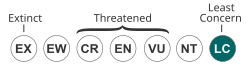
Polyscias murrayi, commonly known as celerywood or pencil cedar, is a species of plants in the family Araliaceae native to coastal areas of eastern Australia.
It occurs as a secondary regeneration species in disturbed rainforest areas, often on hillsides. The tree is identified by cylindrical trunk; abruptly forking into many branches, and supporting an impressive dark canopy.
Other common names include the umbrella tree, white basswood and pencilwood. The range of natural distribution is from the Howe Range, just over the border in the state of Victoria (37° S),4 up through New South Wales and to Atherton, Queensland (17° S). It also occurs in New Guinea.
Description
It grows to 25 metres tall with a trunk diameter of 50 cm. It is unbranched at the end of the main trunk, then breaks out into a many branched crown. The cylindrical trunk is mostly smooth, greyish or brown. The base of the tree is not flanged, fluted or buttressed.
Leaves are alternate and pinnate with 8 to 30 leaflets, opposite on the leaf stalk, entire or toothed, ovate lanceolate in shape, 8 to 15 cm long. However, leaves may be much larger on younger trees. Leaf stalks are up to 120 cm long and leaflet stalks 3 to 8 mm long. Between each pair of leaflets on the leaf stalk, a gland may be seen. The midrib is white or paler green, raised under the leaf. Leaf venation is more easily seen on the top of the leaf.56
Creamy green flowers form on stalks on umbels in the months of February to March. The fruit is a blue drupe, usually with two lobes, sometimes three. Fruit matures from April to June. Germination from fresh seed is slow.
Ecology
The fruit is eaten by a variety of bird species, as well as the Herbert River ringtail possum and the Musky rat-kangaroo.57
Uses
Polyscias murrayi is useful to bush regenerators as a nursery tree, which provides shade for longer lived young trees underneath. It is also an attractive ornamental tree.
References
References
- Bessen, E. (2022). "Polyscias murrayi". IUCN Red List of Threatened Species. 2022 e.T172724030A172724324. doi:10.2305/IUCN.UK.2022-1.RLTS.T172724030A172724324.en.
- "Polyscias murrayi (F.Muell.) Harms". Australian Plant Name Index (APNI). Centre for Australian National Biodiversity Research, Australian Government. Retrieved 20 April 2026.
- "Polyscias murrayi (F.Muell.) Harms". Plants of the World Online. Royal Botanic Gardens, Kew. 2026. Retrieved 20 April 2026.
- "Croajingolong National Park" (PDF). Parks Victoria. Archived from the original (PDF) on 23 July 2008. Retrieved 12 July 2008.
- F.A.Zich; B.P.M.Hyland; T.Whiffen; R.A.Kerrigan (2020). "Polyscias murrayi". Australian Tropical Rainforest Plants Edition 8 (RFK8). Centre for Australian National Biodiversity Research (CANBR), Australian Government. Retrieved 20 April 2026.
- M. J. Henwood; R. O. Makinson (1992). "Polyscias murrayi (F.Muell.) Harms". PlantNET (The NSW Plant Information Network System). Royal Botanic Gardens and Domain Trust, Sydney. Retrieved 20 April 2026.
- Cooper, Wendy; Cooper, William T. (June 2004). Fruits of the Australian Tropical Rainforest. Clifton Hill, Victoria, Australia: Nokomis Editions. p. 66. ISBN 978-0-9581742-1-3.