| Polyscias elegans | |
|---|---|
| |
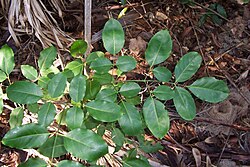
| Polyscias elegans at Wyrrabalong National Park, Australia | |
Scientific classification 
| |
| Kingdom: | Plantae |
| Clade: | Embryophytes |
| Clade: | Tracheophytes |
| Clade: | Spermatophytes |
| Clade: | Angiosperms |
| Clade: | Eudicots |
| Clade: | Asterids |
| Order: | Apiales |
| Family: | Araliaceae |
| Genus: | Polyscias |
| Species: | P. elegans
|
| Binomial name | |
| Polyscias elegans | |
| Synonyms | |
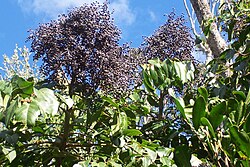
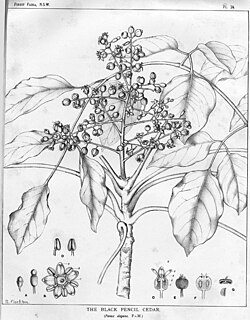
Polyscias elegans, known as the celery wood, is a rainforest tree of eastern Australia. It occurs in a variety of different rainforest types, from fertile basaltic soils, to sand dunes and less fertile sedimentary soils. The range of natural distribution is from Jervis Bay (35° S) in southern New South Wales to Thursday Island (10° S), north of the Australian continent. Other common names include black pencil cedar and silver basswood. Polyscias elegans is useful to bush regenerators as a nursery tree, which provides shade for longer-lived young trees underneath. Polyscias elegans is also known as Celery wood, Mowbulan whitewood, Silver basswood and White sycamore.5
Description
It is a fast-growing medium-sized tree with an attractive palm-like or umbrella-shaped crown. Up to 30 meters tall and a trunk diameter of 75 cm. The trunk is mostly straight, unbuttressed and cylindrical, smooth-barked on young trees but fissured, scaly and rough-barked on larger trees.
Leaves are large, pinnate or bi-pinnate with almost opposite leaflets, often in threes. Leaflets ovate in shape, with a point, 5 to 13 cm long. Leaf veins noticeable on both sides, net veins visible below.
Purple flowers form on a terminal panicle, arranged in a series of racemes in the months of February to April. However, flowers can form at other times. The fruit is a drupe; brown or purplish black in colour, 5 to 7 mm wide. Inside the drupe are two cells, containing one seed each, 5 mm long. Seed is fertile for regeneration from the droppings of the pied currawong.
The fruit is eaten by a large variety of birds, including brown cuckoo dove, Australasian figbird, green catbird, Lewin's honeyeater, olive-backed oriole, pied currawong, paradise riflebird, rose crowned fruit dove, silvereye, superb fruit dove, topknot pigeon and wompoo fruit dove.
References
References
- Harms Nat. Pflanzenfam. 3(8): 45 1894
- "Polyscias elegans (C.Moore & F.Muell.) Harms'". Australian Plant Name Index (APNI), IBIS database. Canberra, Australian Capital Territory: Centre for Plant Biodiversity Research, Australian Government. Retrieved 30 July 2013.
- C. Moore & F. Muell. Trans. Philos. Inst. Victoria 2: 68 1858
- R. Vig. Bull. Soc. Bot. France 52: 308 1905
- http://www.plantnames.unimelb.edu.au/Sorting/Polyscias.html Sorting Polyscias names
- Floyd, A. G. (1989). Rainforest Trees of Mainland South-eastern Australia (1st ed.). Port Melbourne: Elsevier Australia - Inkata Imprint, copyright Forestry Commission of New South Wales (published 1 December 1989). p. 73. ISBN 0-909605-57-2. Retrieved 20 June 2009. (other publication details, included in citation)
- Polyscias elegans at NSW Flora Online Retrieved 20 June 2009