| Polari | |
|---|---|
| Palare, Parlary, Palarie, Palari | |
| Region | United Kingdom |
Native speakers | None1 |
English-based slang and other Indo-European influences | |
| Language codes | |
| ISO 639-3 | pld |
| Glottolog | pola1249 |
| Part of a series on |
| LGBTQ people |
|---|
 LGBTQ portal LGBTQ portal |
Polari (from Italian parlare 'to talk') is a form of slang or cant historically used primarily in the United Kingdom among the gay subculture, as well as some actors, circus and fairground performers, professional wrestlers, merchant navy sailors, criminals, and prostitutes.
There is some debate about its origins,2 but it can be traced to at least the 19th century and possibly as early as the 16th century.3 Polari has a long-standing connection with Punch and Judy street puppeteers, who traditionally used it to converse.4
Terminology
Alternative spellings include Parlare, Parlary, Palare, Palarie and Palari. The term comes from Italian parlare 'to talk'.
Description
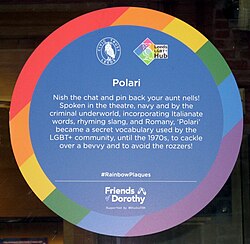
Polari is a mixture of Romance (Italian5 or Mediterranean Lingua Franca), Romani, rhyming slang, sailors' slang and thieves' cant, which later expanded to contain words from Yiddish and 1960s drug subculture slang. It was constantly evolving, with a small core lexicon of about 20 words, including: bona (good),6 ajax (nearby), eek (face), cod (bad, in the sense of tacky or vile), naff (bad, in the sense of drab or dull, though borrowed into mainstream British English with a meaning more like that of cod), lattie (room, house, flat), nanti (not, no), omi (man), palone (woman), riah (hair), zhoosh or tjuz (smarten up, stylise), TBH ('to be had', sexually accessible), trade (sex) and vada (see).7
There were once two distinct forms of Polari in London: an East End version which stressed Cockney rhyming slang and a West End version which stressed theatrical and classical influences. There was some interchange between the two.8
When used by homosexual men, Polari also involves inverting gendered personal pronouns and names, typically switching them from male forms to female forms. For example, he may become she (known as she-ing), and the name Paul may become Pauline.91011
Usage
From the 19th century on, Polari was used in London fish markets, theatres, fairgrounds, and circuses, hence the many borrowings from Romani.12 As many homosexual men worked in theatrical entertainment, it was also used among the gay subculture to disguise homosexuals from hostile outsiders and undercover policemen. It was also used extensively in the British Merchant Navy, where many gay men worked as waiters, stewards, and entertainers.13
According to Oxford English Dictionary associate editor Peter Gilliver, little written evidence of Polari exists before the 1890s. The dictionary's entry for rozzer (policeman) includes a quote from P. H. Emerson's 1893 book Signor Lippo – Burnt Cork Artiste:14 "If the rozzers was to see him in bona clobber they'd take him for a gun." ("If the police were to see him finely dressed, they would know that he is a thief.")15
The almost identical Parlyaree has been spoken in fairgrounds since at least the 17th century16 and is still used by show travellers in England and Scotland. As theatrical booths, circus acts, and menageries were once common parts of European fairs, it is likely that the roots of Polari/Parlyaree lie in the period before both theatre and circus became independent of fairgrounds. The Parlyaree spoken on fairgrounds tends to borrow much more from Romani, as well as other languages and cants spoken by travelling people, such as thieves' cant and back slang.
Henry Mayhew gave an account of Polari as part of an interview with a Punch and Judy showman in the 1850s. The discussion he recorded references Punch's arrival in England, crediting these early shows to an Italian performer called Porcini (John Payne Collier's account calls him Porchini, a literal rendering of the Italian pronunciation).17 Mayhew provides the following:
Punch Talk
"Bona Parle" means language; name of patter. "Yeute munjare" – no food. "Yeute lente" – no bed. "Yeute bivare" – no drink. I've "yeute munjare", and "yeute bivare", and, what's worse, "yeute lente". This is better than the costers' talk, because that ain't no slang and all, and this is a broken Italian, and much higher than the costers' lingo. We know what o'clock it is, besides.4
Additional accounts of particular words relate to puppet performance:4
- "'Slumarys' – figures, frame, scenes, properties.
- "'Slum' – call, or unknown tongue" ("unknown" is a reference to the "swazzle", a voice modifier used by Punch performers).
Decline
Polari had begun to fall into disuse among the gay subculture by the late 1960s. The popularity of the BBC radio comedy Round the Horne, with its camp gay characters Julian and Sandy, ensured that some of the Polari terms they used became public knowledge.18 The need for a secret means of communication in the subculture also declined with the partial decriminalisation of adult homosexual acts in England and Wales under the Sexual Offences Act 1967; in the 1970s, the gay liberation movement began to view Polari as old-fashioned and perpetuating harmful camp stereotypes.19
Mainstream usage
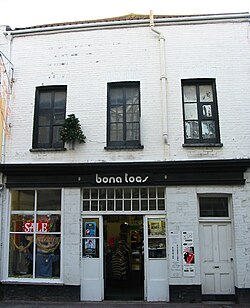
A number of words from Polari have entered mainstream slang. The list below includes words in general use with the meanings listed: acdc, barney, blag, butch, camp, khazi, cottaging, hoofer, mince, ogle, scarper, slap, strides, tod, [rough] trade.
The Polari word naff, meaning inferior or tacky, has an uncertain etymology. Michael Quinion says it is probably from the 16th-century Italian word gnaffa, meaning "a despicable person".20 There are a number of false etymologies, many based on backronyms—"Not Available For Fucking", "Normal As Fuck", etc. The phrase "naff off" was used euphemistically in place of "fuck off" along with the intensifier "naffing" in Keith Waterhouse's Billy Liar (1959).21 Usage of "naff" increased in the 1970s when the television sitcom Porridge employed it as an alternative to expletives which were not broadcastable at the time.20 Princess Anne allegedly told a reporter to "naff off" at the Badminton horse trials in April 1982.22 However, the photographers who were present have since stated that this was a censored version of what she actually said.23
"Zhoosh" (/ʒʊʃ, ʒuːʃ/;24 alternatively spelled "zhuzh," "jeuje," and a number of other variety spellings25), meaning to smarten up, style or improve something, became commonplace in the mid-2000s, having been used in the 2003 United States TV series Queer Eye for the Straight Guy and What Not to Wear. "Jush", an alternative spelling of the word, was popularised by drag queen Jasmine Masters after her appearance on the seventh series of RuPaul's Drag Race in 2015.2627
Legacy and revival
Since the late 20th and early 21st century, there has been a renewed interest in Polari, especially as a part of LGBTQ+ heritage.282930 Gay's the Word has held workshops in Polari, the Sisters of Perpetual Indulgence have translated (partially relexified) the King James Bible into Polari,31 and Madame Jo Jo's nightclub in Soho taught its staff to speak Polari.32
Now as reefing fakements offered unto idols, we know that we all have knowledge. Knowledge puffeth up, but charity edifieth.
— Bible into Polari 1 Corinthians 8:1 (Polari in italics)
Linguist Paul Baker attributes increased interest in Polari primarily to the growing body of academic work on the subject.2829 Author George Reiner explains that "the revival of a language like Polari offers the possibility of an alternate queer linguistic space" at a time when closing LGBTQ+ venues and dating apps have reduced queer social spaces.29
In 2007, writer and activist Paul Burston launched Polari Literary Salon in London to platform LGBTQ+ writers. He launched the Polari First Book Prize in 2011. This was followed by the Polari Prize for LGBTQ+ writers at all stages of their career in 2019 and the Polari Children's & YA Prize in 2022.3334 Other organisations have also taken names inspired by Polari, such as Polari Magazine,35 Vada Magazine,36 and VADA LGBTQ Community Theatre Company.37
In 2012 and 2013, Manchester artists Jez Dolan and Joe Richardson presented a performance-based tour and exhibition titled Polari Mission, which explored LGBTQ+ history and language use in the UK. This was presented at The John Rylands Library and Contact Theatre.38 In 2015, Dolan also translated sections of the 1957 Wolfenden Report into Polari for a commission from the UK Parliament.3940 Dolan and Richardson also worked with Paul Baker to produce a 500-word dictionary of Polari as an app.41
In December 2016, to launch LGBT+ History Month 2017 and celebrate the 50th anniversary of the 1967 Sexual Offences Act, poet Adam Lowe performed his Polari poem "Vada That" in Parliament's Speaker's House with accompaniment by musician Nikki Franklin.42 In 2017, a service at Westcott House, Cambridge was conducted in Polari. Trainee priests held the service to commemorate LGBT History Month; following media attention, Chris Chivers, the principal, expressed his regret.43444546
In 2019, Reaktion Books published Paul Baker's third book on Polari, Fabulosa!: The Story of Polari, Britain's Secret Gay Language.4748 His first two books on the subject (Polari: Fantabulosa: A Dictionary of Polari and Gay Slang and Polari: The Lost Language of Gay Men) were published in 2002 and 2003, respectively.49
In popular culture
- Polari (spelt "Polare") was popularised on the 1960s BBC radio show Round the Horne. The camp gay Polari-speaking characters Julian and Sandy were played by Hugh Paddick and Kenneth Williams.50
- In the Doctor Who serial Carnival of Monsters (1973), Vorg, a showman, attempts to converse with the Doctor in Polari.51
- Ralph Filthy, a theatrical agent played by Nigel Planer in the BBC TV series Filthy Rich & Catflap, regularly used Polari.52
- In 1990, Morrissey released the single "Piccadilly Palare" containing a number of lyrics in Polari and exploring a subculture in which Polari was used. "Piccadilly Palare" later appeared on his compilation album Bona Drag, whose title is also taken from Polari.53
- In Doom Patrol, Danny the Street often speaks Polari.54
- In his 1995 novel Behind Closed Doors, Coronation Street creator Tony Warren depicts his characters using Polari on the gay scene of 1950s Manchester.55
- In the 1998 film Velvet Goldmine, two characters speak Polari in a London nightclub. The scene has English subtitles in the American release of the film.19
- In 2015, Brian Fairbairn and Karl Eccleston made a short film, "Putting on the Dish", which features a conversation entirely in Polari.5657
- The song Girl Loves Me from David Bowie's 2016 album Blackstar features lyrics in both Polari and the fictional language Nadsat from the novel A Clockwork Orange.58
- In 2018, George Reiner and Penny Burkett published cruising for lavs, written mostly in Polari.28
- In 2019, the first opera in Polari, The Sins of the Cities of the Plain (based on the book of the same title), premiered at Espacio Turina in Seville, Spain. The libretto was written in Polari by librettist and playwright Fabrizio Funari and the music is by Germán Alonso.59
- The same year, the English-language localisation of the Japanese video game Dragon Quest Builders 2 included a character called Jules, who spoke in Polari with non-standard capitalisation.6061
- In the 2020 film Roald & Beatrix: The Tail of the Curious Mouse, a young Roald Dahl runs away from home and meets "a silver-tongued, Polari-speaking eccentric who may be a figment of the boy's imagination" played by Bill Bailey.62
- In 2023, Peepal Tree Press published Adam Lowe's debut poetry collection Patterflash, which features a number of Polari poems. The title is translated in the book's glossary as "Gossip, chat, ostentatious or pretentious speech; the lyrics pouring out of my gob".63
- In the fourth episode of Funny Woman (2024), characters discuss BBC Radio using Polari in Round the Horne and visit a comedy club where gay and entertainment-industry characters converse in Polari.64
- British singer Olly Alexander released his debut album Polari on 7 February 2025.65
Glossary
Numbers:
| Number | Definition | Italian numbers |
|---|---|---|
| medza, medzer | half | mezza |
| una, oney | one | uno |
| dooey | two | due |
| tray | three | tre |
| quarter | four | quattro |
| chinker | five | cinque |
| say | six | sei |
| say oney, setter | seven | sette |
| say dooey, otter | eight | otto |
| say tray, nobber | nine | nove |
| daiture | ten | dieci |
| long dedger, lepta | eleven | undici |
| kenza | twelve | dodici |
| chenter47 | one hundred | cento |
Some words or phrases that may derive from Polari (this is an incomplete list):
| Word | Definition |
|---|---|
| acdc, bibi | bisexual6649 |
| ajax | nearby (shortened form of "adjacent to")6649 |
| alamo! | they're attractive! (via acronym "LMO" meaning "Lick Me Out!")66 |
| arva | to have sex (from Italian chiavare, to screw)67 |
| aunt nell | listen!66 |
| aunt nells | ears5066 |
| aunt nelly fakes | earrings66 |
| barney | a fight66 |
| bat, batts, bates | shoes66 |
| bevvy | drink (diminutive of "beverage")6 |
| billy doo | love letter49 |
| bitch | effeminate or passive gay man49 |
| bijou | small/little (from French, jewel)66 |
| bitaine | whore (French putain) |
| blag | sexually pick up6649 |
| bold | homosexual67 |
| bona | good66 |
| bona nochy | goodnight (from Italian – buona notte)6649 |
| butch | masculine; masculine lesbian66 |
| buvare | a drink; something drinkable (from Italian – bere or old-fashioned Italian – bevere or Lingua Franca bevire)6649 |
| cackle | talk/gossip66 |
| camp | effeminate (possibly from Italian campare or campeggiare "emphasise, make stand out") (possibly from the phrase "camp follower" those itinerants who followed behind the men in uniform/highly decorative dress) |
| capello, capella, capelli, kapella | hat (from Italian – cappello)66 |
| carsey, karsey, khazi | house or a toilet66 |
| cartes | penis (from Italian – cazzo)66 |
| cats | trousers66 |
| charper | to search or to look (from Italian acchiappare, to catch)66 |
| charpering omi | policeman49 |
| charver | sexual intercourse6649 |
| chicken | young man49 |
| clevie | vagina68 |
| clobber | clothes66 |
| cod | bad66 |
| corybungus | backside, posterior68 |
| cottage | a public lavatory used for sexual encounters (public lavatories in British parks and elsewhere were often built in the style of a Tudor cottage)[1] |
| cottaging | seeking or obtaining sexual encounters in public lavatories49 |
| cove | taxi66 |
| dhobi / dhobie / dohbie | wash (from Hindi, dohb)66 |
| Dilly boy | a male prostitute, from Piccadilly boy49 |
| Dilly, the | Piccadilly circus, a place where cruising went on49 |
| dinari | money (Latin 'denarii' was the 'd' of the pre decimal penny. This word is cognate with the Spanish word 'dinero' also meaning money)69 |
| dish | buttocks6646 |
| dolly | pretty, nice, pleasant, (from Irish dóighiúil/Scottish Gaelic dòigheil, handsome, pronounced 'doil') |
| dona | woman (perhaps from Italian donna or Lingua Franca dona)66: 26 |
| ecaf | face (backslang)6661 |
| eek/eke47 | face (abbreviation of ecaf)6661 |
| ends | hair6 |
| esong, sedon | nose (backslang)6632 |
| fambles | hands68 |
| fantabulosa | fabulous/wonderful49 |
| farting crackers | trousers68 |
| feele / feely / filly | child/young (from the Italian figlio, for son)49 |
| feele omi / feely omi | young man49 |
| flowery | lodgings, accommodations68 |
| fogus | tobacco49 |
| fortuni | gorgeous, beautiful68 |
| fruit | gay man49 |
| funt | pound £ (Yiddish)49 |
| fungus | old man/beard68 |
| gelt | money (Yiddish)49 |
| bag | money49 |
| hoofer | dancer49 |
| HP (homy palone) | gay man, especially an effeminate one49 |
| irish | wig (from Cockney rhyming slang, "Irish jig")49 |
| jarry | food, also mangarie (from Italian mangiare or Lingua Franca mangiaria)49 |
| jubes | breasts49 |
| kaffies | trousers49 |
| lacoddy, lucoddy | body |
| lallies / lylies | legs, sometimes also knees (as in "get down on yer lallies")49 |
| lallie tappers | feet49 |
| latty / lattie | room, house or flat49 |
| lau | lay or place upon70 |
| lavs | words71 (Irish: labhairt to speak) |
| lills | hands49 |
| lilly | police (Lilly Law)49 |
| lyles | legs (prob. from "Lisle stockings")49 |
| luppers | fingers (from Yiddish lapa – paw)49 |
| mangarie | food, also jarry (from Italian mangiare or Lingua Franca mangiaria)49 |
| manky | worthless, dirty (from Italian mancare – "to be lacking")72 |
| martinis | hands49 |
| measures | money49 |
| medzered | divided73 |
| meese | plain, ugly (from Yiddish mieskeit, in turn from Hebrew מָאוּס repulsive, loathsome, despicable, abominable) |
| meshigener | nutty, crazy, mental (from Yiddish 'meshugge', in turn from Hebrew מְשֻׁגָּע crazy)49 |
| meshigener carsey | church71 |
| metzas | money (from Italian mezzi, "means, wherewithal")49 |
| mince | walk affectedly49 |
| mollying | involved in the act of sex74 |
| mogue | deceive49 |
| munge | darkness71 |
| naff | awful, dull, hetero49 |
| nana / nanna | awful49 |
| nanti | not, no, none49 (from Italian, niente) |
| national handbag | dole, welfare, government financial assistance49 |
| nishta | nothing6 from Yiddish nishto נישטא meaning nothing |
| ogle | look admiringly49 |
| ogles | eyes49 |
| oglefakes | glasses49 |
| omi | man49 (from Romance) |
| onk | nose49 (from "conk") |
| orbs | eyes49 |
| orderly daughters | police49 |
| oven | mouth (nanti pots in the oven = no teeth in the mouth)49 |
| palare / polari pipe | telephone ("talk pipe")49 |
| palliass | back49 |
| park, parker | give49 |
| plate | feet49 (Cockney rhyming slang "plates of meat"); to fellate |
| palone | woman49 (Italian paglione – "straw mattress"; cf. old Cant hay-bag – "woman"); also spelled "polony" in Graham Greene's 1938 novel Brighton Rock |
| palone-omi | lesbian49 |
| pots | teeth49 |
| quongs | testicles49 |
| reef | touch49 |
| remould | sex change49 |
| rozzer | policeman15 |
| riah / riha | hair (backslang)49 |
| riah zhoosher | hairdresser49 |
| rough trade | a working class or blue collar sex partner or potential sex partner; a tough, thuggish or potentially violent sex partner49 |
| scarper | to run off49 (from Italian scappare, to escape or run away or from rhyming slang "scapa flow", to go) |
| scharda | shame49 (from German schade, "a shame" or "a pity") |
| schlumph | drink49 |
| schmutter | apparel75 from Yiddish shmatte שמאטע meaning rag |
| schooner | bottle49 |
| scotch | leg49 (scotch egg=leg) |
| screech | mouth, speak49 |
| screeve | write75 (either from Irish scríobh/Scottish Gaelic sgrìobh, Scots scrieve to write or italian 'scrivere' meaning to write) |
| sharpy | policeman49 (from – charpering omi) |
| sharpy polone | policewoman49 |
| shush | steal (from client)49 |
| shush bag | hold-all49 |
| shyker / shyckle | wig49 (mutation of the Yiddish sheitel) |
| slap | makeup49 |
| so | homosexual49 (e.g. "Is he 'so'?") |
| stimps | legs49 |
| stimpcovers | stockings, hosiery49 |
| strides | trousers49 |
| strillers | piano49 |
| switch | wig49 |
| TBH (to be had) | prospective sexual conquest49 |
| thews | thighs49 |
| tober | road (a Shelta word, Irish bóthar); temporary site for a circus, carnival |
| todd (Sloan) or tod | from Cockney rhyming slang "alone" |
| tootsie trade | sex between two passive or feminine homosexuals49 (as in: 'I don't do tootsie trade') |
| trade | sex, sex-partner, potential sex-partner49 |
| troll | to walk about (esp. looking for trade)49 |
| vada / varder | to see (from Italian dialect vardare = guardare – look at)49 |
| vera (lynn) | gin49 |
| vogue | cigarette49 (from Lingua Franca fogus – "fire, smoke") |
| vogueress | female smoker |
| wallop | dance76 |
| willets | breasts49 |
| yeute | no, none |
| yews | (from French "yeux") eyes49 |
| zhoosh | style, improve, clothes49(cf. Romani zhouzho – "clean, neat") |
| zhooshy | showy49 |
Usage examples
Omies and palones of the jury, vada well at the eek of the poor ome who stands before you, his lallies trembling. – taken from "Bona Law", one of the Julian and Sandy sketches from Round The Horne, written by Barry Took and Marty Feldman
- Translation: "Men and women of the jury, look well at the face of the poor man who stands before you, his legs trembling."
So bona to vada...oh you! Your lovely eek and your lovely riah. – taken from "Piccadilly Palare", a song by Morrissey
- Translation: "So good to see...oh you! Your lovely face and your lovely hair."
As feely ommes...we would zhoosh our riah, powder our eeks, climb into our bona new drag, don our batts and troll off to some bona bijou bar. In the bar we would stand around with our sisters, vada the bona cartes on the butch omme ajax who, if we fluttered our ogle riahs at him sweetly, might just troll over to offer a light for the unlit vogue clenched between our teeth. – taken from Parallel Lives, the memoirs of renowned gay journalist Peter Burton
- Translation: "As young men...we would style our hair, powder our faces, climb into our great new clothes, don our shoes and wander/walk off to some great little bar. In the bar we would stand around with our gay companions, look at the great genitals on the butch man nearby who, if we fluttered our eyelashes at him sweetly, might just wander/walk over to offer a light for the unlit cigarette clenched between our teeth."
In the Are You Being Served? episode "The Old Order Changes", Captain Peacock asks Mr Humphries to get "some strides for the omi with the naff riah" (i.e., trousers for the fellow with the unstylish hair).77
See also
See also
- African-American Vernacular English (sometimes called Ebonics)
- Bahasa Binan
- Boontling
- Caló (Chicano)
- Carny, North American fairground cant
- Gayle language
- Gay slang
- Grypsera
- IsiNgqumo
- Lavender linguistics
- Lunfardo and Vesre
- Mediterranean Lingua Franca
- Pajubá
- Julian and Sandy
- Rotwelsch
- Shelta
- Swardspeak, argot used by LGBT people in the Philippines
- Verlan
- Lubunca
References
References
- Polari at Ethnologue (18th ed., 2015) (subscription required)
- Quinion, Michael (1996). "How Bona to Vada Your Eek!". WorldWideWords. Archived from the original on 7 September 2019. Retrieved 20 February 2006.
- Collins English Dictionary, Third Edition
- Mayhew, Henry (1968). London Labour and the London Poor, 1861. Vol. 3. New York: Dover Press. p. 47.
- "British Spies: Licensed to be Gay". Time. 19 August 2008. Archived from the original on 22 August 2008. Retrieved 9 May 2018.
- "The Secret Language of Polari – Merseyside Maritime Museum, Liverpool Museums". Liverpoolmuseums.org.uk. Retrieved 5 July 2018.
- Baker, Paul (2002). Fantabulosa: A Dictionary of Polari and Gay Slang. London: Continuum. ISBN 0-8264-5961-7.
- McKenna, David (1993). A Storm in a Teacup. Channel 4 Television.
- "Lavender Language, The Queer Way to Speak". www.out.com. Retrieved 9 March 2025.
Polari was rife with 'she-ing', an academic term that refers to the linguistic practice of feminizing people and things. She-ing appears almost universally and across centuries in gay language, from Peru to the Philippines to South Africa (where gay slang is called Gayle), to Israel (called oxtchit, derived from an Arabic word meaning 'my sister'), to Soviet-era Russia [in the gay slang goluboy].
- Baker, Paul (22 August 2019). "The Feints and Jabs of Polari, Britain's Gay Slang". Literary Hub. Retrieved 9 March 2025.
In the Polari speaker's world, gender was linguistically reversed—he was she and (less commonly) she became he. This practice of feminizing through language, referred to by artist and Sister of Perpetual Indulgence (Manchester branch) Jez Dolan, is referred to as 'she-ing'. She-ing is one of the aspects of Polari that has survived into more recent decades, and the practice was so pervasive at a particular bar on Canal Street in Manchester's Gay Village that a 'She-box' was installed a few years ago, akin to a 'Swear-box', where patrons would have to put in a few coins if they she'd someone, with the proceeds being donated to charity.
- Motschenbacher, Heiko (2020). "Review of Fabulosa! The Story of Polari, Britain's Secret Gay Language, by Paul Baker". Language. 96 (4): 938–940. doi:10.1353/lan.2020.0067.
In the domain of personal reference, Polari speakers often draw on inverted appellation practices (for example, 'she-ing'—the use of female pronouns to refer to male social actors), objectifying use of the pronoun it, endearment terms, metaphorical uses of kinship terms, and camp names.
- Jivani, Alkarim (January 1997). It's Not Unusual: A History of Lesbian and Gay Britain in the Twentieth Century. Bloomington. ISBN 0-253-33348-2. OCLC 37115577.
{{cite book}}: CS1 maint: location missing publisher (link) - "Gay Men in the Merchant Marine". Liverpool Maritime Museum. Retrieved 9 May 2018.
- "Historical Origins of English Words and Phrases". Live Journal. 24 October 2008. Retrieved 9 May 2018.
- D'Silva, Beverley (10 December 2000). "Mind Your Language". The Observer. Retrieved 9 May 2018.
- Partridge, Eric (1937). Dictionary of Slang and Unconventional English.
- Collier, John Payne (1859). Punch and Judy. London: Thomas Hailes Lacey.
- Richardson, Colin (17 January 2005). "Polari, the Gay Slang, Is Being Revived". The Guardian. London. Retrieved 5 July 2018.
- Baker, Paul (22 March 2019). "What's Polari?". Fabulosa! The Story of Polari, Britain's Secret Gay Language. Lancaster University. Retrieved 11 April 2024.
- Quinion, Michael. "Naff". World Wide Words. Retrieved 10 January 2010.
- Waterhouse, Keith (1959). Billy Liar. Michael Joseph. pp. 35, 46. ISBN 0-7181-1155-9.
{{cite book}}: ISBN / Date incompatibility (help) p35 "Naff off, Stamp, for Christ sake!" p46 "Well which one of them's got the naffing engagement ring?" - Dalzell, Tom; Victor, Terry (2006). The New Partridge Dictionary of Slang and Unconventional English. Vol. II. Routledge. p. 1349.
- Llewelyn, Abbie (8 September 2019). "Princess Never Said 'Naff Off' – 'We Made It Up'". Daily Express. London. Retrieved 28 January 2022.
- "Definition for Zhoosh – Oxford Dictionaries Online (World English)". Oxforddictionaries.com. Archived from the original on 11 September 2017. Retrieved 9 May 2018.
- Phelan, Hayley (31 January 2022). "'Jeuje,' 'Zhoosh,' 'Zhuzh': A Word of Many Spellings, and Meanings". The New York Times. Archived from the original on 13 October 2023. Retrieved 12 January 2024.
- "Jasmine Masters the Meaning of Jush". 7 April 2017. Retrieved 26 November 2022 – via YouTube.
- Schiller, Rebecca (4 June 2018). "'Drag Race' Queen Jasmine Masters Explains What 'Jush' Means: Watch". Billboard. Retrieved 26 November 2022.
- "The Revival of Polari, the U.K.'s Secret Queer Language". MEL Magazine. 23 January 2020. Retrieved 12 October 2024.
- "The New Book Written in Polari, a Secret Language for Queer Survival". Dazed. 25 September 2018. Retrieved 12 October 2024.
- Baker, Paul (28 February 2013). "Polari: The Lost-and-Found Language of Gay Men (PDF)" (PDF). Babel: The Language Magazine. Retrieved 12 October 2024.
- "Rediscovering Polari: What Is Polari And Why Did It Die Out?". Babbel Magazine. Retrieved 12 October 2024.
- "'Fabulosa' Lingo Revived at Club". BBC News. 6 December 2004. Retrieved 12 October 2024.
- "Polari Prize 2024". polarisalon. Retrieved 21 June 2024.
- "Paul Burston: The Polari Prize and Beyond". National Centre for Writing. Retrieved 21 June 2024.
- "About Polari Magazine". Polari Magazine. Retrieved 12 October 2024.
- Forward, Stuart (27 November 2012). "Meet the Team". Retrieved 12 October 2024.
- "VADA History". Vada: LGBTQ Community Theatre. Retrieved 12 October 2024.
- "Polari Mission Exhibit". John Rylands Library. Archived from the original on 2 December 2013.
- James, Louise (31 January 2022). "In Focus: LGBT+ History Month: Jez Dolan's 'Wolfenden'". House of Lords Library. Retrieved 21 June 2024.
- "Wolfenden by Jez Dolan". UK Parliament. Retrieved 21 June 2024.
- "Secret Gay Language Polari Gets an 'Appy Return". Manchester Evening News. 4 August 2012. Retrieved 12 October 2024.
- "Parliament's Speaker's Chamber Goes Rainbow to Launch LGBT History Month 2017". LGBT+ History Month. 1 December 2016. Retrieved 21 June 2024.
- "Church 'Regret' as Trainees Hold Service in Gay Slang". BBC News. 4 February 2017. Retrieved 4 February 2017.
- Sherwood, Harriet (3 February 2017). "C of E College Apologises for Students' Attempt to 'Queer Evening Prayer'". The Guardian. London.
- Flood, Rebecca (4 February 2017). "Church Expresses 'Huge Regret' After Cambridge LGBT Commemoration Service Held in Gay Slang Language". The Independent. London. Retrieved 9 May 2018.
- Robb, Simon (4 February 2017). "Priests Delivered a Service in Gay Slang and the Church Weren't Happy". Metro. London. Retrieved 9 May 2018.
- Baker, Paul (2019). Fabulosa!: The Story of Polari, Britain's Secret Gay Language. London: Reaktion Books. ISBN 978-1-78914-294-5.
- "Fabulosa! by Paul Baker from Reaktion Books". reaktionbooks.co.uk. Archived from the original on 30 September 2020. Retrieved 5 August 2020.
- Baker, Paul (2004). Fantabulosa: A Dictionary of Polari and Gay Slang. ISBN 978-0-8264-7343-1 – via Internet Archive.
- Stevens, Christopher (2010). Born Brilliant: The Life of Kenneth Williams. John Murray. p. 206. ISBN 978-1-84854-195-5.
- Baker 2003, p. 161.
- "Into the World of Filthy Rich & Catflap - Comedy Rewind". British Comedy Guide. 12 November 2023. Retrieved 12 October 2024.
- Kent, Nick (March 1990). "Morrissey Interviewed by Nick Kent". The Face.
- Johnston, Rich (29 January 2023). "First Appearance Of Danny The Street & Flex Metallo- Doom Patrol #35". bleedingcool.com. Retrieved 12 October 2024.
- Warren, Tony (1995). Behind Closed Doors. London: Century. pp. 189, 212, 239, 285, 297, 301, 307. ISBN 978-0-7126-5643-6.
- "Polari, the Gay Dialect, Can Be Heard in This Great Short Film". Slate. July 2015. Retrieved 27 March 2025.
- "Watch: The Lost Language of Gay Men". The Advocate. 12 August 2015. Retrieved 27 March 2025.
- Eastmond, Dean. "Remembering Polari, the Forgotten Language of Britain's Gay Community". VICE. VICE. Retrieved 15 September 2025.
- "Pornografía Bruitista". Diario de Sevilla (in European Spanish). 26 May 2019. Retrieved 26 June 2019.
- Square Enix (20 December 2018). Dragon Quest Builders 2 (Nintendo Switch). Square Enix.
- Hawkes, Edward. "The Coded Gay Jargon in Dragon Quest Builders 2".
- Feay, Suzi (24 December 2020). "Roald and Beatrix: The Tail of the Curious Mouse — a Christmas Classic Is Born". Financial Times. London. Retrieved 12 October 2024.
- Hayter, Annie (17 June 2023). "Patterflash by Adam Lowe Review: Acrobatic and Winking Poems of Queer Life". Big Issue. Retrieved 21 June 2024.
- Hautzinger, Daniel (28 January 2024). ""Funny Woman" Recap: Episode 4". WTTW. Retrieved 12 October 2024.
- Kheraj, Alim (11 October 2024). "Olly Alexander Announces New Album Polari Along with Single "Cupid's Bow"". Attitude. Retrieved 11 January 2025.
- Baker 2003.
- "What Is Polari All About?". Polari Magazine. 13 August 2012. Retrieved 30 July 2018.
- Grose, Francis (2012). 1811 Dictionary of the Vulgar Tongue. tebbo. ISBN 978-1-4861-4841-7.
- Sutherland, C. H. V. (1973). English Coinage 600-1900. p. 10. ISBN 0-7134-0731-X.
- "A Polari Christmas". Polari Magazine. 12 December 2009. Retrieved 30 July 2018.
- "The Polari Bible". .josephrichardson.tv. Archived from the original on 2 June 2020. Retrieved 30 July 2018.
- "Manky". Collins English Dictionary. Retrieved 21 December 2018.
- "Let There Be Sparkle". Polari Magazine. 10 December 2012. Retrieved 30 July 2018.
- D'Silva, Beverley (10 December 2000). "The Way We Live Now: Mind Your Language". The Guardian. Retrieved 5 July 2018.
- "Polari Bible". josephrichardson.tv/home.html. Retrieved 1 August 2018.
- "World Wide Words: How Bona to Vada Your Eek!". World Wide Words. Archived from the original on 7 September 2019. Retrieved 5 July 2018.
- "The Old Order Changes". Are You Being Served?. 18 March 1977.
Bibliography
Bibliography
- Baker, Paul (2002). Fantabulosa: A Dictionary of Polari and Gay Slang. London: Continuum. ISBN 0-8264-5961-7.
- Baker, Paul (2003). Polari: The Lost Language of Gay Men. London: Routledge. ISBN 978-1-134-50635-4.
- Baker, Paul (2019). Fabulosa!: The Story of Polari, Britain's Secret Gay Language. London: Reaktion Books. ISBN 978-1-78914-168-9.
- Elmes, Simon; Rosen, Michael (2002). Word of Mouth. Oxford: Oxford University Press. ISBN 0-19-866263-7.
External links
External links
- The Polari Bible compiled by The Manchester Sisters of Perpetual Indulgence Archived 12 April 2016 at the Wayback Machine
- Polari Mission exhibit (archived) at the University of Manchester's John Rylands Library
- Colin Richardson, The Guardian, 17 January 2005, "What brings you trolling back, then?"
- Liverpool Museums: The secret language of polari (archived)
- Paul Clevett's Polari Translator
- Putting it on the Dish, a 2015 short film featuring Polari extensively
- A brief history of Polari: the curious after-life of the dead language for gay men, 8 February 2017.
- Polari Dictionary based on Paul Baker's glossary and dictionary