A point source of pollution is a single identifiable source of air, water, thermal, noise or light pollution. A point source has negligible extent, distinguishing it from other pollution source geometrics (such as nonpoint source or area source). The sources are called point sources because in mathematical modeling, they can be approximated as a mathematical point to simplify analysis.1 Pollution point sources are identical to other physics, engineering, optics, and chemistry point sources and include:
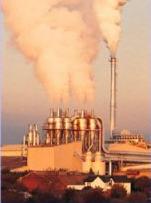
- Air pollution from an industrial source (rather than an airport or a road, considered a line source, or a forest fire, which is considered an area source, or volume source)2
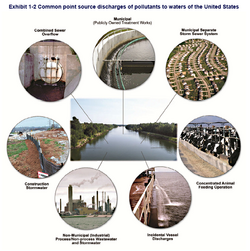
- Water pollution from factories, power plants, municipal sewage treatment plants and some farms (see concentrated animal feeding operation).3 The U.S. Clean Water Act also defines municipal separate storm sewer systems and industrial stormwater discharges (such as construction sites) as point sources.4
- Man-made, natural, and groundwater reservoirs can all be contaminated by point source pollution which can threaten human health and safety.5
- Noise pollution from a jet engine67
- Disruptive seismic vibration from a localized seismic study8
- Light pollution from an intrusive street light9
- Radio emissions from an interference-producing electrical device
References
References
- van Leeuwen, C.J. (2010). Risk Assessment of Chemicals: An Introduction, 2nd Ed. Dordrecht, The Netherlands: Springer. ISBN 978-1-4020-6101-1.
- "Air Pollution Emissions Overview". Washington, D.C.: U.S. Environmental Protection Agency. 2016-06-08.
- Harrison, Roy M., ed. (2001). Pollution: Causes, Effects and Control (4th ed.). Cambridge, UK: Royal Society of Chemistry. p. 2. ISBN 0-85404-621-6.
- United States. Clean Water Act. Section 402(p), 33 U.S.C. § 1342(p).
- "Choose your library affiliation". docs.shib.ncsu.edu. doi:10.1007/978-981-10-0669-2. Retrieved 2024-09-24.
- "Point sources". Sound Waves. University of Southampton. Retrieved 2018-01-24.
- Brüel & Kjær, Nærum, Denmark. "Environmental Noise Propagation". Noise Pollution Clearinghouse. Montpelier, VT. Retrieved 2018-01-24.
{{cite web}}: CS1 maint: multiple names: authors list (link) - Stähler, Simon; Hosseini, Kasra; Zhang, Ran; Sigloch, Karin (2014). "Estimating the uncertainty of seismic point source solutions". Conference: EGU General Assembly 2014, held 27 April - 2 May, 2014 in Vienna, Austria, id.9911.
- "Light Pollution Sources". Night Skies. U.S. National Park Service. Retrieved 2018-01-24.