Ploubazlanec
Plaeraneg | |
|---|---|
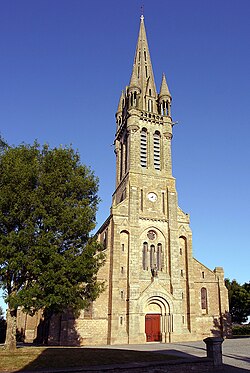 The church of Ploubazlanec | |
 Location of Ploubazlanec | |
Ploubazlanec Ploubazlanec | |
| Coordinates: 48°48′05″N 3°01′56″W / 48.8014°N 3.0322°W / 48.8014; -3.0322 | |
| Country | France |
| Region | Brittany |
| Department | Côtes-d'Armor |
| Arrondissement | Guingamp |
| Canton | Paimpol |
| Intercommunality | Guingamp-Paimpol Agglomération |
| Government | |
| • Mayor (2021–2026) | Richard Vibert1 |
Area 1 | 15.04 km2 (5.81 sq mi) |
| Population (2023)2 | 2,932 |
| • Density | 194.9/km2 (504.9/sq mi) |
| Time zone | UTC+01:00 (CET) |
| • Summer (DST) | UTC+02:00 (CEST) |
| INSEE/Postal code | 22210 /22620 |
| Elevation | 0–72 m (0–236 ft) |
| 1 French Land Register data, which excludes lakes, ponds, glaciers > 1 km2 (0.386 sq mi or 247 acres) and river estuaries. | |
Ploubazlanec (French pronunciation: [plubazlanɛk]; Breton: Plaeraneg) is a commune in the Côtes-d'Armor department in Brittany in northwestern France.
Historically its economy relied on fishing. Fishermen in the 19th century and early 20th century went to Iceland aboard sailing ships called goelettes.
The name Ploubazlanec is typically Breton, "plou" meaning "land of". The name changed from Pleraneg, which still can be seen on road signs.
Ploubazlanec is the embarkation point for boats to the Île-de-Bréhat.
The place was made famous by the French novel by Pierre Loti, Pêcheur d'Islande.
Population
Inhabitants of Ploubazlanec are called ploubazlanecains in French.
| Year | Pop. | ±% p.a. |
|---|---|---|
| 1968 | 3,500 | — |
| 1975 | 3,358 | −0.59% |
| 1982 | 3,653 | +1.21% |
| 1990 | 3,725 | +0.24% |
| 1999 | 3,321 | −1.27% |
| 2007 | 3,250 | −0.27% |
| 2012 | 3,125 | −0.78% |
| 2017 | 3,014 | −0.72% |
| 2023 | 2,932 | −0.46% |
| Source: INSEE3 | ||
References
References
- "Répertoire national des élus: les maires" (in French). data.gouv.fr, Plateforme ouverte des données publiques françaises. 4 May 2022.
- "Populations de référence 2023" (in French). National Institute of Statistics and Economic Studies. 18 December 2025.
- Population municipale entre 1968 et 2023, INSEE
External links
External links
- Official website (in French)
- Base Mérimée: Search for heritage in the commune, Ministère français de la Culture. (in French)