Article · Wikipedia archive · Last revised May 30, 2026

Pisolite

A pisolite is a sedimentary rock made of pisoids, which are concretionary grains – typically of calcium carbonate which resemble ooids, but are more than 2 mm in diameter. These grains are approximately spherical and have concentric layers reaching 10 mm in diameter.

Last revised
May 30, 2026
Read time
≈ 1 min
Length
118 w
Citations
1
Source
Pisoids in the Conococheague limestone (Upper Cambrian) of eastern Pennsylvania source ↗
Pisolitic limestone; Itaboraí, Rio de Janeiro, Brazil; pisolith diameters average 1.0 cm source ↗
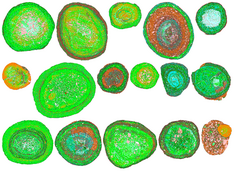
QEMSCAN mineral map of bauxite forming pisoids source ↗

A pisolite (from Ancient Greek πίσον (píson) 'pea') is a sedimentary rock made of pisoids, which are concretionary grains – typically of calcium carbonate which resemble ooids, but are more than 2 mm in diameter.1 These grains are approximately spherical and have concentric layers reaching 10 mm in diameter.

Bauxites, limonites, and siderites often have a pisolitic structure.

See also

See also

References

References

Further reading

Further reading

  • Manutchehr-Danai, Mohsen (2009). Dictionary of gems and gemology (3rd ed.). Springer. ISBN 978-3-540-72795-8.