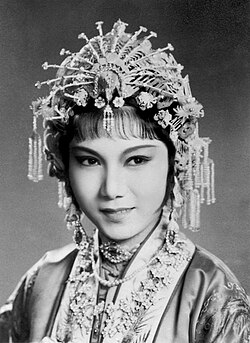
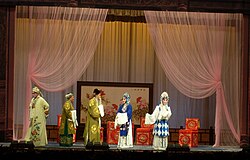
Pingju or Ping opera (Chinese: 評劇; pinyin: píngjù) is a form of Chinese opera from northern China.
History
Pingju originated in Tangshan, Hebei, near the city of Tianjin.1 Among all China's regional operas, it was the most famous in the Republican period for its passionate performances and romantic plots.2
Movies based upon and incorporating Pingju include Zhang Shichuan's 1936 Red Begonia (t 海棠紅, s 海棠红, Hǎitáng Hóng), starring Bai Yushuang.3
Performers
Bai Yushuang was known as the "Queen of Pingju". Other famed performers include Xin Fengxia4 and her mentor Hua Furong.5
References
References
- "China Pingju Festival", China Culture, archived from the original on 2009-03-30, retrieved 2009-02-11.
- Cheng (2002), p. 8.
- Cheng (2002), p. 11.
- Davis, Edward L. (January 2009). Encyclopedia of Contemporary Chinese Culture. Taylor & Francis. p. 649. ISBN 978-0-415-77716-2.
- Cheng (2002), p. 7.
Bibliography
Bibliography
- Cheng, Weikun (June 2002). "The Use of "Public" Women: Commercialized Performance, Nation-Building, and Actresses' Strategies in Early Twentieth-Century Beijing" (PDF). WID Working Papers. Ann Arbor: Office of Women in International Development, Michigan State University.
Further reading
Further reading
- Chinnery, John (2007). Pingju: Real Life Opera of Northern China. New World Press.