| Pilostyles | |
|---|---|
| |
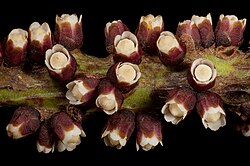
| A cluster of Pilostyles hamiltonii flowers growing out of a Daviesia stem | |
Scientific classification 
| |
| Kingdom: | Plantae |
| Clade: | Embryophytes |
| Clade: | Tracheophytes |
| Clade: | Spermatophytes |
| Clade: | Angiosperms |
| Clade: | Eudicots |
| Clade: | Rosids |
| Order: | Cucurbitales |
| Family: | Apodanthaceae |
| Genus: | Pilostyles Guill. |
| Species | |
|
See text | |
| Synonyms | |
|
Berlinianche (Harms) Vattimo-Gil | |
Pilostyles is a genus of flowering plants in the family Apodanthaceae. It includes about 11 species of very small, completely parasitic plants that live inside the stems of woody legumes.12 Plants of this genus are sometimes referred to as stemsuckers.3
The plants completely lack stems, roots, leaves, and chlorophyll. While not flowering, they do not resemble most plants, living entirely inside the host as " [...] a mycelium-like endophyte formed by strands of parenchyma cells that are in close contact to the host vasculature".4 Their presence is only noticeable when the flowers emerge out of the stems of the host plant.2
Pilostyles is dioecious, with separate male and female plants.5 Male and female plants are not commonly known to inhabit the same host.6 Flowers are two or three millimeters wide and in some species each female flower can produce over 100 seeds, which are less than 1 mm (0.04 in) long.76 These seeds contain embryos composed of just eight cells, the smallest dicot embryo presently known.8
Species are found in several countries, with a discontinuous distribution. Species have been found in most of South America and tropical Africa, and also in Australia, Iran, Iraq, Mexico, Syria, Turkey, and the United States.19
Species include:1
- Pilostyles aethiopica Welw.
- Pilostyles berteroi Guill.
- Pilostyles blanchetii (Gardner) R.Br.
- Pilostyles boyacensis F.Gonzáles & Pabón-Mora
- Pilostyles coccoidea K.R.Thiele
- Pilostyles collina Dell
- Pilostyles hamiltonii C.A.Gardner
- Pilostyles haussknechtii Boiss.
- Pilostyles maya P.Ortega, Gonz.-Martínez & S.Vásquez
- Pilostyles mexicana (Brandegee) Rose
- Pilostyles thurberi A.Gray
The genus was formerly considered a member of Rafflesiaceae, and was re-classified after new DNA evidence.109
References
References
- "Pilostyles Guill. | Plants of the World Online | Kew Science". Plants of the World Online. Retrieved 2022-03-10.
- Gomes, André Luis; Fernandes, G. Wilson (1994-09-01). "Influence of Parasitism by Pilostyles ingae (Rafflesiaceae) on its Host Plant, Mimosa naguirei (Leguminosae)". Annals of Botany. 74 (3): 205–208. doi:10.1006/anbo.1994.1110.
- USDA Plants Profile: Pilostyles
- González, Angie D.; Pabón-Mora, Natalia; Alzate, Juan F.; González, Favio (2020). "Meristem Genes in the Highly Reduced Endoparasitic Pilostyles boyacensis (Apodanthaceae)". Frontiers in Ecology and Evolution. 8. doi:10.3389/fevo.2020.00209. ISSN 2296-701X.
- Fernandes, G. W.; De Mattos, E. A.; Franco, A. C.; Lüttge, U.; Ziegler, H. (1998). "Influence of the Parasite Pilostyles ingae (Rafflesiaceae) on some Physiological Parameters of the Host Plant, Mimosa naguirei (Mimosaceae)". Botanica Acta. 111: 51–54. doi:10.1111/j.1438-8677.1998.tb00676.x.
- McComb, Jen (2018-08-13). "The mysterious Pilostyles is a plant within a plant". Murdoch University. Retrieved 2022-03-10.
- Armstrong, W. Southern California's Most Unusual Wildflower
- Wylle, Steve; McComb, Jen; Thiele, Kevin (August 10, 2018). "The Mysterious Pilostyles is a Plant within a Plant". Retrieved April 5, 2023.
- Filipowicz, Natalia; Renner, Susanne S (2010-07-21). "The worldwide holoparasitic Apodanthaceae confidently placed in the Cucurbitales by nuclear and mitochondrial gene trees". BMC Evolutionary Biology. 10 (1): 219. Bibcode:2010BMCEE..10..219F. doi:10.1186/1471-2148-10-219. ISSN 1471-2148. PMC 3055242. PMID 20663122.
- Stevens, P.F. "Apodanthaceae". Angiosperm Phylogeny Website. Retrieved 2013-07-02.