| Physocarpus | |
|---|---|
| |
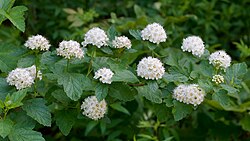
| Physocarpus opulifolius | |
Scientific classification 
| |
| Kingdom: | Plantae |
| Clade: | Embryophytes |
| Clade: | Tracheophytes |
| Clade: | Spermatophytes |
| Clade: | Angiosperms |
| Clade: | Eudicots |
| Clade: | Rosids |
| Order: | Rosales |
| Family: | Rosaceae |
| Subfamily: | Amygdaloideae |
| Tribe: | Neillieae |
| Genus: | Physocarpus (Cambess.) Raf. 18361 |
| Species | |
|
6–20, see text | |
Physocarpus, commonly called ninebark, is a genus of flowering plants in the family Rosaceae. All but two species are native to North America; the two outliers being native to northeastern Asia.
The genus name Physocarpus comes from the Greek for "bladder fruit", referring to the inflated fruits of some species.2 The common name 'ninebark' refers to the peeling bark of mature branches, which comes away in strips.3
Description
Physocarpus are deciduous shrubs with peeling bark3 and alternately arranged leaves. The leaves are palmate with 3 to 7 lobes and often toothed edges. The inflorescence is a cluster of bell-shaped flowers with 5 rounded white or pink petals and many stamens. The fruit is a flat or inflated dehiscent follicle.45
Physocarpus opulifolius is cultivated as an ornamental plant. Several cultivars have been bred, particularly for foliage of varying colors, including 'Dart's Gold' and 'Luteus', which have yellowish leaves, and 'Monlo' and 'Seward', which have reddish purple foliage.6
Taxonomy
Species
There are six478 to 205 species in the genus. They include:

- Physocarpus alternans (M.E.Jones) J.T.Howell (1931) – dwarf ninebark (western North America)9
- Physocarpus amurensis (Maxim.) Maxim. (1879) – Asian ninebark (Asia)10
- Physocarpus australis (Rydb.) Rehder (1920)11
- Physocarpus bracteatus (Rydb.) Rehder (1916) – (Colorado)12
- Physocarpus capitatus (Pursh) Kuntze (1891) – Pacific ninebark (western North America)13
- Physocarpus glabratus (Rydb.) Rehder (1915) – (Colorado)14
- Physocarpus malvaceus (Greene) Kuntze (1891) – mallow ninebark (western North America)15
- Physocarpus monogynus (Torr.) J.M. Coult. (1891) – mountain ninebark (North America)16
- Physocarpus opulifolius (L.) Maxim. (1879) – common ninebark (eastern North America)17
- Physocarpus pauciflorus C.K.Schneid. (1906)18
- Physocarpus ribesifolia Kom. (1973)19 – (Asia)
Synonyms
- Physocarpus hanceana Kuntze (1891) = Neillia hanceana (Kuntze) S.H.Oh (2006)20
- Physocarpus intermedius (Rydb.) C.K.Schneid. (1906) = Physocarpus opulifolius var. intermedius (Rydb.) B.L.Rob. (1908)21
- Physocarpus torreyi (S. Watson) Maxim. (1879) = Physocarpus monogynus (Torr.) J.M.Coult. (1891)22
- Physocarpus stellatus (Rydb. ex Small) Rehder (1920) = Physocarpus opulifolius (L.) Maxim. (1879)23
Cultivation
Propagation is by seeds sown as soon as ripe or they can be stored dry in airtight containers in a cool place for up to a year and then sown. Plants can be divided in the early spring, with a sharp spade or even an axe, chopping right through the middle. Softwood and hardwood cuttings are easy to root.
Garden writers describe few if any problems, but it is not unheard for armies of aphids to attack some varieties. Some seaside specimens exhibit powdery mildew in summer.
References
References
- Physocarpus Tropicos.org. Missouri Botanical Garden. Retrieved 22 January 2012.
- Coombes, Allen J. (2012). The A to Z of Plant Names. USA: Timber Press. ISBN 978-1-60469-196-2.
- Physocarpus opulifolius 'Diabolo'. Missouri Botanical Garden.
- Physocarpus. The Jepson eFlora 2013.
- Physocarpus. Flora of China.
- Common Ninebark, Physocarpus opulifolius. University of Illinois Extension.
- Oh, S. H. and D. Potter. (2005). Molecular phylogenetic systematics and biogeography of tribe Neillieae (Rosaceae) using DNA sequences of cpDNA, rDNA, and LEAFY. American Journal of Botany 92(1), 179–92.
- Oh, S. H., et al. (2010). Phylogenetic relationship of Physocarpus insularis (Rosaceae) endemic on Ulleung Island: implications for conservation biology. Journal of Plant Biology 53(1), 94–105.
- NRCS. "Physocarpus alternans". PLANTS Database. United States Department of Agriculture (USDA). Retrieved 22 January 2012.
- P. amurensis Flora of China. Retrieved 22 January 2012.
- P. australis Archived 3 March 2016 at the Wayback Machine International Organization for Plant Information (IOPI). Retrieved 22 January 2012.
- "Physocarpus bracteatus". Germplasm Resources Information Network. Agricultural Research Service, United States Department of Agriculture. Retrieved 4 January 2018.
- NRCS. "Physocarpus capitatus". PLANTS Database. United States Department of Agriculture (USDA). Retrieved 22 January 2012.
- P. glabratus Tropicos.org. Missouri Botanical Garden. Retrieved 22 January 2012.
- NRCS. "Physocarpus malvaceus". PLANTS Database. United States Department of Agriculture (USDA). Retrieved 22 January 2012.
- NRCS. "Physocarpus monogynus". PLANTS Database. United States Department of Agriculture (USDA). Retrieved 22 January 2012.
- NRCS. "Physocarpus opulifolius". PLANTS Database. United States Department of Agriculture (USDA). Retrieved 22 January 2012.
- P. pauciflorus International Organization for Plant Information (IOPI). Retrieved 22 January 2012.
- P. ribesifolia Tropicos.org. Missouri Botanical Garden. 22 January 2012
- "Physocarpus hanceana". Germplasm Resources Information Network. Agricultural Research Service, United States Department of Agriculture. Retrieved 4 January 2018.
- P. intermedius Tropicos.org. Missouri Botanical Garden. Retrieved 22 January 2012.
- P. torreyi Integrated Taxonomic Information System (ITIS). Retrieved 22 January 2012.
- "Physocarpus stellatus". Germplasm Resources Information Network. Agricultural Research Service, United States Department of Agriculture. Retrieved 4 January 2018.