| Phalangeriformes Temporal range:
| |
|---|---|
| |
Scientific classification
| |
| Kingdom: | Animalia |
| Phylum: | Chordata |
| Class: | Mammalia |
| Infraclass: | Marsupialia |
| Order: | Diprotodontia |
| Suborder: | Phalangeriformes Szalay in Archer, 1982 |
| Groups included | |
| Cladistically included but traditionally excluded taxa | |
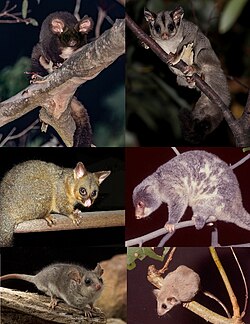
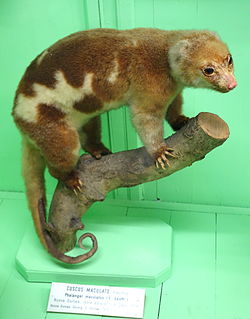
Phalangeriformes /fəˈlændʒərɪfɔːrmiːz/ are quadrupedal marsupials with long tails. They are a paraphyletic1 suborder of diprotodontia, consiting of about 70 species of small to medium-sized marsupials native to Australia, New Guinea, and Sulawesi.2 It includes possums,3 gliders, and cuscus.
Phalangeriformes species are typically nocturnal and at least partially arboreal. They mostly inhabit vegetated habitats, and several species have adjusted well to urban settings. Diets range from generalist herbivores or omnivores (the common brushtail possum) to specialist browsers of eucalyptus (greater glider), insectivores (mountain pygmy possum) and nectar-feeders (honey possum).
The smallest phalangeriforme species, indeed the smallest diprotodont marsupial, is the Tasmanian pygmy possum, with an adult head-body length of 70 mm (2+3⁄4 in) and a weight of 10 g (3⁄8 oz).4 The largest are the two species of bear cuscus, which may exceed 7 kg (15 lb 7 oz).
The common name "(o)possum" for various Phalangeriformes species derives from the creatures' resemblance to the opossums of the Americas (the term comes from Powhatan language aposoum "white animal", from Proto-Algonquian *wa·p-aʔɬemwa "white dog").5 However, although opossums are also marsupials, Australasian possums are more closely related to other Australasian marsupials such as kangaroos.
Classification
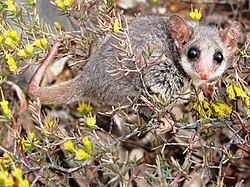
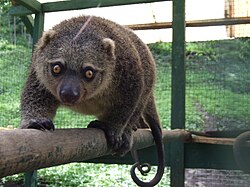
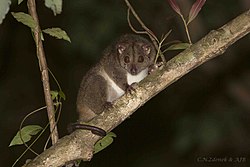


About two-thirds of Australian marsupials belong to the order Diprotodontia, which is split into three suborders, namely the Vombatiformes (wombats and the koala, four species in total); the large and diverse Phalangeriformes (the possums and gliders) and Macropodiformes (kangaroos, potoroos, wallabies and the musky rat-kangaroo).
Note: this classification is based on Ruedas & Morales 2005. However, Phalangeriformes has been recovered as paraphyletic with respect to Macropodiformes, rendering the latter a subset of the former if Phalangeriformes are to be considered a natural group.67
Classification:
- Suborder Phalangeriformes: possums, gliders and allies
- Superfamily Phalangeroidea
- Family †Ektopodontidae:
- Genus †Ektopodon
- †Ektopodon serratus
- †Ektopodon stirtoni
- †Ektopodon ulta
- Genus †Ektopodon
- Family Burramyidae: (pygmy possums)
- Genus Burramys
- Mountain pygmy possum, B. parvus
- Genus Cercartetus
- Long-tailed pygmy possum, C. caudatus
- Southwestern pygmy possum, C. concinnus
- Tasmanian pygmy possum, C. lepidus
- Eastern pygmy possum, C. nanus
- Genus Burramys
- Family Phalangeridae: (brushtail possums and cuscuses)
- Subfamily Ailuropinae
- Genus Ailurops
- Talaud bear cuscus, A. melanotis
- Sulawesi bear cuscus, A. ursinus
- Genus Strigocuscus
- Sulawesi dwarf cuscus, S. celebensis
- Banggai cuscus, S. pelegensis
- Genus Ailurops
- Subfamily Phalangerinae
- Tribe Phalangerini
- Genus Phalanger
- Gebe cuscus, P. alexandrae
- Mountain cuscus, P. carmelitae
- Ground cuscus, P. gymnotis
- Eastern common cuscus, P. intercastellanus
- Woodlark cuscus, P. lullulae
- Blue-eyed cuscus, P. matabiru
- Telefomin cuscus, P. matanim
- Southern common cuscus, P. mimicus
- Northern common cuscus, P. orientalis
- Ornate cuscus, P. ornatus
- Rothschild's cuscus, P. rothschildi
- Silky cuscus, P. sericeus
- Stein's cuscus, P. vestitus
- Genus Spilocuscus
- Admiralty Island cuscus, S. kraemeri
- Common spotted cuscus, S. maculatus
- Waigeou cuscus, S. papuensis
- Black-spotted cuscus, S. rufoniger
- Blue-eyed spotted cuscus, S. wilsoni
- Genus Phalanger
- Tribe Trichosurini
- Genus Trichosurus
- Northern brushtail possum, T. arnhemensis
- Short-eared possum, T. caninus
- Mountain brushtail possum, T. cunninghami
- Coppery brushtail possum, T. johnstonii
- Common brushtail possum, T. vulpecula
- Genus Wyulda
- Scaly-tailed possum, W. squamicaudata
- Genus Trichosurus
- Tribe Phalangerini
- Subfamily Ailuropinae
- Family †Ektopodontidae:
- Superfamily Petauroidea
- Family Pseudocheiridae: (ring-tailed possums and allies)
- Subfamily Hemibelideinae
- Genus Hemibelideus
- Lemur-like ringtail possum, H. lemuroides
- Genus Tous
- Ring-tailed glider, T. ayamaruensis
- Genus Petauroides
- Central greater glider, P. armillatus
- Northern greater glider, P. minor
- Southern greater glider, P. volans
- Genus Hemibelideus
- Subfamily Pseudocheirinae
- Genus Petropseudes
- Rock-haunting ringtail possum, P. dahli
- Genus Pseudocheirus
- Common ringtail possum, P. peregrinus
- Genus Pseudochirulus
- Lowland ringtail possum, P. canescens
- Weyland ringtail possum, P. caroli
- Cinereus ringtail possum, P. cinereus
- Painted ringtail possum, P. forbesi
- Herbert River ringtail possum, P. herbertensis
- Masked ringtail possum, P. larvatus
- Pygmy ringtail possum, P. mayeri
- Vogelkop ringtail possum, P. schlegeli
- Genus Petropseudes
- Subfamily Pseudochiropsinae
- Genus Pseudochirops
- D'Albertis' ringtail possum, P. albertisii
- Green ringtail possum, P. archeri
- Plush-coated ringtail possum, P. corinnae
- Reclusive ringtail possum, P. coronatus
- Coppery ringtail possum, P. cupreus
- Genus Pseudochirops
- Subfamily Hemibelideinae
- Family Petauridae: (striped possum, Leadbeater's possum, yellow-bellied glider, sugar glider, mahogany glider, squirrel glider)
- Subfamily Dactylopsilinae
- Genus Dactylopsila
- Great-tailed triok, D. megalura
- Long-fingered triok, D. palpator
- Tate's triok, D. tatei
- Striped possum, D. trivirgata
- Genus Dactylonax
- Pygmy long-fingered possum, D. kambuayai
- Genus Dactylopsila
- Subfamily Petaurinae
- Genus Gymnobelideus
- Leadbeater's possum, G. leadbeateri
- Genus Petaurus
- Northern glider, P. abidi
- Savanna glider, P. ariel
- Yellow-bellied glider, P. australis
- Biak glider, P. biacensis
- Sugar glider, P. breviceps
- Mahogany glider, P. gracilis
- Squirrel glider, P. norfolcensis
- Krefft's glider, P. notatus
- Genus Gymnobelideus
- Subfamily Dactylopsilinae
- Family Tarsipedidae: (honey possum)
- Genus Tarsipes
- Honey possum or noolbenger, T. rostratus
- Genus Tarsipes
- Family Acrobatidae: (feathertail glider and feather-tailed possum)
- Genus Acrobates
- Feathertail glider, A. pygmaeus
- Genus Distoechurus
- Feather-tailed possum, D. pennatus
- Genus Acrobates
- Family Pseudocheiridae: (ring-tailed possums and allies)
- Superfamily Phalangeroidea
References
References
- Eldridge, Mark D B; Beck, Robin M D; Croft, Darin A; Travouillon, Kenny J; Fox, Barry J (23 May 2019). "An emerging consensus in the evolution, phylogeny, and systematics of marsupials and their fossil relatives (Metatheria)". Journal of Mammalogy. 100 (3): 802–837. doi:10.1093/jmammal/gyz018. ISSN 0022-2372.
- Groves, C. P. (2005). "Suborder Phalangeriformes". In Wilson, D. E.; Reeder, D. M (eds.). Mammal Species of the World: A Taxonomic and Geographic Reference (3rd ed.). Johns Hopkins University Press. pp. 44–56. ISBN 978-0-8018-8221-0. OCLC 62265494.
- "opossum". Oxford English Dictionary (Online ed.). Oxford University Press. doi:10.1093/OED/8236326670. (Subscription or participating institution membership required.)
- Ward, S.J. (1992). "Life-History of the Little Pygmy-Possum, Cercartetus lepidus (Marsupialia, Burramyidae), in the Big Desert, Victoria". Australian Journal of Zoology. 40 (1): 43–55. doi:10.1071/ZO9920043.
- Siebert, Frank T. Jr. (1975). "Resurrecting Virginia Algonquian from the Dead: The Reconstituted and Historical Phonology of Powhatan". In Crawford, James Mack (ed.). Studies in Southeastern Indian Languages. University of Georgia Press.
- Warburton, Natalie M.; Prideaux, Gavin J. (2021). "The skeleton of Congruus kitcheneri, a semiarboreal kangaroo from the Pleistocene of southern Australia". Royal Society Open Science. 8 (3) 202216. Bibcode:2021RSOS....802216W. doi:10.1098/rsos.202216. PMC 8074921. PMID 33959368.
- Eldridge, Mark D B; Beck, Robin M D; Croft, Darin A; Travouillon, Kenny J; Fox, Barry J (23 May 2019). "An emerging consensus in the evolution, phylogeny, and systematics of marsupials and their fossil relatives (Metatheria)". Journal of Mammalogy. 100 (3): 802–837. doi:10.1093/jmammal/gyz018. ISSN 0022-2372.
Further reading
Further reading
- Possums and Gliders Archived 6 June 2013 at the Wayback Machine – Australia Zoo
- Urban Possums – ABC (Science), Australian Broadcasting Corporation
- Ruedas, L.A.; Morales, J.C. (2005). "Evolutionary relationships among genera of Phalangeridae (Metatheria: Diprotodontia) inferred from mitochondrial data". Journal of Mammalogy. 86 (2): 353–365. doi:10.1644/BER-117.1. JSTOR 4094355.
- Possums or Opossums? on Museum of New Zealand Te Papa Tongarewa