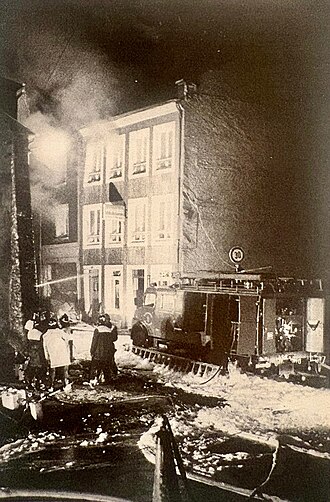
 First responders attending the scene of the explosion | |
 | |
| Date | 30 May 1976 (1976-05-30) |
|---|---|
| Time | 21:40 |
| Location | Pfaffenthal, Luxembourg City |
| Coordinates | 49°36′57″N 6°07′54″E / 49.615855°N 6.131693°E / 49.615855; 6.131693 |
| Cause | Negligent release of 11,000 liters of gasoline into an underground sewer |
| Deaths | 3 |
| Non-fatal injuries | 20-25 |
| Property damage | c. 20 houses destroyed or demolished due to extensive damage |
| Displaced | c. 93 people unhoused permanently |
In the evening of 30 May 1976, a series of explosions caused by the release of a large quantity of gasoline into an underground sewer tore through a block of houses in Pfaffenthal, a district of Luxembourg City, Luxembourg. Three residents were killed, including a four-year old child, and between 20 and 25 more people were injured. The explosion, labelled by Tageblatt at the time as "the worst disaster since the end of the war",1 further destroyed or caused irreparable damage to around 20 houses, unhousing nearly 100 people.
In 1982, three people were held responsible for the explosion by Luxembourg's court of appeals, and sentenced to pay fines and damages to implicated insurance companies. A social housing development was built in place of the demolished block, and, despite promises by city authorities to reconstruct rapidly, was completed in 1986, a decade after the catastrophe.
Background
Pfaffenthal is one of 24 districts of Luxembourg City, situated in a narrow part of the Alzette valley, downstream from Clausen and below the Ville-Haute, the city's old town. Historically an important point of passage for people going up to the gates of what was then a fortress city, it became densely populated, concentrating up to 16% of the city's entire population as of 1806.2: 74-75 Pfaffenthal entered into decline starting with the dismantling of the fortress in the 1870s3: 189 and the construction of the Côte d'Eich, a road leading up to the Ville-Haute from the north that bypassed it.42: 78 The part of the district located on the left bank of the Alzette, around the Béinchen bridge, became known as a working-class neighbourhood with an important immigrant population drawn by affordable housing.54
Before the second World War, the district was home to around 4,600 residents; this number would strongly decline in the decades following the war, down to about 1,500 in the 1970s-1980s.6 As of 1974, 41% of Pfaffenthal residents were immigrants, compared to 24% for the city as a whole,7 and Portuguese immigrants in particular made up a sizeable proportion of the neighbourhood's population.8
All the while, living conditions had improved little since the beginning of the century; homes were often small and cramped, with extremely basic amenities.4 Robert Conrad, a former head of the City's housing department, would later describe these conditions as "the worst in the entire city" and "almost like in the Middle Ages".9 For much of the 20th century, the City pursued a hygienist policy in the neighbourhood, buying up and demolishing a number of unsanitary homes.1092: 78 Consequently, part of the block where the explosion would take place, located between the Alzette, the Béinchen bridge, Rue Laurent Menager and Rue du Pont, close to where a panoramic elevator stands today, already stood vacant.2: 64 In January 1976, just four months before the explosions, the city's communal council approved a plan for the block's restoration, which would have involved the preservation of existing buildings and the creation of a traffic-calmed street, a "revolutionary idea" at the time.3: 193
Gas explosions and fires were not uncommon in the neighbourhood. On 21 September 1973, for instance, in the courtyard of a building on Rue Laurent Menager, a man's attempt at connecting a gas cylinder, together with the presence of candles used for light due to the lack of electricity in many homes, triggered a strong explosion which injured four and caused a large fire.11 It was reportedly the eighth fire within three years at the time.12
Explosion

On 30 May 1976, at 21:20, residents at 45, Rue Laurent Menager noticed a suspicious gas smell that prompted them to call the city's gasworks.13 At 21:30, a member of the gasworks emergency personnel arrived at the scene, and determined that the smell could not have been coming from the city gasworks, as pipes were intact.13
Shortly thereafter, around 21:40, a first explosion occurred at number 3, Rue du Pont, and the adjacent Café du Pont.1415 The house at number 3 collapsed almost entirely, killing a woman and a child who were buried under the rubble, with a man left hanging by a window, his legs trapped by rubble.1315 This first explosion caused many residents to run out of their homes, which, alongside the fact that many others had been out at neighbourhood cafés, likely limited the death toll.13 Emergency services, which were alerted at 21:56, rushed to the scene, but around 22:10, as the man stuck in the window was being rescued, a second explosion took place, described as "far more devastating" than the first15 and which sent several manhole covers flying into the air.1 Using a megaphone, a fireman chief urged people to evacuate the area, likely preventing further victims.16 In total, about a half dozen explosions, likely caused by fire interacting with gas,17 followed the first one.18
Over 100 emergency personnel attended the scene, including paramedics with a "fleet of ambulances", professional fire brigades, police, Gendarmerie, army, Red Cross and Protection Civile personnel, with teams from the city aided by backup from Lintgen, Mamer and Bettembourg.192013 Some firemen were in service for as long as 29 straight hours to attend the scene.21 As the smell of gas could be sensed as far downstream as Eich and Weimerskirch, the supply was cut in a number of surrounding streets22 and a light-foam extract was injected into shafts in order to prevent further explosions.20 In the late hours of the night, Luxembourg City mayor Colette Flesch and Internal Affairs minister Jos Wohlfart arrived at the scene to assess the extent of the explosions.19 The next day, in an official statement to the communal council and after having promised speedy compensation for victims,17 Flesch would describe the event as "one of the worst catastrophes in peacetime".1
Casualties and aftermath


Three people were killed by the explosion, with their bodies found in the rubble of houses number 1 and 3 at Rue du Pont by 2 am on 31 May. These victims were 36-year old Luxembourger Emile "Mulles" Mauer of Rumelange,23 35-year old Portuguese Maria Da Conceição Antunes, a native of Torres Vedras, and her four-year old sona Nuno Duarte Antunes Ramos.125
Between 20 and 25 people were injured in the incident, two of whom severely, and treated at Eich clinic,145 some suffering from severe fractures, burns or gas poisoning.19 Among the injured were three firemen,13 one of whom was hit in the head by a flying manhole cover,21 as well as a 5-year old girl who was found alive in the rubble after 7 hours.14
Various accounts estimate that between 150 and 200 affected residents, those who lived in houses located along Rue du Pont and Rue Laurent Menager, were displaced in the immediate aftermath of the catastrophe. All were entitled to an indefinitely renewable "victim's certificate", which granted them temporary accommodation in a number of structures, and support from the City's social services.26 Most, as many as 93 on the first night, were housed in the nearby youth hostel, while others were given shelter in a number of other structures in Pfaffenthal, other parts of the city and Esch-sur-Alzette.113 Within a week, residents of all but three of the houses on Rue Laurent Menager were allowed to return to their homes, as these had been deemed habitable by experts.27 A total of about 93 people lost their home indefinitely,28 either because it was destroyed immediately or because it was evaluated to be uninhabitable and slated for demolition.27
According to historian Michel Pauly, the handling of the many displaced Portuguese residents was troubled. No interpreter was present to ensure communication between them and city authorities, which planned to temporarily house them at the military centre in Diekirch, 30 km (19 mi) north of Luxembourg City, despite few of them owning a car. Consequently, as Pauly claims, they had to sleep in a city park for several nights.8
Investigation and trial
Initial investigation of the causes

The cause of the explosion was not immediately apparent. Reportedly, in the week following the catastrophe, a number of Pfaffenthal residents maintained the belief that it had been caused by natural gas.28 By 1 June, the lead of a potential gasoline leak was explored, as a team of experts discovered the presence of thousands of liters of gasoline at the Beggen wastewater treatment plant, about 3.8 km (2.4 mi) north.26 A call for witnesses was published the next day, asking anyone who had noticed a gasoline smell in the area on 30 May, or who had information about suspicious fuel deliveries on 29 or 30 May, to contact authorities.29
On 4 June, a teletype release from the police information service, first circulated by Le Républicain Lorrain, revealed the conclusions reached the previous day by an in-depth inquiry from police and forensic experts. In the evening of 30 May, at a depot of petroleum company Elf in Cessange, an 'unexperienced' truck driver employed by transportation company Intralux had intended to deliver 10,000 litersb of gasoline, left over from a delivery the previous day, into an underground reserve tank he had never previously used.2728 Unknowingly, he instead discharged the load into a kind of cistern known as an oil separator, from which it overflowed into the sewer system.2725 The gasoline then flowed towards Pfaffenthal, as it is one of the lowest points in the city,9 and its fumes rose into the cellars of the neighbourhood, many of which were poorly insulated due to a lack of siphons, where they accumulated.15 A spark, reportedly coming from a refrigerator compressor, then ignited the fumes and the gasoline, causing the first explosion.53132
It was reported that the driver responsible for the leak turned himself in and was questioned, but not arrested, as he had only worked for the company for a few weeks and was unfamiliar with the systems at the facility.2728
1981-1982 trial
The trial pertaining to the explosion began before the police tribunal of Luxembourg City on 25 March 1981.33 Three people stood accused: Remy Faber, the delivery driver responsible for the gasoline release, and brothers Ernest and Marcel Ehlinger, who were the directors of Elf and Intralux respectively at the time of the explosion.30 The key question of the trial was whether the explosion had been caused by gasoline fumes, as had notably been concluded by police in the days following the catastrophe, or by a gas leak, as the defense lawyers argued.3334 After hearing a number of expert witnesses, the court upheld the gasoline fumes theory; on 8 July, it acquitted Faber and Marcel Ehlinger, sentencing Ernest Ehlinger to a suspended sentence of 8 months in prison as well as a 100,000 LUF fine, and ordered him to pay 5 million LUF in damages to three insurance companies.30
However, the decision was appealed, and reviewed on 18 June 1982 by the Court of Appeals of Luxembourg. All three defendants were recognised as being solely and jointly responsible for the consequences of the explosion, while the owners of the destroyed homes would bear no responsibility, as the absence of siphons in the neighbourhood's homes did not constitute negligence on their part.35 Faber was sentenced to a 30,000 LUF fine, Marcel Ehlinger to a 100,000 LUF fine by way of extenuating circumstance, while Ernest Ehlinger was relieved of his original sentencing. All three were condemned to jointly pay the 5 million LUF of damages to insurance companies, as well as 700,000 LUF of legal fees.35
Reconstruction
Planning

Over 20 houses were damaged by the explosion, and while most standing thereafter, the entire block was eventually demolished. Houses number 1 and 3 on Rue du Pont were demolished immediately,14 while at least another 17, which were considered uninhabitable or unsalvageable, were torn down starting on 15 June.3: 195
In the days following the catastrophe, mayor Flesch declared that the reconstruction of Pfaffenthal was an "absolute priority", and that the process would need to take into account both the architectural character of the neighbourhood and the needs of its inhabitants.3: 195 A master plan for reconstruction, based on the existing plan by architect group Ewert-Haagen-Jagen that had been approved the previous January, was approved in September 1976.63: 195 Speedy reconstruction was to be facilitated by the fact that almost all of the terrain was already owned by the City of Luxembourg.36 Nonetheless, due to a stated necessity to ensure no similar catastrophe would happen in the future, and the communal council's delay in approving a definitive reconstruction plan, it took until September 1977 for an architectural design competition to be decided on, and then until June 1978 for it to be launched.3: 196
In October 1978, architects Fritsch, Herr and Huybenrechts were announced as winners of the design competition.10 Their design concept, which originated in the Netherlands,9 centered on a courtyard overlooked by surrounding houses that would architecturally blend with the rest of the neighbourhood, comprising 39 homes for a total of around 120 residents.102: 119 While construction was supposed to begin soon thereafter, further delays occurred; aside from unforeseen technical difficulties on the terrain, the initial building cost of 149 million LUF was perceived as too high by the city's council of aldermen, which demanded adjustments to the project, leading to several years of further revisions.3: 197-198 The fifth anniversary of the catastrophe, in 1981, was marked by a protest that involved as many as 200 attendees, dressed in mourning clothes, who made their way to the still vacant terrain and laid a symbolic foundation stone in protest of the delays.37
Construction and rehousing

The construction permit for the final version of the project was approved in August 1982, now comprising 12 single-family homes, 17 apartments, 4 studio apartments, one café, one business and one community hall, at a cost that would end up amounting to 230 million LUF.63: 199 The groundbreaking for the housing development, which became known as "beim Béinchen" or "um Béinchen" after the nearby bridge, took place on 25 February 1983, with now mayor Lydie Polfer giving the ceremonial first cut of the spade.153: 199 Construction took just over three years, and the dedication ceremony, during which Polfer unveiled a plaque dedicated to the victims of the explosion, took place on 20 September 1986, a full decade after the catastrophe.1538
All of the homes were made available as social housing, benefitting from a law adopted by the Chamber of Deputies in 1979, during the project's planning phase, and which had for the first time created a formal status for social housing in Luxembourg.63: 197 While an initial aim of the reconstruction project had been to rehouse former residents who wished to return, only 8 families ended up doing so,18 as most had long found permanent housing elsewhere.49 To some extent, this turnover of residents led to a sociological recomposition of the neighbourhood, marking, according to Jean-André Stammet, the general secretary of Pfaffenthal's local advocacy syndicate, the "destruction of [the neighbourhood's] sociological fabric".52: 10
Notes and references
Notes
- News sources largely refer to the child victim as a girl; however, Nuno is a male given name, and a reader's letter from Nuno's father published on 22 December 1976 refers to the child as his son.24
- Some accounts put the number at 20,000 liters instead of 10,000; in 1981, the police tribunal of Luxembourg City would conclude that it was 11,000 liters.30
References
- Weides, Fernand [in Luxembourgish] (1 June 1976). "Das schwerste Unglück seit Kriegsende". Tageblatt (in German). pp. 4–5. Retrieved 30 May 2026.
- Syndicat d'intérêts locaux Pfaffenthal-Siechenhof (2023). Kanner o Kanner : eng Hymne op eng eenzegaarteg Ënnerstad (in Luxembourgish) (2nd ed.). Luxembourg City: Saint-Paul. ISBN 978-99959-0-852-2.
- Théato, Fernand [in Luxembourgish] (1985). "Die unglaubwürdige Geschichte des "Quartier Béinchen" : oder. Warum es so lange dauerte". Laurent Menager (in German). Luxembourg City: Chorale Sang a Klang Pafendall. p. 187-200.
- Hoffmann, Jean-Paul (June 1983). "Pfaffenthal : la réalité au-delà des clichés" (PDF). Ons Stad. No. 13. p. 3-6. Retrieved 30 May 2026.
- "Ce jour terrible qui a bouleversé le Pfaffenthal". Le Quotidien (in French). 1 June 2016. Retrieved 30 May 2026.
- Clesse, René (June 1983). "Um "Béinchen" rührt sich was" (PDF). Ons Stad (in German). No. 13. p. 14-15. Retrieved 30 May 2026.
- Hirsch, Mario (27 January 1978). "Reconquête des faubourgs?". d'Lëtzebuerger Land (in French). Retrieved 30 May 2026.
- Pauly, Michel [in Luxembourgish] (2022). Die Geschichte der Stadt Luxemburg in 99 Objekten (in German). Capybara Books. p. 380. ISBN 978-99959-43-46-2.
- Thomas, Bernard; Herr, Lynn; Conrad, Robert (7 October 2011). "Die Explosion im Béinchen" (PDF). Forum (in German). No. 311. pp. 46–47. Retrieved 30 May 2026.
- "Pfaffenthal, ein Jahr nach der Explosionskatastrophe vom 30. Mai 1976". Luxemburger Wort (in German). 28 May 1977. p. 7. Retrieved 30 May 2026.
- "Vier zum teil schwer verletzte forderte die Gasexplosion". Luxemburger Wort. 24 September 1973. p. 7. Retrieved 30 May 2026.
- "Mehrere Schwerverletzte bei Gasexplosion in Pfaffenthal". Luxemburger Wort (in German). 22 September 1973. p. 6. Retrieved 30 May 2026.
- "«Eine der schwersten Katastrophen in Friedenszeiten»". Revue (in German). 5 June 1976. pp. 10–11. Retrieved 30 May 2026.
- Burggraff, Emile (1 June 1976). "In Pfaffenthal müssen wenigstens 17 baufällige Häuser abgetragen werden". Luxemburger Wort (in German). p. 6. Retrieved 30 May 2026.
- "Katastrophe in Friedenszeiten". Revue (in German). 25 September 1986. pp. 16–18. Retrieved 30 May 2026.
- Brucker, Christelle (30 May 2026). "Il y a 50 ans, une série d'explosions dévastait le Pfaffenthal : «C'était comme à la guerre»". Le Quotidien (in French). Retrieved 30 May 2026.
- Hayum, Danièle (30 May 2026). "30 mai 1976: une explosion catastrophique a bouleversé le Pfaffenthal". virgule.lu (in French). Retrieved 30 May 2026.
- Meyrath, Alannah; Oudendijk, Josh (2 October 2024). "Remembering Luxembourg's worst gas explosion: video". RTL Today. Retrieved 30 May 2026.
- "Schwere Explosionskatastrophe in Pfaffenthal". Luxemburger Wort (in German). 31 May 1976. p. 5. Retrieved 30 May 2026.
- "Konferenz über die Katastrophe im Pfaffenthal". Luxemburger Wort (in German). 7 February 1977. p. 7. Retrieved 30 May 2026.
- Hermes, Sophie (1 June 2016). "Das Pfaffenthal erinnert sich". Luxemburger Wort (in German). Retrieved 30 May 2026.
- Weides, Fernand [in Luxembourgish] (31 May 1976). "Furchtbare Explosionen in Pfaffenthal - 3 Tote und 21 Verletzte" (in German). pp. 1, 24. Retrieved 30 May 2026.
- "Avis mortuaire". Luxemburger Wort. 1 June 1976. p. 5. Retrieved 30 May 2026.
- Ramos, Avelino (22 December 1976). "Où est resté l'argent?". Luxemburger Wort (in French). p. 11. Retrieved 30 May 2026.
- "Luxembourg remembers horrific gas explosion, 40 years ago". Luxembourg Times. 30 May 2016.
- Di Bartolomeo, Mars (2 June 1976). "Pfaffenthal: Das große Warten..." Tageblatt. p. 5. Retrieved 30 May 2026.
- Di Bartolomeo, Mars (5 June 1976). "Pfaffenthal: Tragischer Irrtum verschuldete Explosionskatastrophe 20.000 Liter Benzin in Kanal gepumpt". Tageblatt (in German). pp. 1, 28. Retrieved 30 May 2026.
- "Pfaffenthal, 10 Tage danach". Revue (in German). 12 June 1976. pp. 13–14. Retrieved 30 May 2026.
- "Aufruf an die Bevölkerung zur Explosionskatastrophe in Pfaffenthal". Luxemburger Wort (in German). 2 June 1976. p. 6. Retrieved 30 May 2026.
- "8 Monate Gefängnis mit Strafaufschub in Sachen Explosionskatastrophe Pfaffenthal". Tageblatt (in German). 8 July 1981. p. 24. Retrieved 30 May 2026.
- "Procession to Honour Victims of 1976 Explosion in Pfaffenthal". chronicle.lu. 26 May 2016. Retrieved 30 May 2026.
- "L'explosion du 30 mai 1976 à Luxembourg-Pfaffenthal". Syndicat d'Intérêts Locaux Pfaffenthal-Siechenhof (in French). 23 May 2016. Retrieved 30 May 2026.
- "Was löste die Katastrophe aus: Benzindämpfe oder Gas?". Tageblatt (in German). 26 March 1981. p. 24. Retrieved 30 May 2026.
- "Prozeß „Beinchen 1976"". Tageblatt (in German). 30 May 1981. p. 3. Retrieved 30 May 2026.
- Ministère Public v Ehlinger, Ehlinger et Faber, 125/82 (Cour d'appel du Grand-duché de Luxembourg 18 June 1982).
- "Gewinner des Architektenwettbewerbs zum Wiederaufbau des Stadtteils „Beim Béinchen" in Luxemburg-Pfaffenthal ermittelt". Luxemburger Wort (in German). 20 October 1978. p. 7. Retrieved 30 May 2026.
- "„Hei steet d'Strauss, a weit a breet keen Haus"!". Tageblatt (in German). 1 June 1981. p. 3. Retrieved 30 May 2026.
- Hei Elei vum 21. September 1986 (Television production) (in Luxembourgish). RTL. 21 September 1986. 24 minutes in.