 | |
| Discovery | |
|---|---|
| Discovered by | Erich Karkoschka / Voyager 2 |
| Discovery date | May 18, 1999 (in images dating back to January 18, 1986) |
| Designations | |
Designation | Uranus XXV |
| Pronunciation | /ˈpɜːrdətə/1 |
| Adjectives | Perditean /pɜːrdəˈtiːən/23 |
| Orbital characteristics | |
Mean orbit radius | 76,417 ± 1 km4 |
| Eccentricity | 0.0012 ± 0.00054 |
| 0.638021 ± 0.000013 d4 | |
| Inclination | 0.0 ± 0.3° (to Uranus's equator)4 |
| Satellite of | Uranus |
| Physical characteristics | |
| 13.3±0.7 km5 | |
| ~2200 km2a | |
| Volume | ~9900 km3a |
| Mass | ~(4.9–12)×1015 kga |
Mean density | 0.56–1.267 g/cm3 |
| ~0.002–0.004 m/s2a | |
| ~0.007–0.011 km/sa | |
| synchronous4 | |
| zero4 | |
| Albedo | 0.08 ± 0.01 (assumed)8 |
| Temperature | ~64 Ka |
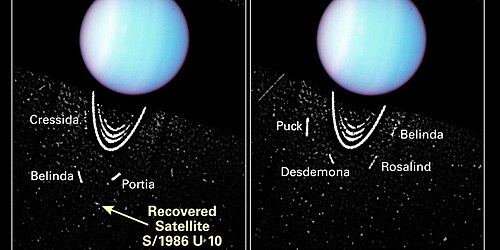
Perdita /ˈpɜːrdətə/ is a small inner satellite of Uranus. Perdita's discovery was very complicated, as the first photographs of Perdita were taken by the Voyager 2 spacecraft in 1986, but it was not recognized from the photographs for more than a decade. In 1999, the moon was noticed by Erich Karkoschka and reported.49 However, because no further pictures could be taken to confirm its existence, it was officially demoted in 2001.10 However, in 2003, pictures taken by the Hubble Space Telescope managed to pick up an object where Perdita was supposed to be, finally confirming its existence.811
Following its discovery in 1999, it was given the temporary designation of S/1986 U 10.9 It was named Perdita (Latin for 'lost') after the daughter of Leontes and Hermione in William Shakespeare's play The Winter's Tale. The moon is also designated Uranus XXV.12
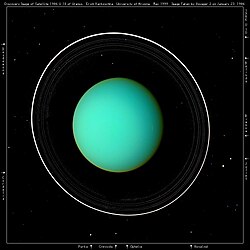
The moon orbits between Belinda and Puck. The above-mentioned Hubble measurements prove that Perdita does not follow a direct Keplerian motion around Uranus. Instead, it is clearly caught in a 43:44 orbital resonance with the nearby moon Belinda, and from this resonance it has been determined that Belinda's mass is 2613 or 277 times that of Perdita. It is also close to an 8:7 resonance with Rosalind.48
Perdita belongs to the Portia group of satellites, which also includes Bianca, Cressida, Desdemona, Portia, Juliet, Cupid, Rosalind, and Belinda.14 These satellites have similar orbits and photometric properties.14 Little is known about Perdita apart from its orbit,48 radius of 13.3 km (8.3 mi),5 and geometric albedo of 0.08.148
Notes
Notes
- Calculated on the basis of other parameters.
References
References
Citations
- Benjamin Smith (1903). The Century Dictionary and Cyclopedia.
- Byrne (2008). Perdita: the literary, theatrical, scandalous life of Mary Robinson.
- J. B. Lethbridge (2013) Shakespeare and Spenser: Attractive opposites.
- Karkoschka, Voyager 2001.
- Showalter & Lissauer (2006),8 as cited in Ćuk et al. (2022).7
- French & Showalter 2012.
- Ćuk et al. 2022.
- Showalter & Lissauer 2006.
- IAUC 7171.
- Foust 2001.
- IAUC 8194.
- USGS: Planet and Satellite Names and Discoverers.
- French, Robert S.; Showalter, Mark R.; de Pater, Imke; Lissauer, Jack J. (2017-10-01). Orbital and Photometric Analysis of the Inner Uranian Satellites from Hubble Images. Vol. 49. p. 214.19.
- Karkoschka, Hubble 2001.
Sources
- Karkoschka, Erich (2001). "Voyager's Eleventh Discovery of a Satellite of Uranus and Photometry and the First Size Measurements of Nine Satellites". Icarus. 151 (1): 69–77. Bibcode:2001Icar..151...69K. doi:10.1006/icar.2001.6597.
- Karkoschka, Erich (2001). "Comprehensive Photometry of the Rings and 16 Satellites of Uranus with the Hubble Space Telescope". Icarus. 151 (1): 51–68. Bibcode:2001Icar..151...51K. doi:10.1006/icar.2001.6596.
- Green, Daniel W. E. (May 18, 1999). "S/1986 U 10". IAU Circular. 7171: 1. Bibcode:1999IAUC.7171....1K. ISSN 0081-0304. Retrieved 2012-01-26.
- Foust, Jeff (December 31, 2001). "Moon of Uranus is demoted". Spaceflight Now. Retrieved 2012-01-26.
- Showalter, Mark R.; Lissauer, Jack J. (2006-02-17). "The Second Ring-Moon System of Uranus: Discovery and Dynamics". Science. 311 (5763): 973–977. Bibcode:2006Sci...311..973S. doi:10.1126/science.1122882. PMID 16373533. S2CID 13240973.
- Green, Daniel W. E. (September 3, 2003). "Satellites of Uranus". IAU Circular. 8194. ISSN 0081-0304. Retrieved 2012-01-26.
- USGS/IAU (July 21, 2006). "Planet and Satellite Names and Discoverers". Gazetteer of Planetary Nomenclature. USGS Astrogeology. Retrieved 2012-01-26.
- Ćuk, Matija; French, Robert S.; Showalter, Mark R.; Tiscareno, Matthew S.; Moutamid, Maryame El (2022-07-16). "Cupid is not Doomed Yet: On the Stability of the Inner Moons of Uranus". The Astronomical Journal. 164 (2): 38. arXiv:2205.14272. doi:10.3847/1538-3881/ac745d. ISSN 1538-3881.
- French, Robert S.; Showalter, Mark R. (August 2012). "Cupid is Doomed: An Analysis of the Stability of the Inner Uranian Satellites". Icarus. 220 (2): 911–921. arXiv:1408.2543. doi:10.1016/j.icarus.2012.06.031.
External links
External links
- Uranus 'Loses' a Moon: The 'New' Official Moon Count of the Solar System (Archived), Melanie Melton, The Planetary Society, 20 December 2001