| Peraclidae | |
|---|---|
| |
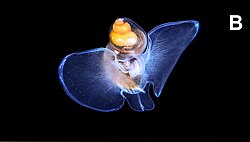
| Peracle reticulata, from the Catalan coast | |
Scientific classification 
| |
| Kingdom: | Animalia |
| Phylum: | Mollusca |
| Class: | Gastropoda |
| Clade: | Euopisthobranchia |
| Order: | Pteropoda |
| Superfamily: | Cymbulioidea |
| Family: | Peraclidae Tesch, 19131 |
| Synonyms2 | |
|
Procymbuliidae, 1913 | |
Peraclidae is a family of pelagic sea snails or "sea butterflies", marine gastropod molluscs in the superfamily Cymbulioidea.2
This family has no subfamilies (according to the taxonomy of the Gastropoda by Bouchet & Rocroi, 2005).
This family was originally called Procymbuliidae Tesch, 1913 and then called Peraclididae by Wenz in 1938.2 The name Peraclidae takes precedence.
Peracle is the type genus of the family Peraclidae.
"Peraclis" Pelseener, 1888 is a unjustied modification (Giovine, F. 1988)
Description
The left-coiled shell resembles the shell of most snails. The columella is somewhat elongated into a curved rostrum. There is an operculum and a gill.
Species
Species within the genus Peracle Forbes, 1844 include:
- † Peracle charlotteae Janssen & Little, 20103
- Peracle depressa Meisenheimer, 1906 - Distribution: Cuba, Brazil, Argentina, Oceanic, Equatorial Atlantic.
- Peracle diversa (Monterosato, 1875) - synonyms: Peracle apicifulva Meisenheimer, 1906,
- Peracle bispinosa Pelseneer, 1888, Two-spine pteropod. Distribution: Florida, Bermuda, Cuba, Argentina, Mediterranean. Length: 4 mm.
- Peracle moluccensis Tesch, 1903 - Distribution: Panama, Brazil, British Isles, Oceanic. Length: 3 mm.
- Peracle philiporum (R. W. Gilmer, 1990) - Distribution: Bahamas. Length: 4.5 mm.
- Peracle reticulata (d'Orbigny, 1836) - Reticulate pteropod. Distribution: Oceanic, Florida, Texas; Mediterranean. Length: 6 mm. Description: the shell, which shows a hexagonal pattern, is rather heavy and compels this little animal to flap continuously to keep afloat. Table 4, figure 2
- Peracle triacantha (P. Fischer, 1882) - Distribution: Oceanic, Cuba, Bermuda, Venezuela, Mediterranean. Length: 5 mm
- Peracle valdiviae Meisenheimer 1905 - Distribution: Oceanic, Argentina. Length: 5 mm.
References
References
- Tesch (1913). Das Tierreich 36: 71.
- Bouchet, Philippe; Rocroi, Jean-Pierre; Frýda, Jiri; Hausdorf, Bernard; Ponder, Winston; Valdés, Ángel & Warén, Anders (2005). "Classification and nomenclator of gastropod families". Malacologia. 47 (1–2). Hackenheim, Germany: ConchBooks: 1–397. ISBN 3-925919-72-4. ISSN 0076-2997.
- Janssen A. W. & Little C. T. S. (2010). "Holoplanktonic gastropoda (Mollusca) from the Miocene of Cyprus: systematics and biostratigraphy". Palaeontology 53(5): 1111-1145. doi:10.1111/j.1475-4983.2010.00993.x.
Peracle bispinosa is not synonyms of Peracle diversa. It is quite a different species! The reference for synonyms of Peracle diversa and Peracle apicifulva is : Giovine F. (1988). "The genus Peracle in the Mediterranean (Heterobranchia: Peraclidae)". La Conchiglia 20(226-227): 22-24, 5 figs.
Further reading
Further reading
- Giovine F. (1988). "The genus Peracle in the Mediterranean (Heterobranchia: Peraclidae)". La Conchiglia 20(226-227): 22-24, 5 figs.