
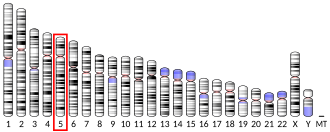



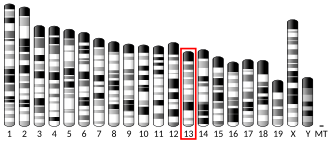

Protein pelota homolog (hPelogta) is a protein that in humans is encoded by the PELO gene.56
This gene encodes a protein which contains a conserved nuclear localization signal. The encoded protein may have a role in spermatogenesis, cell cycle control, and in meiotic cell division.6 In yeasts, the Dom34-Hbs1 complex (with ABCE1) that it forms is responsible for reactivating ribosomes and for recovering those stuck on mRNAs.7 It is a paralog of the release factor eRF1.
The Drosophila homolog was first discovered in 1993. Mutants exhibit G2/M arrest in meiosis and large nebenkern form in late spermatocytes.8 Human, yeast (Dom34), plant, and worm homologs are reported in 1995,9 followed by one found in archaea.10
References
References
- GRCh38: Ensembl release 89: ENSG00000152684 – Ensembl, May 2017
- GRCm38: Ensembl release 89: ENSMUSG00000042275 – Ensembl, May 2017
- "Human PubMed Reference:". National Center for Biotechnology Information, U.S. National Library of Medicine.
- "Mouse PubMed Reference:". National Center for Biotechnology Information, U.S. National Library of Medicine.
- Shamsadin R, Adham IM, von Beust G, Engel W (Nov 2000). "Molecular cloning, expression and chromosome location of the human pelota gene PELO". Cytogenetics and Cell Genetics. 90 (1–2): 75–8. doi:10.1159/000015667. PMID 11060452. S2CID 35316587.
- "Entrez Gene: PELO pelota homolog (Drosophila)".
- van den Elzen AM, Schuller A, Green R, Séraphin B (February 2014). "Dom34-Hbs1 mediated dissociation of inactive 80S ribosomes promotes restart of translation after stress". The EMBO Journal. 33 (3): 265–76. doi:10.1002/embj.201386123. PMC 3989619. PMID 24424461.
- Castrillon DH, Gönczy P, Alexander S, Rawson R, Eberhart CG, Viswanathan S, et al. (October 1993). "Toward a molecular genetic analysis of spermatogenesis in Drosophila melanogaster: characterization of male-sterile mutants generated by single P element mutagenesis". Genetics. 135 (2): 489–505. doi:10.1093/genetics/135.2.489. PMC 1205651. PMID 8244010.
- Eberhart CG, Wasserman SA (October 1995). "The pelota locus encodes a protein required for meiotic cell division: an analysis of G2/M arrest in Drosophila spermatogenesis". Development. 121 (10): 3477–86. doi:10.1242/dev.121.10.3477. PMID 7588080.
- Ragan MA, Logsdon JM, Sensen CW, Charlebois RL, Doolittle WF (November 1996). "An archaebacterial homolog of pelota, a meiotic cell division protein in eukaryotes". FEMS Microbiology Letters. 144 (2–3): 151–5. doi:10.1111/j.1574-6968.1996.tb08522.x. PMID 8900058.
Further reading
Further reading
- Cheli Y, Kanaji S, Jacquelin B, Chang M, Nugent DJ, Kunicki TJ (2007). "Transcriptional and epigenetic regulation of the integrin collagen receptor locus ITGA1-PELO-ITGA2". Biochimica et Biophysica Acta (BBA) - Gene Structure and Expression. 1769 (9–10): 546–58. doi:10.1016/j.bbaexp.2007.06.004. PMC 2682338. PMID 17669516.
- Ewing RM, Chu P, Elisma F, Li H, Taylor P, Climie S, et al. (2007). "Large-scale mapping of human protein-protein interactions by mass spectrometry". Molecular Systems Biology. 3 (1): 89. doi:10.1038/msb4100134. PMC 1847948. PMID 17353931.
- Olsen JV, Blagoev B, Gnad F, Macek B, Kumar C, Mortensen P, Mann M (November 2006). "Global, in vivo, and site-specific phosphorylation dynamics in signaling networks". Cell. 127 (3): 635–48. doi:10.1016/j.cell.2006.09.026. PMID 17081983. S2CID 7827573.
- Andersen JS, Lam YW, Leung AK, Ong SE, Lyon CE, Lamond AI, Mann M (January 2005). "Nucleolar proteome dynamics". Nature. 433 (7021): 77–83. Bibcode:2005Natur.433...77A. doi:10.1038/nature03207. PMID 15635413. S2CID 4344740.
- Lai CH, Chou CY, Ch'ang LY, Liu CS, Lin W (May 2000). "Identification of novel human genes evolutionarily conserved in Caenorhabditis elegans by comparative proteomics". Genome Research. 10 (5): 703–13. doi:10.1101/gr.10.5.703. PMC 310876. PMID 10810093.