 | |
 | |
| Names | |
|---|---|
| Other names
Lead difluoride
plumbous fluoride | |
| Identifiers | |
3D model (JSmol)
|
|
| ChemSpider | |
| ECHA InfoCard | 100.029.089 |
PubChem CID
|
|
| UNII | |
CompTox Dashboard (EPA)
|
|
| |
| |
| Properties | |
| PbF2 | |
| Molar mass | 245.20 g/mol |
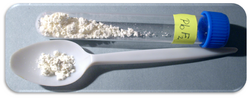
| Appearance | white powder |
| Odor | odorless |
| Density | 8.445 g/cm3 (orthorhombic) 7.750 g/cm3 (cubic) |
| Melting point | 824 °C (1,515 °F; 1,097 K) |
| Boiling point | 1,293 °C (2,359 °F; 1,566 K) |
| 0.057 g/100 mL (0 °C) 0.0671 g/100 mL (20 °C)1 | |
Solubility product (Ksp)
|
2.05·10−8 (20 °C) |
| Solubility | soluble in nitric acid and hydrochloric acid; insoluble in acetone and ammonia |
| −58.1·10−6 cm3/mol | |
| Structure | |
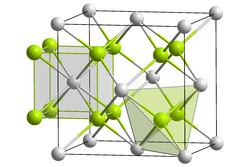
| Fluorite (cubic), cF12 | |
| Fm3m, No. 225 | |
| Hazards | |
| Lethal dose or concentration (LD, LC): | |
LD50 (median dose)
|
3031 mg/kg (oral, rat) |
| Related compounds | |
Other anions
|
Lead(II) chloride Lead(II) bromide Lead(II) iodide |
Other cations
|
Difluorocarbene Difluorosilylene Difluorogermylene Stannous fluoride |
Except where otherwise noted, data are given for materials in their standard state (at 25 °C [77 °F], 100 kPa).
| |


Lead(II) fluoride is the inorganic compound with the formula PbF2. It is a white solid. The compound is polymorphic, at ambient temperatures it exists in orthorhombic (PbCl2 type) form, while at high temperatures it is cubic (Fluorite type).2
Preparation
Lead(II) fluoride can be prepared by treating lead(II) hydroxide or lead(II) carbonate with hydrofluoric acid:3
- Pb(OH)2 + 2 HF → PbF2 + 2 H2O
Alternatively, it is precipitated by adding hydrofluoric acid to a lead(II) salt solution, or by adding a fluoride salt to a lead salt, such as potassium fluoride to a lead(II) nitrate solution,4
- 2 KF + Pb(NO3)2 → PbF2 + 2 KNO3
or sodium fluoride to a lead(II) acetate solution.
- 2 NaF + Pb(CH3COO)2 → PbF2 + 2 NaCH3COO
It appears as the very rare mineral fluorocronite.56
Uses
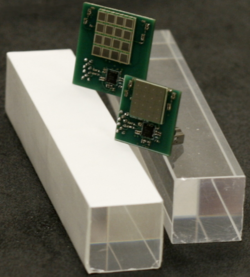
2 scintillator crystals used in the Muon g−2 experiment. source ↗
Lead(II) fluoride is used in low melting glasses, in glass coatings to reflect infrared rays, in phosphors for television-tube screens, and as a catalyst for the manufacture of picoline.3 The Muon g−2 experiment uses PbF
2 crystals in conjunction with silicon photomultipliers. High energy charged particles create Cerenkov light as they pass through the crystals, which is measured by the silicon photomultipliers.78
It also serves as an oxygen scavenger in high-temperature fluorine chemistry, as plumbous oxide is relatively volatile.9
References
References
- NIST-data review 1980
- Haines, J.; Léger, J. M.; Schulte, O. (1998-04-01). "High-pressure isosymmetric phase transition in orthorhombic lead fluoride". Physical Review B. 57 (13). American Physical Society (APS): 7551–7555. Bibcode:1998PhRvB..57.7551H. doi:10.1103/physrevb.57.7551. ISSN 0163-1829.
- Carr, Dodd S. "Lead Compounds". Ullmann's Encyclopedia of Industrial Chemistry. Weinheim: Wiley-VCH. doi:10.1002/14356007.a15_249. ISBN 978-3-527-30673-2.
- Arnold Hollemann, Egon Wiberg, 101st ed., de Gruyter 1995 Berlin; ISBN 3-11-012641-9
- "Fluorocronite".
- "List of Minerals". 21 March 2011.
- Khaw, K.S.; et al. (2019). "Performance of the Muon <math><mrow>g<mo linebreak="goodbreak" linebreakstyle="after">−2</mrow></math> calorimeter and readout systems measured with test beam data". Nuclear Instruments and Methods in Physics Research Section A: Accelerators, Spectrometers, Detectors and Associated Equipment. 945. arXiv:1905.04407. doi:10.1016/j.nima.2019.162558.
- Fienberg, A.T.; et al. (2015). "Studies of an array of PbF2 Cherenkov crystals with large-area SiPM readout". Nuclear Instruments and Methods in Physics Research Section A: Accelerators, Spectrometers, Detectors and Associated Equipment. 783: 12–21. arXiv:1412.5525. doi:10.1016/j.nima.2015.02.028.
- Beeks, Kjeld; Sikorsky, Tomas; Rosecker, Veronika; Pressler, Martin; Schaden, Fabian; Werban, David; Hosseini, Niyusha; Rudischer, Lukas; Schneider, Felix; Berwian, Patrick; Friedrich, Jochen; Hainz, Dieter; Welch, Jan; Sterba, Johannes H.; Kazakov, Georgy; Schumm, Thorsten (2023). "Growth and characterization of thorium‑doped calcium fluoride single crystals" (PDF). Scientific Reports. 13 (1): 3897–. Bibcode:2023NatSR..13.3897B. doi:10.1038/s41598-023-31045-5. PMC 9995343. PMID 36890210.