| Passerida | |
|---|---|
| |
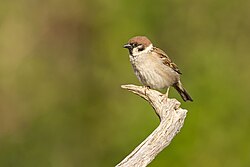
| Eurasian tree sparrow (Passer montanus) | |
Scientific classification 
| |
| Kingdom: | Animalia |
| Phylum: | Chordata |
| Class: | Aves |
| Order: | Passeriformes |
| Suborder: | Passeri |
| Infraorder: | Passerides |
| Parvorder: | Passerida |
| Superfamilies | |
|
See text | |
Passerida are one of four parvorders contained within the infraorder Passerides.
Characteristics
Passerida are omnivorous birds found in East Africa and the Palearctic realm.1 They live in open areas with minimal trees such as Saharas and forest clearings. They are stocky birds between 12 cm (4.7 inches) and 18 cm (7.1 inches). The head and neck are a blackish-gray, and they have a very short beak.1
Systematics and phylogeny
Mostly smallish herbivores, near-global distribution centered on Palearctic and Americas. Often pronounced sexual dimorphism with males among the most colorful birds alive. Songs tend to be fairly simple warbling and chirping, with many species relying as much or more on visual mating displays. Includes the nine-primaried oscines (probably a subclade). The basal radiation is mostly found in the Old World, with only Motacillidae naturally occurring in the Americas and Estrildidae in Australia.
Passerida contains the following families:2
- Modulatricidae: robin-babblers
- Promeropidae: sugarbirds
- Nectariniidae: sunbirds
- Dicaeidae: flowerpeckers
- Chloropseidae: leafbirds
- Irenidae: fairy bluebirds
- Passeridae: true sparrows
- Prunellidae: accentors
- Urocynchramidae: Przewalski's finch. Recently split from Fringillidae; tentatively placed here.
- Ploceoidea
- Estrildidae: estrildid finches (waxbills, munias, etc.)
- Ploceidae: weavers. Certain members of Ploceidae, such as the long-tailed widowbird are well known for their elaborate sexual ornaments.
- Viduidae: indigobirds and whydahs
- Motacillidae: wagtails and pipits
- Peucedramidae: olive warbler
- Fringillidae: true finches. Includes the Hawaiian honeycreepers
- Emberizoidea: New World nine-primaried oscine radiation345
- Icteridae: grackles, New World blackbirds, and New World orioles
- Parulidae: New World warblers
- Icteriidae: yellow-breasted chat
- Phaenicophilidae: Hispaniolan tanagers
- Zeledoniidae: wrenthrush
- Teretistridae: Cuban warblers
- Thraupidae: tanagers and allies
- Mitrospingidae: mitrospingid tanagers and allies
- Rhodinocichlidae: rosy thrush tanager
- Calyptophilidae: chat-tanagers
- Nesospingidae: Puerto Rican tanager
- Spindalidae: spindalises
- Cardinalidae: cardinal-grosbeaks
- Emberizidae: buntings
- Passerellidae: American sparrows
- Calcariidae: snow buntings and longspurs
References
References
- "Passeridae (Old World sparrows)". Animal Diversity Web. Retrieved 2025-09-03.
- Oliveros, C.H.; et al. (2019). "Earth history and the passerine superradiation". Proceedings of the National Academy of Sciences of the United States. 116 (16): 7916–7925. Bibcode:2019PNAS..116.7916O. doi:10.1073/pnas.1813206116. PMC 6475423. PMID 30936315.
- Barker, F. K.; Burns, K. J.; Klicka, J.; Lanyon, S. M.; Lovette, I. J. (2013). "Going to extremes: Contrasting rates of diversification in a recent radiation of New World passerine birds". Systematic Biology. 62 (2): 298–320. doi:10.1093/sysbio/sys094. PMID 23229025.
- Barker, F. K.; Burns, K. J.; Klicka, J.; Lanyon, S. M.; Lovette, I. J. (2015). "New insights into New World biogeography: An integrated view from the phylogeny of blackbirds, cardinals, sparrows, tanagers, warblers, and allies". The Auk. 132 (2): 333–348. doi:10.1642/AUK-14-110.1. S2CID 53058340.
- del Hoyo, J.; Elliott, A.; Sargatal, J.; Christie, D.A.; de Juana, E., eds. (2019). "Passeriformes". Handbook of the Birds of the World Alive. Lynx Edicions, Barcelona. Retrieved 5 January 2019.
- Jønsson, Knud A.; Fjeldså, Jon (2006). "A phylogenetic supertree of oscine passerine birds (Aves: Passeri)". Zool. Scripta. 35 (2): 149–186. doi:10.1111/j.1463-6409.2006.00221.x. S2CID 85317440.
- Harshman, John (2008). Passerida. Version 23 June 2008 (under construction). in The Tree of Life Web Project. Retrieved 24 January 2011.
- Sibley, Charles Gald & Ahlquist, Jon Edward (1990): Phylogeny and classification of birds. Yale University Press, New Haven, Conn.