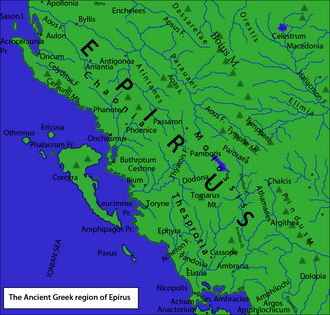
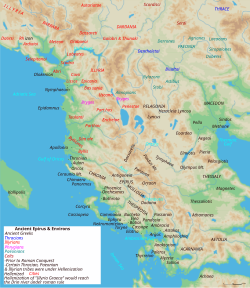
Passaron (Greek: Πασσαρών) was an ancient Greek city of ancient Epirus.1 It was founded by the Molossian king Tharrhypas sometime between 420 and 400 BCE as the capital of the Molossian kingdom.2 As capital, the Molossian kings and the assembled people were accustomed to take mutual oaths, the one to govern according to the laws, the other to defend the kingdom.3 Later, in 330 BCE, it became the capital of the newfound united kingdom of Epirus until 295 BCE, when Pyrrhus of Epirus moved the capital to Amvrakia. The town was taken by the Roman praetor Lucius Anicius Gallus in 167 BCE.4
Its site is located near the modern Rodotopi in the municipal unit of Pasaronas (Greek: Πασαρώνας) in the Ioannina regional unit, in Greece.56
References
References
- Rome's Mediterranean Empire Book 41-45 and the Periochae (Oxford World's Classics) (Books 41-45) by Livy and Jane D. Chaplin, 2007, page 195,"... had been made public, Anicius returned to winter quarters at Passaron in Epirus. 27. ..."
- A. Vlachopoulou Economou, Ancient Passaron, Website of the Archeological Society in Athens
- Plutarch Pyrrh. 5.
- Livy. Ab urbe condita Libri [History of Rome]. Vol. 45.26, 45.33-34.
- Talbert, Richard, ed. (2000). Barrington Atlas of the Greek and Roman World. Princeton University Press. p. 54. ISBN 978-0-691-03169-9, with accompanying Map-by-Map Directory.
- Lund University. Digital Atlas of the Roman Empire.
This article incorporates text from a publication now in the public domain: Smith, William, ed. (1854–1857). "Passaron". Dictionary of Greek and Roman Geography. London: John Murray.
39°42′36″N 20°45′58″E / 39.71013°N 20.76618°E / 39.71013; 20.76618