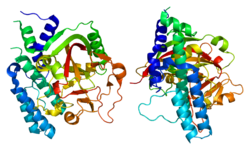
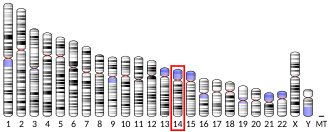






Poly [ADP-ribose] polymerase 2 is an enzyme that in humans is encoded by the PARP2 gene.567 It is one of the PARP family of enzymes.
Function
This gene encodes poly(ADP-ribosyl)transferase-like 2 protein, which contains a catalytic domain and is capable of catalyzing a poly(ADP-ribosyl)ation reaction. This protein has a catalytic domain which is homologous to that of poly (ADP-ribosyl) transferase, but lacks an N-terminal DNA binding domain which activates the C-terminal catalytic domain of poly (ADP-ribosyl) transferase. The basic residues within the N-terminal region of this protein may bear potential DNA-binding properties, and may be involved in the nuclear and/or nucleolar targeting of the protein. Two alternatively spliced transcript variants encoding distinct isoforms have been found.7
In the plant species Arabidopsis thaliana, PARP2 plays more significant roles than PARP1 in protective responses to DNA damage and bacterial pathogenesis.8 The plant PARP2 carries N-terminal SAP DNA binding motifs rather than the Zn-finger DNA binding motifs of plant and animal PARP1 proteins.8
PARP inhibitor drugs
Some PARP inhibitor anti-cancer drugs (primarily aimed at PARP1) also inhibit PARP2, e.g. niraparib.
Interactions
PARP2 has been shown to interact with XRCC1.9
PARP2 also interacts with HPF1.101112
PARP2 binds to and bridges blunt DNA ends.121314
References
References
- GRCh38: Ensembl release 89: ENSG00000129484 – Ensembl, May 2017
- GRCm38: Ensembl release 89: ENSMUSG00000036023 – Ensembl, May 2017
- "Human PubMed Reference:". National Center for Biotechnology Information, U.S. National Library of Medicine.
- "Mouse PubMed Reference:". National Center for Biotechnology Information, U.S. National Library of Medicine.
- Johansson M (May 1999). "A human poly(ADP-ribose) polymerase gene family (ADPRTL): cDNA cloning of two novel poly(ADP-ribose) polymerase homologues". Genomics. 57 (3): 442–5. doi:10.1006/geno.1999.5799. PMID 10329013.
- Yélamos J, Schreiber V, Dantzer F (April 2008). "Toward specific functions of poly(ADP-ribose) polymerase-2". Trends in Molecular Medicine. 14 (4): 169–78. doi:10.1016/j.molmed.2008.02.003. PMID 18353725.
- "Entrez Gene: PARP2 poly (ADP-ribose) polymerase family, member 2".
- Song J, Keppler BD, Wise RR, Bent AF (May 2015). "PARP2 Is the Predominant Poly(ADP-Ribose) Polymerase in Arabidopsis DNA Damage and Immune Responses". PLOS Genetics. 11 (5) e1005200. doi:10.1371/journal.pgen.1005200. PMC 4423837. PMID 25950582.
- Schreiber V, Amé JC, Dollé P, Schultz I, Rinaldi B, Fraulob V, Ménissier-de Murcia J, de Murcia G (June 2002). "Poly(ADP-ribose) polymerase-2 (PARP-2) is required for efficient base excision DNA repair in association with PARP-1 and XRCC1". The Journal of Biological Chemistry. 277 (25): 23028–36. doi:10.1074/jbc.M202390200. PMID 11948190.
- Gibbs-Seymour I, Fontana P, Rack JG, Ahel I (5 May 2016). "HPF1/C4orf27 Is a PARP-1-Interacting Protein that Regulates PARP-1 ADP-Ribosylation Activity". Molecular Cell. 62 (3): 432–442. doi:10.1016/j.molcel.2016.03.008. PMC 4858568. PMID 27067600.
- Suskiewicz MJ, Zobel F, Ogden TE, Fontana P, Ariza A, Yang JC, Zhu K, Bracken L, Hawthorne WJ, Ahel D, Neuhaus D, Ahel I (March 2020). "HPF1 completes the PARP active site for DNA damage-induced ADP-ribosylation". Nature. 579 (7800): 598–602. Bibcode:2020Natur.579..598S. doi:10.1038/s41586-020-2013-6. PMC 7104379. PMID 32028527.
- Gaullier G, Roberts G, Muthurajan UM, Bowerman S, Rudolph J, Mahadevan J, Jha A, Rae PS, Luger K (3 November 2020). "Bridging of nucleosome-proximal DNA double-strand breaks by PARP2 enhances its interaction with HPF1". PLOS ONE. 15 (11) e0240932. Bibcode:2020PLoSO..1540932G. doi:10.1371/journal.pone.0240932. PMC 7608914. PMID 33141820.
- Obaji E, Haikarainen T, Lehtiö L (14 December 2018). "Structural basis for DNA break recognition by ARTD2/PARP2". Nucleic Acids Research. 46 (22): 12154–12165. doi:10.1093/nar/gky927. PMC 6294510. PMID 30321391.
- Bilokapic S, Suskiewicz MJ, Ahel I, Halic M (September 2020). "Bridging of DNA breaks activates PARP2-HPF1 to modify chromatin". Nature. 585 (7826): 609–613. Bibcode:2020Natur.585..609B. doi:10.1038/s41586-020-2725-7. PMC 7529888. PMID 32939087.
Further reading
Further reading
- Bashford CL, Chance B, Lloyd D, Poole RK (January 1980). "Oscillations of redox states in synchronously dividing cultures of Acanthamoeba castellanii and Schizosaccharomyces pombe". Biophysical Journal. 29 (1): 1–11. Bibcode:1980BpJ....29....1B. doi:10.1016/S0006-3495(80)85114-9. PMC 1328658. PMID 7260241.
- Berghammer H, Ebner M, Marksteiner R, Auer B (April 1999). "pADPRT-2: a novel mammalian polymerizing(ADP-ribosyl)transferase gene related to truncated pADPRT homologues in plants and Caenorhabditis elegans". FEBS Letters. 449 (2–3): 259–63. doi:10.1016/S0014-5793(99)00448-2. PMID 10338144.
- Amé JC, Rolli V, Schreiber V, Niedergang C, Apiou F, Decker P, Muller S, Höger T, Ménissier-de Murcia J, de Murcia G (June 1999). "PARP-2, A novel mammalian DNA damage-dependent poly(ADP-ribose) polymerase". The Journal of Biological Chemistry. 274 (25): 17860–8. doi:10.1074/jbc.274.25.17860. PMID 10364231.
- Still IH, Vince P, Cowell JK (December 1999). "Identification of a novel gene (ADPRTL1) encoding a potential Poly(ADP-ribosyl)transferase protein". Genomics. 62 (3): 533–6. doi:10.1006/geno.1999.6024. PMID 10644454.
- Schreiber V, Amé JC, Dollé P, Schultz I, Rinaldi B, Fraulob V, Ménissier-de Murcia J, de Murcia G (June 2002). "Poly(ADP-ribose) polymerase-2 (PARP-2) is required for efficient base excision DNA repair in association with PARP-1 and XRCC1". The Journal of Biological Chemistry. 277 (25): 23028–36. doi:10.1074/jbc.M202390200. PMID 11948190.
- Saxena A, Wong LH, Kalitsis P, Earle E, Shaffer LG, Choo KH (September 2002). "Poly(ADP-ribose) polymerase 2 localizes to mammalian active centromeres and interacts with PARP-1, Cenpa, Cenpb and Bub3, but not Cenpc". Human Molecular Genetics. 11 (19): 2319–29. doi:10.1093/hmg/11.19.2319. PMID 12217960.
- Malanga M, Althaus FR (February 2004). "Poly(ADP-ribose) reactivates stalled DNA topoisomerase I and Induces DNA strand break resealing". The Journal of Biological Chemistry. 279 (7): 5244–8. doi:10.1074/jbc.C300437200. PMID 14699148.
- Kimura K, Wakamatsu A, Suzuki Y, Ota T, Nishikawa T, Yamashita R, Yamamoto J, Sekine M, Tsuritani K, Wakaguri H, Ishii S, Sugiyama T, Saito K, Isono Y, Irie R, Kushida N, Yoneyama T, Otsuka R, Kanda K, Yokoi T, Kondo H, Wagatsuma M, Murakawa K, Ishida S, Ishibashi T, Takahashi-Fujii A, Tanase T, Nagai K, Kikuchi H, Nakai K, Isogai T, Sugano S (January 2006). "Diversification of transcriptional modulation: large-scale identification and characterization of putative alternative promoters of human genes". Genome Research. 16 (1): 55–65. doi:10.1101/gr.4039406. PMC 1356129. PMID 16344560.
- Maeda Y, Hunter TC, Loudy DE, Davé V, Schreiber V, Whitsett JA (April 2006). "PARP-2 interacts with TTF-1 and regulates expression of surfactant protein-B". The Journal of Biological Chemistry. 281 (14): 9600–6. doi:10.1074/jbc.M510435200. PMID 16461352.
- Chevanne M, Calia C, Zampieri M, Cecchinelli B, Caldini R, Monti D, Bucci L, Franceschi C, Caiafa P (June 2007). "Oxidative DNA damage repair and parp 1 and parp 2 expression in Epstein-Barr virus-immortalized B lymphocyte cells from young subjects, old subjects, and centenarians". Rejuvenation Research. 10 (2): 191–204. doi:10.1089/rej.2006.0514. PMID 17518695.
- Liang YC, Hsu CY, Yao YL, Yang WM (February 2013). "PARP-2 regulates cell cycle-related genes through histone deacetylation and methylation independently of poly(ADP-ribosyl)ation". Biochemical and Biophysical Research Communications. 431 (1): 58–64. doi:10.1016/j.bbrc.2012.12.092. PMID 23291187.
- Song J, Keppler BD, Wise RR, Bent AF (May 2015). "PARP2 Is the Predominant Poly(ADP-Ribose) Polymerase in Arabidopsis DNA Damage and Immune Responses". PLOS Genetics. 11 (5) e1005200. doi:10.1371/journal.pgen.1005200. PMC 4423837. PMID 25950582.
External links
External links
- PARP2 human gene location in the UCSC Genome Browser.
- PARP2 human gene details in the UCSC Genome Browser.