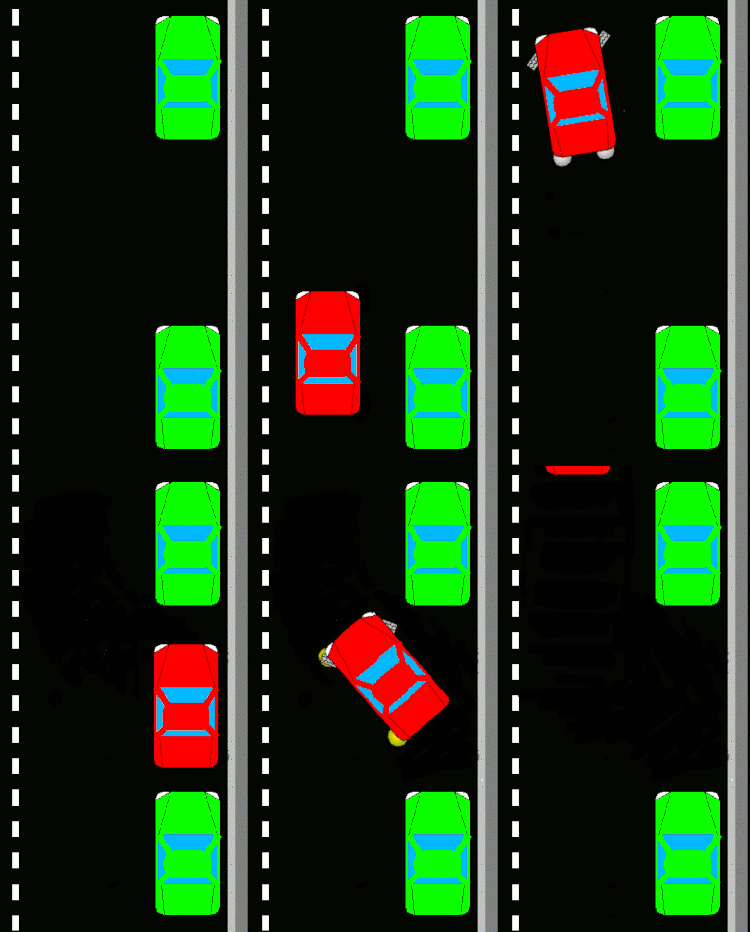
The parallel parking problem is a motion planning problem in control theory and mechanics to determine the path a car must take to parallel park into a parking space. The front wheels of a car are permitted to turn, but the rear wheels must stay aligned. When a car is initially adjacent to a parking space, to move into the space it would need to move in a direction perpendicular to the allowed path of motion of the rear wheels. The admissible motions of the car in its configuration space are an example of a nonholonomic system.
See also
See also
References
References
- Batterman, R (2003), "Falling cats, parallel parking, and polarized light" (PDF), Studies in History and Philosophy of Science Part B: Studies in History and Philosophy of Modern Physics, 34 (4): 527–557, Bibcode:2003SHPMP..34..527B, doi:10.1016/s1355-2198(03)00062-5.
- Reeds, J.A.; Shepp, L.A. (1990), "Optimal paths for a car that goes both forwards and backwards" (PDF), Pacific Journal of Mathematics, 145 (2): 367–393, doi:10.2140/pjm.1990.145.367.