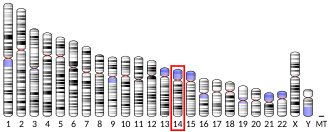
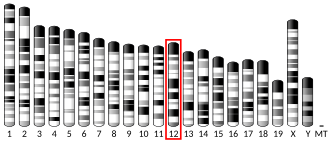
Poly(A) polymerase alpha is an enzyme that in humans is encoded by the PAPOLA gene.567
PAPOLA binds to FIP1L1 (Factor interacting with PAPOLA and CPSF1), a subunit of the cleavage and polyadenylation specificity factor subunit 1 (CPSF1) complex. This complex polyadenylates the 3' end of precursor mRNAs (pre-mRNA) (see CPSF). CPSF1 is an RNA processing protein that binds to uracil-rich sequences in pre-mRNA, binds with and stimulates PAPOLA's Polynucleotide adenylyltransferase activity, and thereby adds adenylyl residues to pre-mRNA. This poly-adenylyl action increases pre mRNA's maturation and movement from the nucleus to cytoplasm while dramatically increasing the stability of the mRNA formed from pre-mRNA: FIP1L1 is a Pre-mRNA 3'-end-processing factor. FIP1L1 gene fusions between it and either the platelet-derived growth factor receptor, alpha (PGDFRA) or Retinoic acid receptor alpha (RARA) genes are causes of certain human diseases associated with pathologically increased levels of blood eosinophils and/or Leukemias.8
References
References
- GRCh38: Ensembl release 89: ENSG00000090060 – Ensembl, May 2017
- GRCm38: Ensembl release 89: ENSMUSG00000021111 – Ensembl, May 2017
- "Human PubMed Reference:". National Center for Biotechnology Information, U.S. National Library of Medicine.
- "Mouse PubMed Reference:". National Center for Biotechnology Information, U.S. National Library of Medicine.
- Thuresson AC, Astrom J, Astrom A, Gronvik KO, Virtanen A (Mar 1994). "Multiple forms of poly(A) polymerases in human cells". Proc Natl Acad Sci U S A. 91 (3): 979–83. Bibcode:1994PNAS...91..979T. doi:10.1073/pnas.91.3.979. PMC 521437. PMID 8302877.
- Yamauchi T, Sugimoto J, Hatakeyama T, Asakawa S, Shimizu N, Isobe M (Sep 1999). "Assignment of the human poly(A) polymerase (PAP) gene to chromosome 14q32.1-q32.2 and isolation of a polymorphic CA repeat sequence". J Hum Genet. 44 (4): 253–5. doi:10.1007/s100380050154. PMID 10429366.
- "Entrez Gene: PAPOLA poly(A) polymerase alpha".
- "FIP1L1 factor interacting with PAPOLA and CPSF1 [Homo sapiens (Human)] - Gene - NCBI".
Further reading
Further reading
- Pendurthi UR, Alok D, Rao LV (1997). "Binding of factor VIIa to tissue factor induces alterations in gene expression in human fibroblast cells: up-regulation of poly(A) polymerase". Proc. Natl. Acad. Sci. U.S.A. 94 (23): 12598–603. Bibcode:1997PNAS...9412598P. doi:10.1073/pnas.94.23.12598. PMC 25051. PMID 9356495.
- Varani L, Gunderson SI, Mattaj IW, et al. (2000). "The NMR structure of the 38 kDa U1A protein - PIE RNA complex reveals the basis of cooperativity in regulation of polyadenylation by human U1A protein". Nat. Struct. Biol. 7 (4): 329–35. doi:10.1038/74101. PMID 10742179. S2CID 13432764.
- Mouland AJ, Coady M, Yao XJ, Cohen EA (2002). "Hypophosphorylation of poly(A) polymerase and increased polyadenylation activity are associated with human immunodeficiency virus type 1 Vpr expression". Virology. 292 (2): 321–30. doi:10.1006/viro.2001.1261. PMID 11878934.
- Strausberg RL, Feingold EA, Grouse LH, et al. (2003). "Generation and initial analysis of more than 15,000 full-length human and mouse cDNA sequences". Proc. Natl. Acad. Sci. U.S.A. 99 (26): 16899–903. Bibcode:2002PNAS...9916899M. doi:10.1073/pnas.242603899. PMC 139241. PMID 12477932.
- Kim H, Lee JH, Lee Y (2003). "Regulation of poly(A) polymerase by 14-3-3epsilon". EMBO J. 22 (19): 5208–19. doi:10.1093/emboj/cdg486. PMC 204469. PMID 14517258.
- Ota T, Suzuki Y, Nishikawa T, et al. (2004). "Complete sequencing and characterization of 21,243 full-length human cDNAs". Nat. Genet. 36 (1): 40–5. doi:10.1038/ng1285. PMID 14702039.
- Bouwmeester T, Bauch A, Ruffner H, et al. (2004). "A physical and functional map of the human TNF-alpha/NF-kappa B signal transduction pathway". Nat. Cell Biol. 6 (2): 97–105. doi:10.1038/ncb1086. PMID 14743216. S2CID 11683986.
- Kaufmann I, Martin G, Friedlein A, et al. (2005). "Human Fip1 is a subunit of CPSF that binds to U-rich RNA elements and stimulates poly(A) polymerase". EMBO J. 23 (3): 616–26. doi:10.1038/sj.emboj.7600070. PMC 1271804. PMID 14749727.
- Dettwiler S, Aringhieri C, Cardinale S, et al. (2005). "Distinct sequence motifs within the 68-kDa subunit of cleavage factor Im mediate RNA binding, protein-protein interactions, and subcellular localization" (PDF). J. Biol. Chem. 279 (34): 35788–97. doi:10.1074/jbc.M403927200. PMID 15169763.
- Colland F, Jacq X, Trouplin V, et al. (2004). "Functional proteomics mapping of a human signaling pathway". Genome Res. 14 (7): 1324–32. doi:10.1101/gr.2334104. PMC 442148. PMID 15231748.
- Beausoleil SA, Jedrychowski M, Schwartz D, et al. (2004). "Large-scale characterization of HeLa cell nuclear phosphoproteins". Proc. Natl. Acad. Sci. U.S.A. 101 (33): 12130–5. Bibcode:2004PNAS..10112130B. doi:10.1073/pnas.0404720101. PMC 514446. PMID 15302935.
- Gerhard DS, Wagner L, Feingold EA, et al. (2004). "The status, quality, and expansion of the NIH full-length cDNA project: the Mammalian Gene Collection (MGC)". Genome Res. 14 (10B): 2121–7. doi:10.1101/gr.2596504. PMC 528928. PMID 15489334.
- Rual JF, Venkatesan K, Hao T, et al. (2005). "Towards a proteome-scale map of the human protein-protein interaction network". Nature. 437 (7062): 1173–8. Bibcode:2005Natur.437.1173R. doi:10.1038/nature04209. PMID 16189514. S2CID 4427026.