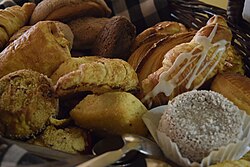
 Pan dulce at a shop in Mexico City | |
| Type | Sweet bread or pastry |
|---|---|
| Place of origin | Mexico |
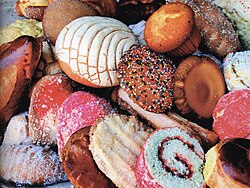
Pan dulce (Latin American Spanish pronunciation: [ˌpan ˈdulse]; lit. 'sweet bread') is the general name for a variety of Mexican baked goods. They are inexpensive treats and are consumed at breakfast, merienda, or dinner. These baked goods oftentimes are created with intent to derive meaning from people, animals, and objects.1 The baked goods originated in Mexico following the introduction of wheat during the Spanish conquest of the Americas and developed into many varieties thanks to French influences in the 19th century.2
Types
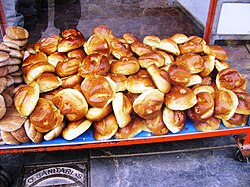
Bread was first introduced in the 1400s by Hernán Cortés and his people. The indigenous people of Mexico accepted this wheat bread even though their bread was considered to be corn tortilla.1 Over the years, the creative contribution of French baked goods to Mexico's cuisine peaked in the early 20th century during the dictatorship of Porfirio Díaz. Skilled Mexican bakers adopted French techniques to create new bread designs with colorful names. Today it is estimated that there are between 500 and 2,000 types of bread currently produced in Mexico. Among these are:
- Alamar
- Almohada
- Antaño
- Barquillo
- Barra para rebanadas
- Beso
- Bicicletas
- Bigote
- Bísquet
- Bocado
- Budín
- Burrita
- Calabaza
- Calvo
- Calzón
- Canasta
- Caracol
- Cemita
- Chafaldrana
- Chamuco
- Chicharrón
- Chilindrina
- Chimistlán
- Chirimoya
- Chirindolfo
- Cocoles
- Colchón
- Concha
- Congal
- Coyota
- Cuerno de mantequilla
- Cuerno de vapor
- Donas
- Doroteo
- Elote
- Empanochada
- Galletas de coco
- Gendarme
- Guarapo
- Gusano
- Gusarapo
- Hojaldra
- Ladrillo
- Manita
- Mexicano
- Moño de danés
- Mundos
- Neblina
- Nopal
- Novia
- Ojo de Pancha
- Oreja
- Pachucos
- Pan catarino
- Pan de caja
- Pan de elote
- Pan de feria
- Pan de muerto
- Pan de pueblo
- Pan de pulque
- Pan de royal
- Pan de yema
- Pan decorado con letras
- Pan en forma de corazón
- Pan en forma de tornillo
- Pan mestizo
- Pan redondo bordado
- Pan redondo o moreliano
- Pan típico de nuez
- Panquecito
- Pechuga
- Piedra
- Polvorón
- Puerquito de piloncillo
- Rebanada
- Regañada
- Reja
- Rehiletes
- Rieles
- Rosca de reyes
- Roscas de canela
- Soles
- Tanas
- Tecoyota
- Trenza
- Yolanda
- Yoyos
Besos
A beso (kiss), from Mexico, is made by creating round domes on the top with a drop filling of jam in the middle.3
Campechanas
Campechanas are rectangular or round glazed Mexican pastries (referred to as hojaldre, Mexican millefeuille). They are crisp, flaky, and have a shiny caramel colored finish. Champechanas are a very common pan dulce.4
Conchas (shells)
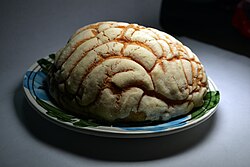
Conchas (shells) are known for their shell-like shape and sugar shell pattern on the top. This is the most common of a genre of bizcocho (egg dough) that is topped with a plethora of toppings elaborated out of sugar crust. Although the classic shape is shell-like, it can also be shaped like a snail and the cookie-dough topping can be stamped to be in the pattern of squares as well. Some are sprinkled with different types of sugar or sesame. Each shape and presentation has a different name; there are dozens. Classic colors are chocolate, vanilla, egg, or pink, but they can be made in any food color available. The dough is traditionally flavored with vanilla or orange blossom (flor de azahar), and can be mixed with anise seeds or cinnamon. Other names include arracadas, potosinas, and novias. The concha is a Mexican creation from the 19th century. It is not related to Japanese melon pan or Hong Kong pineapple buns, but is visually similar. This is one of the most famous Mexican pastries and widely recognized in the United States. It is also referred to as "pan de huevo" (egg bread) in other Latin American countries, such as Chile, where they are eaten during tea time or at the beach.5 They are known as cemitas in Honduras, and as bizcochos in Spain.
Cuernos (horns)
Cuernos (horns) are a Mexican pastry that is known for their horn-like shape. This pastry has garnered many comparisons to the French croissant.6
Empanadas (turnovers)
Empanadas are a turnover more commonly served in Cuba and South America but also have a place in Mexican cuisine. They are filled with meat or other ingredients such as cheese or vegetables of different sorts. They are also filled with fruit such as pumpkin or apple.7
Marianas
Marianas are small vanilla sponge cakes that are coated with raspberry jam and coconut along the outside. The top part of Marianas are usually filled with icing or fruit filling.8
Marranitos / cochinitos / puerquitos (little pigs)

Marranitos/cochinitos/puerquitos (little pigs) are pig-shaped pastries sweetened with piloncillo and spiced with cinnamon. The bread has erroneously been called "gingerbread pig" because the finished result looks similar to gingerbread. However, ginger isn't used to make the pastry.9
Orejas (ears)
Orejas (ears) are flaky and sweet Mexican pastries that are shaped like an ear and are very common at bakeries.10 They are very similar to a French Palmier.
Piedras (rocks or stones)
Piedras (rocks or stones) is a pastry made of old bread and is known to be as hard as a rock. Many people eat this with very hot drinks.11
Polvorones (wedding cookies)

Polvorones (wedding cookies) are shortbread cookies, often eaten at weddings It's fairly simple to make and can come in a variety of colors such as pink.12
Yoyos (yo-yos)
Yoyos (yo-yos) are a Mexican pastry named after the yo-yo toy, and is shaped exactly like it, but does not have the string. It has a filling which usually consists of raspberry jam.13
Religious and seasonal pastries
With the invention of pan dulce in Mexico, other significant breads were produced to celebrate special occasions and traditions, such as rosca de reyes and pan de muerto. These special breads are part of the traditional customs that have been around for centuries. The stories behind these special occasional breads derive from religious beliefs, the dominant being Roman Catholic.
Rosca de reyes

Rosca de reyes ("kings' crown") is a treat in addition to a gift that is given on Three Kings Day, Dia de los Reyes Magos, which is held twelve days after Christmas (January 6), the celebration date of the birth of Jesus Christ. This bread is symbolic in many ways, the most illustrative being its round shape which signifies the crown of the Magi. Baked inside is a small white plastic or ceramic figurine which represents the baby Jesus. The hidden baby Jesus symbolizes the secrecy of the location of Jesus as a child. The ruler of Jerusalem, King Herod, upon learning about the birth of the prophesied King of the Jews, ordered that all male infants be killed so that he could keep his crown. Whoever cuts a slice and finds the small figurine is obligated to host a party for the celebration of the Dia de la Candelaria – Fiesta de la Candelaria – which occurs on February 2.1415
Pan de muerto

Pan de muerto ('bread of the dead') is a special bread that is consumed and offered as a part of the Día de Muertos celebration in October and November. Day of the Dead is a lively and communal commemoration of the dead. The bread was introduced in 1519, after the Spanish had conflicting thoughts about Mexican practices of human sacrifices to their gods. Therefore, the Spanish had designed a bread that was heart shaped that was topped with red sugar. There are over 800 various types of pan de muerto that are made for día de los muertos.16 The bread takes many different shapes, from skulls to animals to crosses and mummies. The traditional pan de muerto is shaped like a skull, round, with a little ball at the center top to represent a cranium. Its shape signifies the human cycle of life and death. Following are the four bones to symbolize the four courses of the universe16. They are placed on the ofrenda as an offering to the loved ones who have passed on.1718 One key ingredient used to make this type of bread is azahar, which is an orange blossom. Its unique flavor and smell is meant to signify the loved ones who have passed on. However, not all pan de muerto contains orange blossom, it all varies and depends on the recipe used.16 Pan de muerto consists of ingredients such as dry yeast, all purpose flour, eggs, butter and salt.19
Cultural significance
Pan dulce is considered to be a Mexican cuisine. Other countries in Latin America and even Europe have adapted some of Mexico's pastries, but it is in Mexico that the creative new shapes originate. Today, pan dulce is seen in many parts of the United States, especially in places like California, Arizona, and Texas, as a result of migration.
Mexico
In Mexico, pan dulce is typically consumed at breakfast or evening supper. It is usually accompanied by hot chocolate, milk (often warm), or coffee, and is dipped into the drink for a different taste. It can also be eaten alone. Pan dulce has become an important staple in the lives of Mexicans, it's a way in which people not only eat, but bond together with family. Pan dulce or bread in general is always present in very important events and celebration of the people from Mexico, it has ultimately become a necessity.1
United States
Pan dulce can be found in Mexican markets or panaderias (bakeries) in many U.S. states. Though pan dulce may not be consumed as frequently, it is commonly consumed in Hispanic or Latino homes. While Americans don't usually partake in celebrations or events related to these various types pan dulce, they are still enjoyed from everyone.1 However, many Americans do take time to buy these pastries or even try to make them from the comfort of their own homes. 20
See also
See also
References
References
- GONZALEZ, A. M. (1986). "el Pan De Cada Dia": The Symbols And Expressive Culture Of Wheat Bread In Greater Mexico (panaderos Ritual, Meaning) (Order No. 8700195).
- "Pan dulce". Taste Atlas. Retrieved April 13, 2024.
- Popik, Barry. "Besos (Mexican pastry "kisses")". barrypopik.com. Archived from the original on 26 March 2016. Retrieved 6 March 2017.
- Popik, Barry. "Campechanas". barrypopik.com. Archived from the original on 25 April 2016. Retrieved 6 March 2017.
- Popik, Barry. "Conchas (Mexican shell-shaped pastries)". barrypopik.com. Archived from the original on 26 March 2016. Retrieved 6 March 2017.
- Popik, Barry. "Cuernos (Mexican horn-shaped pastries)". barrypopik.com. Archived from the original on 12 November 2016. Retrieved 6 March 2017.
- Popik, Barry. "Empanada". barrypopik.com. Archived from the original on 26 March 2016. Retrieved 6 March 2017.
- Popik, Barry (12 December 2008). "Yoyos or Yo-Yos (Mexican Pastries)". Archived from the original on 2 December 2018. Retrieved 2 December 2018.
- Popik, Barry. "Marranitos or Cochinitos or Puerquitos (little gingerbread pigs)". barrypopik.com. Archived from the original on 26 March 2016. Retrieved 6 March 2017.
- Popik, Barry. "Orejas (Mexican pastry "ears")". barrypopik.com. Archived from the original on 31 August 2017. Retrieved 6 March 2017.
- Popik, Barry. "Piedras (Mexican pastry "rocks" or "stones")". barrypopik.com. Archived from the original on 26 March 2016. Retrieved 6 March 2017.
- Popik, Barry. "Pan de Polvo or Polvoron/Polvorones (Mexican Wedding Cookies)". barrypopik.com. Archived from the original on 4 September 2017. Retrieved 6 March 2017.
- Popik, Barry. "Yoyos or Yo-Yos (Mexican pastries)". barrypopik.com. Archived from the original on 26 March 2016. Retrieved 6 March 2017.
- "Three King's Day - January 6th - The Story of Los Tres Reyes Magos". mexonline.com. Archived from the original on 29 May 2021. Retrieved 6 March 2017.
- Gema Candelas Peña (1 January 2011). "El Regalo del Roscón de Reyes" [The Gift of the Kings' Crown]. Boletín de Interpretación (in Spanish) (25). Archived from the original on 6 March 2017. Retrieved 6 March 2017.
- Quintanar, Luna, Rivera, Tania Irais Gonzáles, Víctor Issaí Naranjo, Nayeli Vélez (2024). "Elaboración de pan de muerto Preparation of Bread of the Dead". Boletín Científico de las Ciencias Económico Administrativas de ICEA (13): 71–73 – via ProQuest.
{{cite journal}}: CS1 maint: multiple names: authors list (link) - "Historia del Pan de Muerto". Sabor a México (in Spanish). 31 October 2012. Archived from the original on 10 February 2015.
- "Pan de Muertos (Mexican Bread of the Dead) Recipe". allrecipes.com. Retrieved 6 March 2017.
- Andrade, Mary J (2000). Through the Eyes of the Soul, Day of the Dead in Mexico. Hong Kong: La Oferta Review Newspaper, Inc. pp. 107. ISBN 0966587626.
- Holtz, Susan (2014-04-18). "Free Pan Dulce Recipe Courtesy of Chef Susan (Illustrated Version)..." Baking and Cake Art Academy. Retrieved 2026-05-06.
Further reading
Further reading
- Greenleigh, John; Beimler, Rosalind Rosoff (1 January 1991). The Days of the Dead: Mexico's Festival of Communion with the Departed. Pomegranate. ISBN 9780764906190. Retrieved 6 March 2017 – via Google Books.
- Herrera-Sobek, María (1 January 2012). Celebrating Latino Folklore: An Encyclopedia of Cultural Traditions. ABC-CLIO. ISBN 9780313343391. Retrieved 6 March 2017 – via Google Books.
- Roldán, Aurora (30 November 2004). 50 Recetas de Pan Dulce, Turrones Y Confituras [50 Recipes of Sweet Breads, Turrones and Confectioneries] (in Spanish). Grulla. ISBN 9789875202689. Retrieved 6 March 2017 – via Google Books.