| Pagea Temporal range:
| |
|---|---|
| |
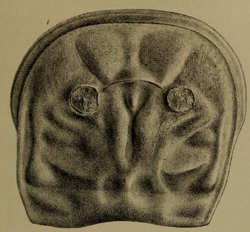
| Carapace of Pagea symondsii. | |
Scientific classification 
| |
| Kingdom: | Animalia |
| Phylum: | Arthropoda |
| Subphylum: | Chelicerata |
| Order: | †Eurypterida |
| Superfamily: | †Stylonuroidea |
| Family: | †Stylonuridae |
| Genus: | †Pagea Waterston, 1962 |
| Type species | |
| Pagea sturrocki (Waterston, 1962)
| |
| Other species | |
| |
| Synonyms | |
| |
Pagea is a genus of prehistoric eurypterid classified as part of the family Stylonuridae. It contains three species, all from the Devonian (Lochkovian to Pragian);1 P. plotnicki from Nunavut, Canada and P. sturrocki and P. symondsii from the Old Red Sandstone of the United Kingdom.2 The genus is named in honor of David Page, an early worker on the fauna of the Old Red Sandstone and describer of the first Stylonurine eurypterid.3
Description
Pagea was a large stylonurid eurypterid. The third and fourth prosomal appendages bore double rows of flat spines. The prosoma was subrectangularly shaped, with the eyes located on the anterior half.3
The metastoma was narrow in relation to the width of the prosoma, being half as wide as it was long. The telson was styliform, long and keeled.3
Synonyms
Leiopterella tetliei, a small eurypterid known only from the single specimen CMN 53573 from the Early Devonian of Nunavut, Canada,4 was synonymized with Pagea by Lamdell (2025).5 Leiopterella was originally described in 2010 as a rhenopterid, though the features claimed in the original description were later determined to not actually be visible in the fossil.5 Lamsdell found no distinguishing characteristics between L. tetliei and the co-occurring Pagea plotnicki, and concluded that Leiopterella merely represented a juvenile individual of that species.5
References
References
- Lamsdell, James C.; Braddy, Simon J. (2010-04-23). "Cope's Rule and Romer's theory: patterns of diversity and gigantism in eurypterids and Palaeozoic vertebrates". Biology Letters. 6 (2): 265–269. doi:10.1098/rsbl.2009.0700. ISSN 1744-9561. PMC 2865068. PMID 19828493.
- Dunlop, J. A., Penney, D. & Jekel, D. 2015. A summary list of fossil spiders and their relatives. In World Spider Catalog. Natural History Museum Bern, online at http://wsc.nmbe.ch, version 16.0 http://www.wsc.nmbe.ch/resources/fossils/Fossils16.0.pdf (PDF).
- "Pagea sturrocki gen. et sp. nov., a new eurypterid from the Old Red Sandstone of Scotland | The Palaeontological Association". www.palass.org. Retrieved 2017-12-27.
- Lamsdell, James C.; Braddy, Simon J.; Loeffler, Elizabeth J.; Dineley, David L. (2010-10-27). "Early Devonian stylonurine eurypterids from Arctic Canada". Canadian Journal of Earth Sciences. 47 (11): 1405–1415. Bibcode:2010CaJES..47.1405J. doi:10.1139/E10-053. ISSN 0008-4077.
- Lamsdell, James C. (2025). "Codex Eurypterida: A Revised Taxonomy Based on Concordant Parsimony and Bayesian Phylogenetic Analyses". Bulletin of the American Museum of Natural History. 2025 (473): 63–64. doi:10.1206/0003-0090.473.1.1.