| Pachystruthio Temporal range:
| |
|---|---|
| |
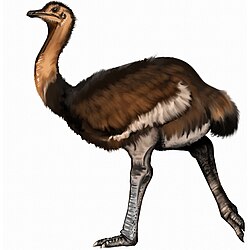
| Restoration of a male P. dmanisensis | |
Scientific classification 
| |
| Kingdom: | Animalia |
| Phylum: | Chordata |
| Class: | Aves |
| Infraclass: | Palaeognathae |
| Order: | Struthioniformes |
| Family: | Struthionidae |
| Genus: | †Pachystruthio (Kretzoi, 1954) |
| Type species | |
| †Pachystruthio pannonicus (Kretzoi, 1954)
| |
| Other species | |
| |
| Synonyms | |
| |
Pachystruthio is an extinct genus of large flightless birds which lived in Eurasia from the Pliocene to the Middle Pleistocene.12 Its fossils have been found in Hungary, Greece3, Crimea, Georgia, and China.4 Pachystruthio was related to living ostriches, being a sister group of the genus Struthio, the genus of living and extinct species of ostriches. One of the species, P. dmanisensis, has been estimated as standing 3.5 metres (11 ft) tall and weighing around 450 kg (990 lb), making it much larger than the modern ostrich and one of the largest known birds.15
Taxonomy
The genus contains three species: P. pannonicus (the type species), P. dmanisensis, and P. transcaucasicus, which were all formerly placed with the ostrich genus, Struthio. Pachystruthio itself was formerly a subgenus of Struthio.14
Zelenkov et al. state that P. dmanisensis and P. pannonicus may represent one species.1
Éric Buffetaut proposed placing the large (albeit smaller than P. dmanisensis) extinct ostrich species Struthio anderssoni from the Late Pleistocene of China in the genus.6
Zelenkov et al. suggested that Struthio karatheodoris may also belong to this genus.1
Although P. dmanisensis is known as the giant ostrich, its relationship to the extant ostriches of the genus Struthio is not clear.17
Description
General characteristics
Pachystruthio were huge, flightless birds, having larger bones and eggs than those of living ostriches.891 Notably, they had a very robust femur, differentiating them from other fossil ostriches, which have a lower "stoutness index" (ratio between total length and minimum shaft width of the femur). Due to lack of available material, it is difficult to reconstruct the general proportions.4
P. dmanisensis
The femur of various specimens from P. dmanisensis measure from 380 – 405 mm in length and a have minimum shaft circumference of 220 – 240 mm, notably more robust than those of extant ostriches and other species within Struthio. The latter value can be used to calculate body weight, yielding values of 382 – 472 kg depending on the specimen.43 Other weight estimates for this species from the femur have been 453 and 462 kg, using different formulas.1 Height for this species has been estimated at 3.5 metres (11 ft),7 comparable in height to other extinct ratites like Aepyornis and Dinornis. P. dmanisensis is the largest known bird of the northern hemisphere.2
Pachystruthio indet.
An incomplete femur from the Nihewan Formation (China) early Pleistocene in age has been assigned to Pachystruthio indet. and has smaller measurements than P. dmanisensis, with a length of 340 mm and minimum shaft circumference of 199 mm, which gives it a weight estimate of 300 kg. This femur is still larger that those of modern ostriches and extinct species Struthio anderssoni, which based on the femur was 269 kg.4
P. pannonicus
This species was described based on a "remarkably large and morphologically distinct" pedal phalanx.1 The estimated egg size from eggshells assigned to P. pannonicus measures 22 x 18 cm in length and width and an estimated weight of 4.25 kg.8 Eggshells associated with P. pannonicus are also much thicker than those of modern ostriches (2.6 – 3.4 mm).1 The (estimated) egg of P. pannonicus is one of the largest eggs from its order, although surpassed in thickness by those of some possibly related oogenera, such as Diamatornis, Namornis, and Psammornis.8 Zelenkov et al. state that P. dmanisensis and P. pannonicus are "similarly sized taxa", although based on different skeletal elements making direct comparison impossible.1
P. transcaucasicus
P. transcaucasicus was described based on a pelvis from the late Pliocene.1 This species has also been associated with thick eggshell fragments (2.9–3.3 mm)8 Mikhailov and Zelenkov note eggshells known from the late Miocene to early Pleistocene in the eastern part of Kazakhstan, being 2.5–3.0 mm or even up to 3.5 mm in thickness may also belong to P. transcaucasicus primarily due to its age, thickness, and geographical occurrence. They considered this the most eastern known range of Pachystruthio (before the description of the Nihewan femur).2 P. transcaucasicus has been described as larger than Struthio wimani, and Struthio karatheodoris based on its larger pelvis,9 and is also larger than Struthio brachydactylus and Struthio camelus (the extant common ostrich).10
Geologic age
While Pachystruthio is well established as a late Pliocene – early Pleistocene taxa, it may have earlier origins, with some authors suggesting that "the evolutionary lineage of these giant early Pleistocene birds can probably be traced back to the early Pliocene and even Miocene of Anatolia."1

Paleobiology
Size
Some authors have proposed that larger body weight may have been an adaptation for tougher, low-nutrition food of arid environments, noting increased body weight in Dromornithidae has been related to increased aridity of Australia. This connection is also present in Eogruidae and has been proposed for Struthio anderssoni, whose large body weight may be explained by an increase in aridity in Inner Asia during cold climatic phases.1 This hypothesis is contested, as Buffetaut and Angst note that in China where Pachystruthio lived was not especially arid. Additionally, Struthio anderssoni, although large, was smaller than Pachystruthio despite that it apparently lived under a more arid climate, and living ostriches that are also smaller lived and used to live in arid environments.4
Locomotion
The robust femur of P. dmanisensis, compared to those more slender of other Pleistocene ostriches such as Struthio oldawayi, may indicate it was less adapted for fast running.3 Similarly, Zelenkov et al. proposed Pachystruthio may not be as good a runner as modern ostriches due to its weight.4 However, it has also been suggested that P. dmanisensis was a better runner than the giant species of Aepyornithidae which possessed an even more robust femur.1 This probably applies to the Nihewan ostrich (P. indet.) as well.4
Interactions with humans and predation
Buffetaut and Angst note that whether early hominins of the Nihewan Basin hunted Pachystruthio giant ostriches is uncertain, but a bird twice the weight of the living ostrich could not have been easy prey, although egg collecting may have been less hazardous.4 Other authors note that these large birds might have been a source of meat, bones, feathers, and eggshell for early hominin populations. 1
Zelenkov et al. state that in contrast to other giant birds, Pachystruthio lived with a variety of highly specialized large carnivorous mammals, such as the giant cheetah (Actionyx pardinensis), giant hyenas (Pachycrocuta brevirostris), and saber-toothed cats (Homotherium spp., Megantereon spp.). Being less adapted for running than recent ostriches, Pachystruthio may have been more susceptible to attacks from large carnivorans,3 though due to their large size, adult individuals of Pachystruthio were less vulnerable than young individuals and smaller Struthio ostriches.1
Extinction
According to Widrig and Field, one theory on the extinction of Eurasian ostriches is that their decline was at least partly linked to climatic cooling during the Cenozoic. However, fossil eggshells indicating the possible presence of ostriches in Mongolia well into the Holocene would seem to contradict this explanation, and a stronger explanation for their disappearance is needed.11
References
References
- Zelenkov, N. V.; Lavrov, A. V.; Startsev, D. B.; Vislobokova, I. A.; Lopatin, A. V. (2019). "A giant early Pleistocene bird from eastern Europe: unexpected component of terrestrial faunas at the time of early Homo arrival". Journal of Vertebrate Paleontology. 39 (2) e1605521. Bibcode:2019JVPal..39E5521Z. doi:10.1080/02724634.2019.1605521. S2CID 198384367.
- Mikhailov, Konstantin E.; Zelenkov, Nikita (September 2020). "The late Cenozoic history of the ostriches (Aves: Struthionidae), as revealed by fossil eggshell and bone remains". Earth-Science Reviews. 208 103270. Bibcode:2020ESRv..20803270M. doi:10.1016/j.earscirev.2020.103270.
- Kostopoulos, Dimitris S.; Konidaris, George E.; Amanatidou, Marina; Chitoglou, Krystalia; Fragkioudakis, Emmanouil; Gerakakis, Nikolaos; Giannakou, Vasiliki; Gkeme, Anastasia; Kalaitzi, Christina; Tsakalidis, Christos; Tsatsalis, Vaggelis (March 2023). "The new fossil site Krimni-3 in Mygdonia Basin and the first evidence of a giant ostrich in the Early Pleistocene of Greece". PalZ. 97 (1): 147–161. Bibcode:2023PalZ...97..147K. doi:10.1007/s12542-022-00632-8. ISSN 0031-0220. S2CID 252750662.
- Buffetaut, Eric; Angst, Delphine (2021). "A Giant Ostrich from the Lower Pleistocene Nihewan Formation of North China, with a Review of the Fossil Ostriches of China". Diversity. 13 (2): 47. Bibcode:2021Diver..13...47B. doi:10.3390/d13020047. hdl:1983/0d3c1bba-d496-47b6-a61c-e141a472612a.
- "Giant bird nearly as heavy as a polar bear lorded it over Pleistocene Europe". Nature. 571 (7763): 8. July 2019. doi:10.1038/d41586-019-01996-9. ISSN 0028-0836.
- Buffetaut, Eric (2023-02-13). "The Missing Late Pleistocene Ostrich Femur from Zhoukoudian (China): New Information Provided by a Rediscovered Old Cast". Diversity. 15 (2): 265. Bibcode:2023Diver..15..265B. doi:10.3390/d15020265. ISSN 1424-2818.
- McRae, Mike (27 June 2019). "Giant 11-Foot Bird Discovered in Europe Would Have Weighed Almost Half a Tonne". ScienceAlert. Retrieved 2019-06-27.
- Sánchez-Marco, Antonio; Amiot, Romain; Angst, Delphine; Bailon, Salvador; Betancort, Juan Francisco; Buffetaut, Eric; García-Castellano, Emma; Guillén-Vargas, Lourdes; Lazzerini, Nicolas; Lécuyer, Christophe; Lomoschitz, Alejandro; López-Jurado, Luis Felipe; Luján, Àngel H.; Perera-Betancort, María Antonia; Salesa, Manuel J. (2025-08-27). "Unraveling the Strange Case of the First Canarian Land Fauna (Lower Pliocene)". Fossil Studies. 3 (3): Supplementary table 1. doi:10.3390/fossils3030013. hdl:10261/399033. ISSN 2813-6284.
- Louchart, Antoine; Bibi, Faysal; Stewart, John R. (2022), Bibi, Faysal; Kraatz, Brian; Beech, Mark J.; Hill, Andrew (eds.), "Birds from the Baynunah Formation", Sands of Time, Cham: Springer International Publishing, pp. 125–139, doi:10.1007/978-3-030-83883-6_9, ISBN 978-3-030-83882-9, retrieved 2026-06-06
{{citation}}: CS1 maint: work parameter with ISBN (link) - Boev, Zlatozar; Spassov, Nikolaï (September 2009). "First record of ostriches (Aves, Struthioniformes, Struthionidae) from the late Miocene of Bulgaria with taxonomic and zoogeographic discussion". Geodiversitas. 31 (3): 493–507. Bibcode:2009Geodv..31..493B. doi:10.5252/g2009n3a1. ISSN 1280-9659.
- Widrig, Klara; Field, Daniel J. (2022-02-01). "The Evolution and Fossil Record of Palaeognathous Birds (Neornithes: Palaeognathae)". Diversity. 14 (2): 105. Bibcode:2022Diver..14..105W. doi:10.3390/d14020105. ISSN 1424-2818.
This article incorporates text from a free content work. Licensed under CC BY 4.0. Text taken from The Evolution and Fossil Record of Palaeognathous Birds (Neornithes: Palaeognathae), Klara Widrig, Daniel J. Field, MDPI.
Further reading
Further reading
- Burchak-Abramovich, N.; Vekua, A. (1990). "The fossil ostrich Struthio dmanisensis sp. n., from the Lower Pleistocene of Georgia" (PDF). Acta Zoologica Cracoviensia. 33 (7): 121–132.
- Hitchcock, Don (2010). "The Dmanisi Site". Retrieved 16 February 2011.
- Zicha, Ondrej (1999). "Struthio orlovi". Biological Library. Retrieved 2 February 2010.