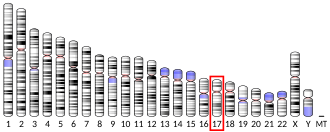



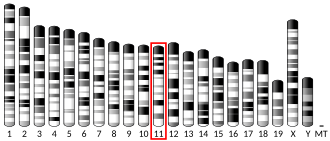

P2X purinoceptor 5 is a protein in humans that is encoded by the P2RX5 gene.56
The product of this gene belongs to the family of purinoceptors for ATP. This receptor functions as a ligand-gated ion channel. Several characteristic motifs of ATP-gated channels are present in its primary structure, but, unlike other members of the purinoceptors family, this receptor has only a single transmembrane domain. Four transcript variants encoding distinct isoforms have been identified for this gene.6
References
References
- GRCh38: Ensembl release 89: ENSG00000083454 – Ensembl, May 2017
- GRCm38: Ensembl release 89: ENSMUSG00000005950 – Ensembl, May 2017
- "Human PubMed Reference:". National Center for Biotechnology Information, U.S. National Library of Medicine.
- "Mouse PubMed Reference:". National Center for Biotechnology Information, U.S. National Library of Medicine.
- Le KT, Paquet M, Nouel D, Babinski K, Seguela P (Jan 1998). "Primary structure and expression of a naturally truncated human P2X ATP receptor subunit from brain and immune system". FEBS Lett. 418 (1–2): 195–9. doi:10.1016/S0014-5793(97)01380-X. PMID 9414125. S2CID 42070561.
- "Entrez Gene: P2RX5 purinergic receptor P2X, ligand-gated ion channel, 5".
Further reading
Further reading
- North RA (2002). "Molecular physiology of P2X receptors". Physiol. Rev. 82 (4): 1013–67. doi:10.1152/physrev.00015.2002. PMID 12270951.
- Andersson B, Wentland MA, Ricafrente JY, et al. (1996). "A "double adaptor" method for improved shotgun library construction". Anal. Biochem. 236 (1): 107–13. doi:10.1006/abio.1996.0138. PMID 8619474.
- Yu W, Andersson B, Worley KC, et al. (1997). "Large-scale concatenation cDNA sequencing". Genome Res. 7 (4): 353–8. doi:10.1101/gr.7.4.353. PMC 139146. PMID 9110174.
- Touchman JW, Anikster Y, Dietrich NL, et al. (2000). "The genomic region encompassing the nephropathic cystinosis gene (CTNS): complete sequencing of a 200-kb segment and discovery of a novel gene within the common cystinosis-causing deletion". Genome Res. 10 (2): 165–73. doi:10.1101/gr.10.2.165. PMC 310836. PMID 10673275.
- Strausberg RL, Feingold EA, Grouse LH, et al. (2003). "Generation and initial analysis of more than 15,000 full-length human and mouse cDNA sequences". Proc. Natl. Acad. Sci. U.S.A. 99 (26): 16899–903. Bibcode:2002PNAS...9916899M. doi:10.1073/pnas.242603899. PMC 139241. PMID 12477932.
- Gevaert K, Goethals M, Martens L, et al. (2004). "Exploring proteomes and analyzing protein processing by mass spectrometric identification of sorted N-terminal peptides". Nat. Biotechnol. 21 (5): 566–9. doi:10.1038/nbt810. PMID 12665801. S2CID 23783563.
- Greig AV, Linge C, Terenghi G, et al. (2003). "Purinergic receptors are part of a functional signaling system for proliferation and differentiation of human epidermal keratinocytes". J. Invest. Dermatol. 120 (6): 1007–15. doi:10.1046/j.1523-1747.2003.12261.x. PMID 12787128.
- Greig AV, Linge C, Healy V, et al. (2003). "Expression of purinergic receptors in non-melanoma skin cancers and their functional roles in A431 cells". J. Invest. Dermatol. 121 (2): 315–27. doi:10.1046/j.1523-1747.2003.12379.x. PMID 12880424.
- Ota T, Suzuki Y, Nishikawa T, et al. (2004). "Complete sequencing and characterization of 21,243 full-length human cDNAs". Nat. Genet. 36 (1): 40–5. doi:10.1038/ng1285. PMID 14702039.
- de Rijke B, van Horssen-Zoetbrood A, Beekman JM, et al. (2006). "A frameshift polymorphism in P2X5 elicits an allogeneic cytotoxic T lymphocyte response associated with remission of chronic myeloid leukemia". J. Clin. Invest. 115 (12): 3506–16. doi:10.1172/JCI24832. PMC 1297240. PMID 16322791.
- Metcalfe MJ, Baker DM, Burnstock G (2007). "Purinoceptor expression on keratinocytes reflects their function on the epidermis during chronic venous insufficiency". Arch. Dermatol. Res. 298 (6): 301–7. doi:10.1007/s00403-006-0693-x. PMID 16967306. S2CID 11545279.
- Duckwitz W, Hausmann R, Aschrafi A, Schmalzing G (2007). "P2X5 subunit assembly requires scaffolding by the second transmembrane domain and a conserved aspartate". J. Biol. Chem. 281 (51): 39561–72. doi:10.1074/jbc.M606113200. hdl:2066/130384. PMID 17001079.
External links
External links
- P2RX5+protein,+human at the U.S. National Library of Medicine Medical Subject Headings (MeSH)
This article incorporates text from the United States National Library of Medicine, which is in the public domain.