| Oraristrix Temporal range:
| |
|---|---|
| |
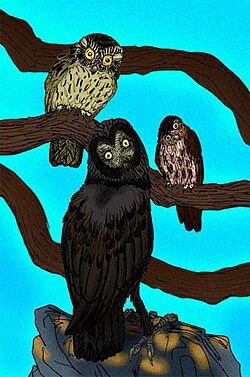
| Comparison of O. brea (center), and other extinct owls | |
Scientific classification 
| |
| Kingdom: | Animalia |
| Phylum: | Chordata |
| Class: | Aves |
| Order: | Strigiformes |
| Family: | Strigidae |
| Genus: | †Oraristrix Campbell & Bocheński, 2010 |
| Species: | †O. brea
|
| Binomial name | |
| †Oraristrix brea (Howard, 1933)
| |
| Synonyms | |
|
Strix brea Howard, 1933 | |
Oraristrix brea, the La Brea owl, is an extinct owl reported from the Upper Pleistocene asphalt deposits of the La Brea Tar Pits in Los Angeles, California. It was first described in 1933 by Hildegarde Howard as Strix brea, but this extinct owl was recently placed into its own genus by Campbell and Bocheński (2010). The La Brea owl has also been found in the Upper Pleistocene asphalt deposits of Carpinteria, California. Oraristrix brea is interpreted as more terrestrial in habits than forest owls because, compared to North American species of Bubo and Strix, it had longer legs relative to its wingspan.
See also
See also
- Glaucidium kurochkini, a pygmy owl also known from the La Brea Tar Pits
- Asphaltoglaux, another owl from the La Brea Tar Pits, this one being more closely related to owls of the genus Aegolius
References
References
- Kenneth E. Campbell, Jr. & Zbigniew M. Bocheński (2010). "A new genus for the extinct Late Pleistocene owl Strix brea Howard (Aves: Strigiformes) from Rancho La Brea, California" (PDF). Records of the Australian Museum. 62 (1): 123–144. doi:10.3853/j.0067-1975.62.2010.1534.
- Hildegarde Howard (1933). "A new species of owl from the Pleistocene of Rancho La Brea, California". The Condor. 35 (2): 66–69. doi:10.2307/1363650. JSTOR 1363650.