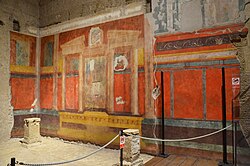
Oecus is the Latinized form of Greek oikos, used by Vitruvius for the principal hall or salon in a Roman house, which was used occasionally as a triclinium for banquets.1
When of great size it became necessary to support its ceiling with columns; thus, according to Vitruvius, the tetrastyle oecus had four columns; in the Corinthian oecus there was a row of columns on each side, virtually therefore dividing the room into nave and aisles, the former being covered over with a barrel vault. The Egyptian oecus had a similar plan, but the aisles were of less height, so that clerestory windows were introduced to light the room, which, as Vitruvius states, presents more the appearance of a basilica than of a triclinium.1
Vitruvius distinguishes four types of oecus:
- Tetrastylos: with four columns;
- Corinthian: with a row of columns supporting an architrave topped with a cornice and a vaulted ceiling;
- Egyptian: particularly magnificent form of the oecus, with columns running all around, which support a gallery also provided with columns;
- Cycicene (κυζίκηνοι from Cyzicus, an ancient city in Mysia): a very spacious, north-facing garden oecus common among the Greeks.
References
References
- One or more of the preceding sentences incorporates text from a publication now in the public domain: Chisholm, Hugh, ed. (1911). "Oecus". Encyclopædia Britannica. Vol. 20 (11th ed.). Cambridge University Press. p. 12.