| Notosacantha | |
|---|---|
| |
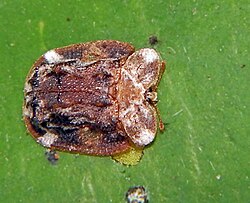
| An unidentified Indian species | |
Scientific classification 
| |
| Kingdom: | Animalia |
| Phylum: | Arthropoda |
| Clade: | Pancrustacea |
| Class: | Insecta |
| Order: | Coleoptera |
| Suborder: | Polyphaga |
| Infraorder: | Cucujiformia |
| Family: | Chrysomelidae |
| Tribe: | Notosacanthini |
| Genus: | Notosacantha Chevrolat, 1837 |
Notosacantha is a genus of cassidine leaf-beetle with nearly 300 species across the Old World and typical of the tribe Notosacanthini. Within Cassidinae, this genus is among the most speciose. They can be very host specific on their host plants. The biology of most species, even the host plants are unknown, but a detailed biology is available for Notosacantha dorsalis.1 Many species have narrow distributions, especially those from islands in Southeast Asia. Nearly 18 species occur in India and many are difficult to identify from external morphology.2
References
References
- Monteith, Geoff B., Sandoval-Gómez, Vivian E., & Caroline S. Chaboo. 2021. Natural history of the Australian tortoise beetle Notosacantha dorsalis (Waterhouse, 1877) (Coleoptera: Chrysomelidae: Cassidinae: Notosacanthini) with summary of the genus in Australia. The Australian Entomologist 48(4): 329–354.
- Sekerka, Lukáš (2009). "Notosacantha dammaropsisp. Nov. From New Guinea (Coleoptera: Chrysomelidae: Cassidinae)". Annales Zoologici. 59 (2): 197–200. doi:10.3161/000345409X464029. S2CID 84639928.