| Interatheriidae | |
|---|---|
| |
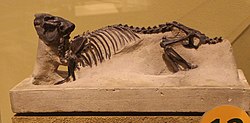
| Skeleton of Interatherium rodens in the Field Museum of Natural History, Chicago | |
Scientific classification 
| |
| Kingdom: | Animalia |
| Phylum: | Chordata |
| Class: | Mammalia |
| Infraclass: | Placentalia |
| Order: | †Notoungulata |
| Suborder: | †Typotheria |
| Family: | †Interatheriidae Ameghino 1887 |
| Subfamilies and genera | |
| |
Interatheriidae is an extinct family of notoungulate mammals from South America. Interatheriids are known from the Middle Eocene (Mustersan) to the Early Pleistocene (Uquian).123 These animals were principally small-sized, occupying a habitat like hares, marmots and viscachas. The majority were very small, like rodents.
Interatheriidae is one of the mammal groups that best represent the fauna from the Santa Cruz Formation. Particularly Protypotherium with three species is characteristic of the formation: P. australe, P. praerutilum and P. attenuatum. Another well-known genus is Interatherium, particularly well represented by I. robustum.
References
References
- McKenna & Bell, 1997
- Linares, 2004
- Carrillo-Briceño, J.; Sánchez, R (23 April 2021). "A Pliocene–Pleistocene continental biota from Venezuela". Swiss Journal of Palaeontology. 140 (1): 9. doi:10.1186/s13358-020-00216-6. PMC 8550326. PMID 34721281.
Bibliography
- Linares, Omar J (2004). "Bioestratigrafía de la fauna de mamíferos de las formaciones Socorro, Urumaco y Codore (Mioceno Medio-Plioceno Temprano) de la región de Urumaco, Falcón, Venezuela" (PDF). Paleobiología Neotropical. 1: 1–26. Archived from the original (PDF) on 2017-07-22. Retrieved 2017-08-15.
- McKenna, Malcolm C., and Bell, Susan K. 1997. Classification of Mammals Above the Species Level. Columbia University Press, New York, 631 pp. ISBN 0-231-11013-8
Further reading
Further reading
- C. Villarroel and L. G. Marshall. 1989. A new fossil land mammal locality of late Miocene (Huayquerian) age from Muyu Huasi, southcentral Bolivia. Boletin del Servicio Geológico de Bolivia, Serie A IV(1):27-40