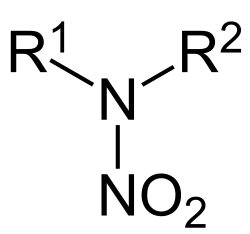
In organic and inorganic chemistry, nitroamines or nitramides are chemical compounds with the general chemical structure R1R2N−NO2. They consist of a nitro group (−NO2) bonded to the nitrogen of an amine.12 The R groups can be any group, typically hydrogen (e.g., methylnitroamine CH3−NH−NO2) and organyl (e.g., diethylnitroamine (CH3CH2−)2N−NO2). An example of inorganic nitroamine is chloronitroamine, Cl−NH−NO2.3 The parent inorganic compound, where both R substituents are hydrogen, is nitramide or nitroamine, H2N−NO2.
N-Nitroaniline rearranges in the presence of acid to give 2-nitroaniline.4
References
References
- Clayden, J.; Greeves, N.; Warren, S.; Wothers, P. (2001). Organic Chemistry. Oxford, Oxfordshire: Oxford University Press. ISBN 0-19-850346-6.
- Smith, Michael B.; March, Jerry (2007), Advanced Organic Chemistry: Reactions, Mechanisms, and Structure (6th ed.), New York: Wiley-Interscience, ISBN 978-0-471-72091-1
- "N-chloronitramide".
- Smith, Michael B.; March, Jerry (2007), Advanced Organic Chemistry: Reactions, Mechanisms, and Structure (6th ed.), New York: Wiley-Interscience, p. 738, ISBN 978-0-471-72091-1
Further reading
Further reading
- Schmidt, Eckart W. (2022). "Nitramines". Encyclopedia of Liquid Fuels. De Gruyter. pp. 4203–4413. doi:10.1515/9783110750287-035. ISBN 978-3-11-075028-7.