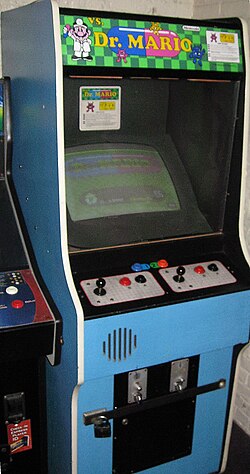
 A VS. Dr. Mario arcade machine | |
| Developer | Nintendo |
|---|---|
| Manufacturer | Nintendo |
| Type | Arcade video game |
| Released | January 1984 (January 1984) |
| Lifespan | 1984-1992 |
| Discontinued | |
| Units sold | 100,000 |
| Media | ROM chips |
| CPU | Ricoh 2A03 |
| Platform | NES-based |
| VS. Super Mario Bros. | |
| Successor | PlayChoice-10 |
The Nintendo VS. Systema is an arcade system that was developed and produced by Nintendo. It is based on most of the same hardware as the Family Computer (Famicom), later released as the Nintendo Entertainment System (NES). As Nintendo was planning to release the NES in North America, they became wary of the effects the video game crash of 1983 on the home console market. By March 1984, the U.S. arcade industry recovered enough for a plan to introduce NES titles, by having the VS. System serve as a preview of the console to prospective players. It became the first version of the Famicom hardware to debut in North America.
Most of its games are conversions from the Famicom and NES, some heavily altered for the arcade format, and some debuted on the VS. System before being released on the Famicom or NES. The system focuses on two-player cooperative play. It was released in three different configurations: upright VS. UniSystem cabinets, upright VS. DualSystem cabinets, and sit-down VS. DualSystem cabinets. Games are on pluggable circuit boards, allowing for each side to have a different game.
The VS. System did not have lasting popularity in Japan, leading to Nintendo's departure from arcade game development. In contrast, it was a commercial success in the United States, with about 100,000 arcade cabinets sold, becoming the highest-grossing arcade machine of 1985. The system's success in arcades proved the market for the test release of the NES in North America in 1985. The final VS. System game was released in 1990.
Background
In 1980, Data East had introduced the concept of a convertible arcade system board, or arcade conversion system, with the DECO Cassette System,3 but it was not a major success. The first successful arcade conversion system is Sega's Convert-a-Game system in 1981.4 Its success led to several other arcade manufacturers introducing their own arcade conversion systems by the mid-1980s, including the Nintendo VS. System in 1984.5
The Nintendo VS. System is pivotal in the history of the Nintendo Entertainment System (NES). The VS. System is the first version of the Family Computer (Famicom) hardware to debut in North America during 1984, the success of which proved the market for the official release of the NES console.67 Following the North American home video game crash of 1983, Nintendo's negotiations with Atari to introduce the Famicom in North America stalled due to Atari's ongoing debacle, and Nintendo of America's market research garnered warnings from retailers and distributors to stay away from home consoles, with U.S. retailers refusing to stock game consoles. Meanwhile, the arcade game industry also had a slump as the golden age of arcade video games was coming to an end, but the arcade industry recovered and stabilized with the help of software conversion kit systems, such as Sega's Convert-a-Game system, the Atari System 1, and the Nintendo-Pak system. Nintendo president Hiroshi Yamauchi realized there was still a market for video games in North America, where players were gradually returning to arcades in significant numbers. Yamauchi still had faith there was a market for the Famicom, so he introduced it to North America through the arcade industry.6
Nintendo based the VS. System hardware on the Famicom, and introduced it as the successor to its Nintendo-Pak arcade system, which had been used for games such as Mario Bros. and Donkey Kong 3. Though technologically inferior to Nintendo's Punch-Out!! arcade hardware, the VS. System was relatively inexpensive. The Nintendo-Pak and Punch-Out!! hardware also have a limited game library, whereas the VS. System accessed a wider variety of games, by easily converting Famicom games. Nintendo of America hired Jeff Walker from Bally to help market the VS. System in North America, where it debuted at the 1984 ASI show along with Punch-Out!! in February.6
Nintendo of America announced in July 1992 that it would stop making arcade machines. The announcement included the last upcoming titles for the NES-based PlayChoice-10 and the SNES-based Nintendo Super System, but none for the VS. System.1
Hardware
The VS. System was designed primarily as a kit to retrofit Donkey Kong, Donkey Kong Jr., Donkey Kong 3, Popeye, and Mario Bros. cabinets, so they require the same special monitor. These monitors use inverse voltage levels for their video signals as compared to most arcade monitors.
Almost all VS. System cabinets have identical hardware powered by a Ricoh 2A03 central processing unit (CPU), the same in the NES, except for special PPUs or video chips.8 Each chip contains a different palette that arrange the colors in different configurations chosen apparently at random. Most boards can be switched to a new game simply by swapping the program ROMs and the appropriate PPU or the game will have incorrect colors.9 Several of the later units employ further copy protection by using special PPUs which swap pairs of I/O registers or return special data from normally unimplemented regions of memory, and games are not interchangeable with these models.
Some dedicated double cabinets look like two games butted together at an angle, with a single motherboard. The Red Tent, a steel sit-down cabinet for the VS. DualSystem, allows play for up to four players simultaneously. It has the same motherboard as the double cabinet.
Because the VS. System has the same CPU as the NES, its games can be ported to the NES with modifications to the console including extra memory banks and additional DIP switches.10 Some games differ from their home console versions. For example, VS. Super Mario Bros. is considerably more difficult than Super Mario Bros.; some of the levels were reused in Super Mario Bros.: The Lost Levels for the Famicom Disk System.11 Some games' graphics differ, such as VS. Duck Hunt having more details and animation sequences.
List of games
Unknown prototypes of VS. System games may have been either unreleased or released briefly for market testing.1213 The launch game is VS. Tennis, released in January 1984.
| Title | Distributor | Released (JP) | Released (NA) | Ref |
|---|---|---|---|---|
| VS. Tennis | Nintendo | January 1984 | March 1984 | 141516 |
| VS. Mahjong | Nintendo | February 1984 | Unreleased | 17 |
| VS. Baseball | Nintendo | May 1, 1984 | July 1984 | 1815 |
| VS. Wrecking Crew | Nintendo | July 26, 1984 | September 1984 | 1920 |
| VS. Pinball | Nintendo | July 26, 1984 | October 1984 | 212215 |
| VS. Stroke and Match Golf | Nintendo | July 26, 1984 | October 1984 | 2215 |
| VS. Ladies Golf | Nintendo | July 26, 1984 | December 1984 | 2215 |
| VS. Balloon Fight | Nintendo | October 3, 1984 | September 1984 | 2120 |
| VS. Clu Clu Land | Nintendo | December 7, 1984 | Unreleased | 23 |
| VS. Excitebike | Nintendo | December 7, 1984 | February 1985 | 2315 |
| VS. Urban Champion | Nintendo | December 1984 | January 1985 | 2425 |
| VS. Ice Climber | Nintendo | February 1, 1985 | March 1985 | 2615 |
| VS. Raid on Bungeling Bay | Nintendo | April 1985 | Cancelled | 2717 |
| VS. Hogan's Alley | Nintendo | Unreleased | May 1985 | 15 |
| VS. Duck Hunt | Nintendo | Unreleased | May 1985 | 15 |
| VS. Mach Rider | Nintendo | August 1985 | November 1985 | 281520 |
| VS. Soccer | Nintendo | December 10, 1985 | November 1985 | 2915 |
| VS. Battle City | Namco | 1985 | Unreleased | |
| VS. Star Luster | Namco | 1985 | Unreleased | |
| VS. Super Mario Bros. | Nintendo | Unreleased | February 1986 | 17 |
| VS. Ninja JaJaMaru-kun | Jaleco | April 1986 | Unreleased | 30 |
| VS. Gumshoe | Nintendo | Unreleased | May 1986 | 1720 |
| VS. Slalom | Nintendo | Unreleased | October 1986 | 1720 |
| VS. Gradius | Nintendo | Unreleased | November 1986 | 1720 |
| VS. The Goonies | Nintendo | Unreleased | November 1986 | 1720 |
| VS. Sky Kid | Sunsoft | Unreleased | November 1986 | 31 |
| VS. Family Stadium / R.B.I. Baseball | Namco (JP) Atari Games (US) |
December 10, 1986 | 1987 | 3217 |
| VS. Super Xevious: GAMP no Nazo | Namco | 1986 | Unreleased | |
| VS. Tower of Babel | Namco | 1986 | Unreleased | |
| VS. Valkyrie no Bōken: Toki no Kagi Densetsu | Namco | 1986 | Unreleased | |
| VS. Castlevania | Nintendo | Unreleased | April 1987 | 33 |
| VS. Family Tennis | Namco | December 1987 | Unreleased | 34 |
| VS. T.K.O. Boxing | Data East | Unreleased | 1987 | 17 |
| VS. The Quest of Ki | Namco | 1988 | Unreleased | |
| VS. Top Gun | Konami | Unreleased | March 1988 | 3536 |
| VS. Freedom Force | Nintendo | Unreleased | March 1988 | 37 |
| VS. Platoon | Sunsoft | Unreleased | November 1988 | 38 |
| VS. Dr. Mario | Nintendo | Unreleased | August 1990 | 39 |
| VS. Motocross | Nintendo | Unreleased | Cancelled | 40 |
| VS. Nintendo 500 | Nintendo | Unreleased | Cancelled | 40 |
| VS. Football | Nintendo | Unreleased | Cancelled | 40 |
| VS. Helifighter | Nintendo | Unreleased | Cancelled | 40 |
| VS. Head to Head Baseball | Nintendo | Unreleased | Cancelled | |
| VS. Mighty Bomb Jack | Tecmo | Cancelled | Cancelled | 4142 |
| VS. Great Tennis | Jaleco | Cancelled | Unreleased | 43 |
| VS. Lionex (prototype) | Sunsoft | Cancelled | Unreleased | 17 |
| VS. The Wing of Madoola (prototype) | Sunsoft | Cancelled | Unreleased | 1744 |
| VS. Tetris | Atari Games | Unreleased | Cancelled |
Reception
Upon release, the VS. System generated excitement in the arcade industry, receiving praise for its easy conversions, affordability, flexibility, and multiplayer capabilities.645 Eddie Adlum of RePlay magazine said Nintendo had suddenly become "the big guy on the block" in 1984 due to the VS. System, which "not only meant interchangeable games but interaction between players on dual-monitor games".46 For Play Meter magazine, Roger C. Sharpe called it a "highly attractive and open-ended interchangeable game system featuring excellent graphics and realistic on-screen visuals" in 198447 and Gene Lewin gave the system a rating of 10+ out of 10 in 1985.48 Others criticized the system's graphics as technologically weaker than more recent rival arcade systems, and than Nintendo's own powerful Punch-Out!! arcade hardware.6
In Japan, VS. Tennis topped Japan's chart for table arcade cabinets in April 198449 and May 1984,50 and VS. Baseball topped the chart in June51 and July 1984.52 By 1985, however, the VS. System had declined in Japan, which led to Yamauchi deciding to withdraw Nintendo from the Japanese coin-op industry in late 198562 and Nintendo focusing more on the Famicom.53
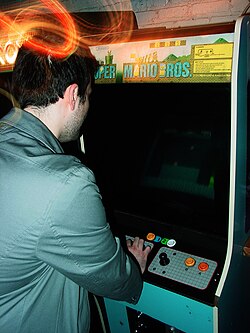
In North America, by contrast, the VS. System became a major success.6 Following the arcade success of sports video games such as Konami's Track & Field (1983), Nintendo capitalized on this trend with sports games Punch-Out!!, VS. Tennis, and VS. Baseball with great success in the US arcade market; Sharpe considered Nintendo "a force to reckon with" based on this strong performance.47 The VS. System was declared an "overwhelming hit" by Play Meter, attributing its success to "good games and low price".54 Between 10,000 and 20,000 arcade cabinets were sold in 1984,55 and individual VS. games were top earners on arcade charts.7 VS. Tennis topped the arcade charts for software conversion kits in July 1984 (on the RePlay charts)56 and August 1984 (on the Play Meter charts),57 and VS. Baseball topped the charts from September58 through November 1984.5960 Hogan's Alley and Duck Hunt then became even more popular in American arcades, popularizing light gun shooter video games.46 By 1985, 50,000 cabinets had been sold, establishing Nintendo as an industry leader in the arcades.61 In November 1985, five VS. games were on the US RePlay top 20 arcade charts, with Hogan's Alley holding the top spot.62 Duck Hunt was also popular in arcades at the time.6 The VS. System went on to become the highest-grossing arcade platform of 1985 in the United States,6364 and Hogan's Alley and Excitebike became the top two highest-grossing arcade system games that year.65
The success of the VS. System gave Nintendo the confidence to repackage the Famicom for North America as the NES. Nintendo's strong positive reputation in the arcades also generated significant interest in the NES. It also gave Nintendo the opportunity to test new games as VS. Paks in the arcades, to determine which games to release for the NES launch. Nintendo's software strategy was to first release games for the Famicom, then the VS. System, and then for the NES. This allowed Nintendo to build a solid launch line-up for the NES. Many games' North American debut was on the VS. System before being released for the NES, which gave players the impression of being "amazed" at the accuracy of the arcade "ports" for the NES.6 At the time, most arcade game hardware was significantly more powerful than home console hardware, and game developers would go through significant effort to try to replicate arcade games on the less powerful home consoles, often with little success.
Within a few months of its 1986 release, 20,000 VS. Super Mario Bros. arcade units were sold, becoming the best-selling VS. release, with each unit consistently earning more than $200 (equivalent to $590 in 2025) per week. Its arcade success helped introduce Super Mario Bros. to many players who did not yet own an NES.66 By the time the NES was launched in North America (from late 1985 to 1986), about 100,000 VS. Systems had been sold to American arcades.676869 According to Ken Horowitz, the VS. System "was perhaps the most vital catalyst in the rise of the NES to the top of the home video game market".6
In Europe, the VS. System was also a success in arcades by early 1986, before the launch of the NES there. At London's Amusement Trades Exhibition International (ATEI) show in January 1986, David Snook of Play Meter magazine listed VS. Super Mario Bros. as one of the top five hits of the show, along with Space Harrier, Halley's Comet, Gauntlet and Tehkan World Cup.70
See also
See also
- PlayChoice-10, Nintendo's other NES-based arcade series
- Nintendo Super System, the Super NES-based arcade system
- Wild Gunman (1984), which had a fictional VS. arcade version featured in the film Back to the Future Part II (1989)
- R.O.B., a toy robot designed to help the NES's commercial performance
References
References
- "Nintendo Stops Games Manufacturing; But Will Continue Supplying Software". Cashbox. September 12, 1992. p. 29 – via the Internet Archive.
- "Coin-Op "Super Mario" Will Shop To Overseas" (PDF). Game Machine. No. 279. Amusement Press, Inc. March 1, 1986. p. 24.
- "Overseas Readers Column: Data East Celebrated Its 10th Anniversary" (PDF). Game Machine. No. 286. Amusement Press, Inc. July 1, 1986. p. 26.
- Adlum, Eddie (November 1985). "The Replay Years: Reflections from Eddie Adlum". RePlay. Vol. 11, no. 2. pp. 134-175 (160-3).
- "The Replay Years: Video Systems". RePlay. Vol. 11, no. 2. November 1985. pp. 128, 130.
- Horowitz, Ken (July 30, 2020). "The Vs. System (1984)". Beyond Donkey Kong: A History of Nintendo Arcade Games. McFarland & Company. pp. 119–28. ISBN 978-1-4766-4176-8.
- Stark, Chelsea (October 19, 2015). "30 years later, Nintendo looks back at when NES came to America". Mashable. Retrieved April 13, 2021.
- "Nintendo Vs. UniSystem/DualSystem Chipsets". pc-10.com. Retrieved July 30, 2017.
- "Nintendo Vs. Unisystem Nintendo Vs. Dualsystem Arcade Manuals, PPU, PCB info, daughter board info, Nintendo Vs. Instruction Cards, game info". www.johnsarcade.com. Retrieved July 30, 2017.
- Assenat, Raphael. "Modding a NES to run Unisystem VS arcade games (1/14)". www.raphnet.net.
- McLaughlin, Rus (September 13, 2010). "IGN Presents: The History of Super Mario Bros". IGN. p. 3. Archived from the original on September 5, 2015. Retrieved April 1, 2015.
- "other unMAMEd Arcade Games up to 1990". unmamed.mameworld.info.
- "Urban Champion - NintendoWiki". niwanetwork.org.
- "Vs. System – Flyer Fever". February 20, 2021. Archived from the original on June 19, 2021.
- "Vs. System: The Vs. Challenge – Flyer Fever". February 20, 2021. Archived from the original on June 22, 2021.
- "Vs. Tennis (Registration Number PA0000204665)". United States Copyright Office. Retrieved May 30, 2021.
- "Flyer Fever – Video Game Flyers From Around The World". Archived from the original on September 29, 2014.
- "任天堂から「VS.ベースボール」で 本格野球プレー 2人が攻守に分かれ同時対戦、タイマー制採用" (PDF). Game Machine (in Japanese). No. 236. Amusement Press, Inc. May 15, 1984. p. 25.
- "Vs. Wrecking Crew – Flyer Fever". February 20, 2021. Archived from the original on June 22, 2021.
- Akagi, Masumi (October 13, 2006). アーケードTVゲームリスト国内•海外編(1971-2005) [Arcade TV Game List: Domestic • Overseas Edition (1971-2005)] (in Japanese). Japan: Amusement News Agency. p. 128. ISBN 978-4990251215.
- "Flyer Fever - Vs. Balloon Fight / Pinball (Japan)". Archived from the original on July 20, 2018. Retrieved September 2, 2017.
- "Flyer Fever - Golf / Pinball (Japan)". Archived from the original on July 20, 2018. Retrieved September 2, 2017.
- "任天堂から1ハード2ゲームで 金塊を探し出す 「クルクルランド」とバイクレース" (PDF). Game Machine (in Japanese). No. 251. Amusement Press, Inc. January 1, 1985. p. 25.
- "ジャブとKOパンチ駆使し素手による決闘任天堂から「アーバンチャンビオン」" (PDF). Game Machine (in Japanese). No. 254. Amusement Press, Inc. February 15, 1985. p. 20.
- "VS Urban Champion". Media Arts Database. Agency for Cultural Affairs. Retrieved June 19, 2021.
- "Flyer Fever - Ice Climber / Excite Bike (Japan)". Archived from the original on July 20, 2018. Retrieved September 2, 2017.
- "Raid on Bungeling Bay" (PDF). Game Machine (in Japanese). No. 258. Amusement Press, Inc. April 15, 1985. p. 21.
- "Mach Rider" (PDF). Game Machine (in Japanese). No. 266. Amusement Press, Inc. August 15, 1985. p. 7.
- "2人同時プレイの試合展開 対戦サッカーで 任天堂からROMキット販売" (PDF). Game Machine (in Japanese). No. 275. Amusement Press, Inc. January 1, 1986. p. 24.
- "Jaleco Ships New Game For "VS. System"" (PDF). Game Machine. No. 283. Amusement Press, Inc. May 1, 1986. p. 20.
- "Cash Box Tours The AMOA Expo '86 Exhibits". The Cash Box. Vol. 50, no. 24. The Cash Box Publishing. November 29, 1986. p. 28.
- "Namco's "Family Stadium" Has Enjoyed Popularity" (PDF). Game Machine. No. 310. Amusement Press, Inc. June 15, 1987. p. 22.
- "U.S. Video Team Picks The 'Top Games' Of ACME '87". The Cash Box. Vol. 50, no. 43. The Cash Box Publishing. April 25, 1987. p. 34.
- "「ファイナルラップ」スタンダード型2人用普及型にナムコ、自社ロケ用「ファミリーテニス」も" (PDF). Game Machine (in Japanese). No. 325. Amusement Press, Inc. February 1, 1988. p. 19.
- "Konami Intro's 'VS. Top Gun'". The Cash Box. Vol. 51, no. 35. The Cash Box Publishing. March 5, 1988. p. 33.
- "VS. Top Gun - Konami (Video Game, 1987) - USA". Museum of the Game.
- "意欲示す米国メーカー日本製は開発に余裕も" (PDF). Game Machine (in Japanese). No. 330. Amusement Press, Inc. April 15, 1988. p. 7.
- "AMOA '88: Music & Mayhem, Or Songs & Sons of Double Dragon!". The Cash Box. Vol. 52, no. 22. The Cash Box Publishing. November 26, 1988. p. 28.
- "Nintendo Bows VS. Dr. Mario Pak At San Diego Distributor Meeting". RePlay. Vol. 16, no. 1. August 1990. pp. 44–46.
- "Flyer Fever - VS.-Pak Library of Proven Best Sellers (U.S.)". Archived from the original on December 7, 2019.
- "発想転換したTV機 テクモ" (PDF). Game Machine (in Japanese). No. 294. Amusement Press, Inc. October 15, 1986. p. 16.
- "Counterfeiters Squeezed at JAMMA Show". Play Meter. Vol. 12, no. 18. Skybird Publishing. October 15, 1986. p. 73.
- "26th Amusement Machine Show" (PDF). Game Machine (in Japanese). No. 343. Amusement Press, Inc. November 1, 1988. p. 8.
- https://www.timeextension.com/news/2023/08/sunsoft-shares-image-of-unreleased-wings-of-madoola-vs-system-prototype
- Cognevich, Valerie (November 15, 1984). "Nintendo presents new Paks at distributor showing". Play Meter. Vol. 10, no. 21. pp. 24–5.
- Adlum, Eddie (November 1985). "The Replay Years: Reflections from Eddie Adlum". RePlay. Vol. 11, no. 2. pp. 134-175 (168-71).
- Sharpe, Roger C. (December 15, 1984). "1984—Every Which Way But Up". Play Meter. Vol. 10, no. 23. pp. 39, 49–51.
- Lewin, Gene (June 15, 1985). "Gene's Gudgements" (PDF). Play Meter. Vol. 11, no. 11. pp. 38–9.
- "Best Hit Games 25" (PDF). Game Machine (in Japanese). No. 233. Amusement Press, Inc. April 1, 1984. p. 27.
- "Best Hit Games 25" (PDF). Game Machine (in Japanese). No. 235. Amusement Press, Inc. May 1, 1984. p. 29.
- "Best Hit Games 25" (PDF). Game Machine (in Japanese). No. 237. Amusement Press, Inc. June 1, 1984. p. 29.
- "Best Hit Games 25" (PDF). Game Machine (in Japanese). No. 239. Amusement Press, Inc. July 1, 1984. p. 25.
- ""Fami-Com" Exceeds 10M. Its Boom Is Continuing" (PDF). Game Machine. No. 307. Amusement Press, Inc. May 1, 1987. p. 26.
- "1984—Even Orwell Couldn't Predict How Bad It Was". Play Meter. Vol. 10, no. 23. December 15, 1984. pp. 23–8.
- Horowitz, Ken (July 30, 2020). Beyond Donkey Kong: A History of Nintendo Arcade Games. McFarland & Company. p. 125. ISBN 978-1-4766-4176-8.
More than 10,000 VS. System units were sold by the end of 1984 alone (some put the figure as high as 20,000).
- "RePlay: The Players' Choice". RePlay. July 1984.
- "National Play Meter". Play Meter. August 15, 1984.
- "RePlay: The Players' Choice". RePlay. September 1984.
- "RePlay: The Players' Choice". RePlay. November 1984.
- "National Play Meter". Play Meter. Vol. 10, no. 21. November 15, 1984. pp. 28–9.
- "The Vs. Challenge". RePlay. Vol. 11, no. 3. December 1985. p. 5.
- "RePlay: The Players' Choice". RePlay. Vol. 11, no. 2. November 1985. p. 6.
- "AMOA Expo '85: Award Winners". RePlay. Vol. 11, no. 3. December 1985. p. 44.
- "Springsteen Sweeps JB Awards" (PDF). Cash Box. November 23, 1985. p. 39.
- "1985 Operator Survey: This Poll Says Go Gettum!". RePlay. Vol. 11, no. 2. November 1985. pp. 91-102 (93-4).
- Horowitz, Ken (July 30, 2020). Beyond Donkey Kong: A History of Nintendo Arcade Games. McFarland & Company. p. 156. ISBN 978-1-4766-4176-8.
- Horowitz, Ken (July 30, 2020). Beyond Donkey Kong: A History of Nintendo Arcade Games. McFarland & Company. p. 155. ISBN 978-1-4766-4176-8.
- "Rx: Nintendo". RePlay. Vol. 16, no. 1. October 1990. pp. 68, 70.
- "Positive attitude hit of AMOA show" (PDF). Play Meter. Vol. 11, no. 21. November 15, 1985. pp. 24–43 (27).
- Snook, David (February 1986). "Corks pop at ATEI". Play Meter. Vol. 12, no. 2. pp. 32–6.