| Emission nebula | |
|---|---|
| H II region | |
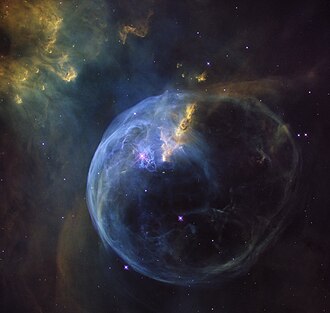 Wide field image of NGC 7635 as captured by the Hubble Space Telescope | |
| Observation data: J2000 epoch | |
| Right ascension | 23h 20m 48.3s1 |
| Declination | +61° 12′ 06″1 |
| Distance | 71002 to 1100034 ly (3,400 pc) |
| Apparent magnitude (V) | 105 |
| Apparent dimensions (V) | 15′ × 8′6 |
| Constellation | Cassiopeia |
| Physical characteristics | |
| Radius | 32 to 574 ly |
| Notable features | Shell around SAO 205751 |
| Designations | Bubble Nebula1 Sharpless 162 (Sh2-162) Caldwell 11 |
The Bubble Nebula, also known as NGC 7635, Sharpless 162, or Caldwell 11, is an H II region1 emission nebula in the constellation Cassiopeia. It lies close to the open cluster Messier 52. The "bubble" is created by the stellar wind from a massive hot, 8.71 magnitude young central star, SAO 20575 (BD+60°2522).7 The nebula is near a giant molecular cloud which contains the expansion of the bubble nebula while itself being excited by the hot central star, causing it to glow.7 It was discovered in November 1787 by William Herschel.5 The star BD+60°2522 is thought to have a mass of about 44 M☉.
Amateur observation
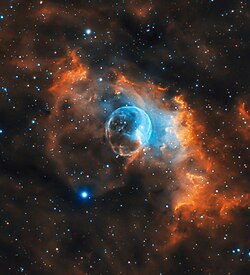
With an 8-or-10-inch (200 or 250 mm) telescope, the nebula is visible as an extremely faint and large shell around the star.61 The nearby 7th magnitude star on the west hinders observation, but one can view the nebula using averted vision.6 Using a 16-to-18-inch (410 to 460 mm) scope, one can see that the faint nebula is irregular, being elongated in the north south direction.6
Notes
Notes
- SIMBAD 2007.
- HubbleSite 2000.
- Nemiroff & Bonnell 2004.
- Nemiroff & Bonnell 2006.
- "NGC-IC Project Database". Archived from the original on 2001-09-04. Retrieved 2008-12-15.
- Kepple & Sanner 1998.
- Nemiroff & Bonnell 2005.
References
References
- SIMBAD (February 23, 2007). "Results for NGC 7635". SIMBAD, Centre de Données Astronomiques de Strasbourg.
- Kepple, George Robert; Sanner, Glen W. (1998). The Night Sky Observer's Guide. Vol. 1. Willmann-Bell, Inc. pp. 108–109. ISBN 978-0-943396-58-3.
- HubbleSite (2000). "An Expanding Bubble in Space".
- Nemiroff, R.; Bonnell, J., eds. (July 16, 2004). "The Bubble". Astronomy Picture of the Day. NASA.
- Nemiroff, R.; Bonnell, J., eds. (November 7, 2005). "NGC 7635: The Bubble Nebula". Astronomy Picture of the Day. NASA.
- Nemiroff, R.; Bonnell, J., eds. (October 18, 2006). "NGC 7635: The Bubble". Astronomy Picture of the Day. NASA.