| Neobodonida | |
|---|---|
| |
| Klosteria | |
Scientific classification 
| |
| Domain: | Eukaryota |
| Clade: | Discoba |
| Phylum: | Euglenozoa |
| Class: | Kinetoplastea |
| Subclass: | Metakinetoplastina |
| Order: | Neobodonida Vickerman 2004: 1871 |
| Families | |
| |
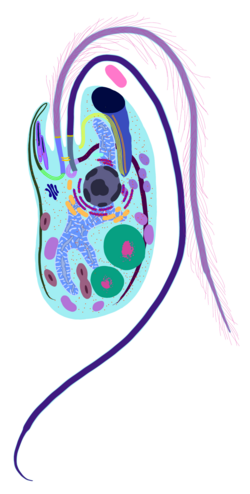
Neobodonida is an order of free-living, unicellular kinetoplastid organisms, related to the parasitic members of the order Trypanosomatida.1 Kinetoplastids in general are frequently found in soil and water samples, but neobodonids appear to be the most abundant in various ecosystems, including halotolerant members, although morphologically they are almost indistinguishable.2 During the Tara Oceans expedition, 98% of the kinetoplastid samples corresponded to neobodonids, which belonged mainly to Neobodo and Rhynchomonas.3
References
References
- "Neobodonida". www.gbif.org (in Spanish). Retrieved 2026-03-22.
- Belyaev, Artem O.; Zagumyonnyi, Dmitriy G.; Mylnikov, Alexander P.; Tikhonenkov, Denis V. (2022-08-01). "The Morphology, Ultrastructure and Molecular Phylogeny of a New Soil-Dwelling Kinetoplastid Avlakibodo gracilis gen. et sp. nov. (Neobodonida; Kinetoplastea)". Protist. 173 (4). 125885. doi:10.1016/j.protis.2022.125885. ISSN 1434-4610.
- Flegontova, Olga; Flegontov, Pavel; Malviya, Shruti; Poulain, Julie; de Vargas, Colomban; Bowler, Chris; Lukeš, Julius; Horák, Aleš (2018). "Neobodonids are dominant kinetoplastids in the global ocean". Environmental Microbiology. 20 (2): 878–889. doi:10.1111/1462-2920.14034. ISSN 1462-2920.