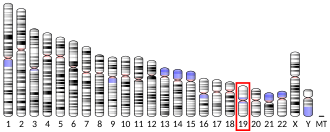
Napsin-A is an aspartic proteinase that is encoded in humans by the NAPSA gene.5 The name napsin comes from novel aspartic proteinase of the pepsin family.6
The activation peptide of an aspartic proteinase acts as an inhibitor of the active site. These peptide segments, or pro-parts, are deemed important for correct folding, targeting, and control of the activation of aspartic proteinase zymogens. The pronapsin A gene is expressed predominantly in lung and kidney. Its translation product is predicted to be a fully functional, glycosylated aspartic proteinase precursor containing an RGD motif and an additional 18 residues at its C-terminus.5
Utility
Detection of NAPSA gene expression can be used to distinguish adenocarcinomas from other forms of lung cancer.7
References
References
- GRCh38: Ensembl release 89: ENSG00000131400 – Ensembl, May 2017
- GRCm38: Ensembl release 89: ENSMUSG00000002204 – Ensembl, May 2017
- "Human PubMed Reference:". National Center for Biotechnology Information, U.S. National Library of Medicine.
- "Mouse PubMed Reference:". National Center for Biotechnology Information, U.S. National Library of Medicine.
- "Entrez Gene: NAPSA napsin A aspartic peptidase".
- Tatnell PJ, Powell DJ, Hill J, Smith TS, Tew DG, Kay J (11 December 1998). "Napsins: new human aspartic proteinases". FEBS Letters. 441 (1): 43–48. doi:10.1016/s0014-5793(98)01522-1. PMID 9877162. S2CID 27656626.
- Ueno T, Linder S, Elmberger G (2004). "Aspartic proteinase napsin is a useful marker for diagnosis of primary lung adenocarcinoma". Br. J. Cancer. 88 (8): 1229–33. doi:10.1038/sj.bjc.6600879. PMC 2747556. PMID 12698189.
Further reading
Further reading
- Koelsch G, Mares M, Metcalf P, Fusek M (1994). "Multiple functions of pro-parts of aspartic proteinase zymogens". FEBS Lett. 343 (1): 6–10. Bibcode:1994FEBSL.343....6K. doi:10.1016/0014-5793(94)80596-2. PMID 8163018. S2CID 32345795.
- Blundell TL, Guruprasad K, Albert A, et al. (1998). Aspartic Proteinases. Adv. Exp. Med. Biol. Vol. 436. pp. 1–13. doi:10.1007/978-1-4615-5373-1_1. ISBN 978-1-4613-7452-7. PMID 9561193.
- Chuman Y, Bergman A, Ueno T, et al. (2000). "Napsin A, a member of the aspartic protease family, is abundantly expressed in normal lung and kidney tissue and is expressed in lung adenocarcinomas". FEBS Lett. 462 (1–2): 129–34. doi:10.1016/S0014-5793(99)01493-3. PMID 10580105. S2CID 23355055.
- Schauer-Vukasinovic V, Bur D, Kling D, et al. (2000). "Human napsin A: expression, immunochemical detection, and tissue localization". FEBS Lett. 462 (1–2): 135–9. doi:10.1016/S0014-5793(99)01458-1. PMID 10580106. S2CID 32798620.
- Yan R, Bienkowski MJ, Shuck ME, et al. (1999). "Membrane-anchored aspartyl protease with Alzheimer's disease beta-secretase activity". Nature. 402 (6761): 533–7. Bibcode:1999Natur.402..533Y. doi:10.1038/990107. PMID 10591213. S2CID 4320087.
- Cook M, Bühling F, Ansorge S, et al. (2002). "Pronapsin A and B gene expression in normal and malignant human lung and mononuclear blood cells". Biochim. Biophys. Acta. 1577 (1): 10–6. doi:10.1016/s0167-4781(02)00400-1. PMID 12151090.
- Strausberg RL, Feingold EA, Grouse LH, et al. (2003). "Generation and initial analysis of more than 15,000 full-length human and mouse cDNA sequences". Proc. Natl. Acad. Sci. U.S.A. 99 (26): 16899–903. Bibcode:2002PNAS...9916899M. doi:10.1073/pnas.242603899. PMC 139241. PMID 12477932.
- Brasch F, Ochs M, Kahne T, et al. (2004). "Involvement of napsin A in the C- and N-terminal processing of surfactant protein B in type-II pneumocytes of the human lung". J. Biol. Chem. 278 (49): 49006–14. doi:10.1074/jbc.M306844200. PMID 13129928.
- Ota T, Suzuki Y, Nishikawa T, et al. (2004). "Complete sequencing and characterization of 21,243 full-length human cDNAs". Nat. Genet. 36 (1): 40–5. doi:10.1038/ng1285. PMID 14702039.
- Innocenti M, Zucconi A, Disanza A, et al. (2004). "Abi1 is essential for the formation and activation of a WAVE2 signalling complex". Nat. Cell Biol. 6 (4): 319–27. doi:10.1038/ncb1105. PMID 15048123. S2CID 22767022.