| Munot | |
|---|---|
| Schaffhausen | |
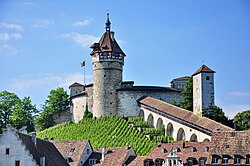 Munot fortifications, view from Feuerthalen | |
| Site information | |
| Code | CH-SH |
| Condition | preserved |
| Location | |
Munot Munot | |
| Coordinates | 47°41′49″N 8°38′23″E / 47.69694°N 8.63972°E / 47.69694; 8.63972 |
| Height | 433 m above the sea |
| Site history | |
| Built | 1564–1589 |
The Munot is a circular 16th-century fortification located on Emmersberg hill in the city of Schaffhausen, Switzerland, and serves as a symbol of the city.12 It is surrounded by vineyards, which have been cultivated since the early 20th century.12 The structure was built between 1564 and 1589, partly through compulsory labor (Frondienst), and formed part of the city’s defensive fortifications.3 The site had earlier fortifications, with references to a structure called Annot in 1376 and Unot in 1460.3
The Munot's circular design strongly reflects the fortress concepts of Albrecht Dürer.3 Its lower level consists of a hexagonal trench structure with caponiers (defensive turrets), above which are circular casemates and a battlement platform. A projecting tower on the city-facing side rises to a height of around 50 metres.3
History
In 1905, a fallow deer colony was introduced into the Munot moat by the Verschönerungsverein Schaffhausen and was transferred to city ownership in 1927.4 As of 2015, the animals were under the care of Grün Schaffhausen, which commissioned an expert report confirming their good health.4
According to a 2019 Swissinfo article, the role of the Guardian of the Munot dates back to 1377, predating the current 16th-century structure.5 The guardian traditionally lived with their family in the tower and was responsible for monitoring the town, sounding an alarm in case of danger, and ringing the Munot bell each evening at 9 p.m. This bell marked the time for city gates to close and for taverns and shops to shut.5 The ritual has remained a daily tradition carried out by the resident guardian.5

Transport
Munot can be reached on foot from the old town of Schaffhausen via several stairs. There are nearby bus stops (Künzleheim/Huus Emmersberg) served by line 4 of Verkehrsbetriebe Schaffhausen (VBSH). There is also a nearby parking lot to the north of Munot. Below the Munot, on the High Rhine, there is a landing stage of the Schweizerische Schifffahrtsgesellschaft Untersee und Rhein (URh), linking Schaffhausen with Stein am Rhein and Konstanz (Lake Constance).
Gallery
-
 Schaffhausen old town from the Munot vineyards
 -
 Fallow deer in the Munot moat
 -
 The Munot tower with its bell
 -
 URh cruise ship at Schifflände
References
References
- "Munot Fortress and Old Town". MySwitzerland.com. Retrieved 29 March 2011.
- History; Heritage; Switzerl; Guide, Tour (2020-09-28). "Discover the Castles, Palaces and Monasteries of Switzerland". Leisure Group Travel. Retrieved 2021-06-18.
- "Munot". Historisches Lexikon der Schweiz (HLS). 25 June 2007. Retrieved 27 June 2025.
- "Damhirsche beim Schaffhauser Munot brauchen mehr Rückzugsorte". Swissinfo. 7 December 2015. Retrieved 27 June 2025.
- "The woman who guards a Swiss town". Swissinfo. 16 February 2019. Retrieved 27 June 2025.