The Multan Fort was a historic fort in the city of Multan, Punjab, Pakistan.1 It was built on a hillock separated from the city by the Ravi River.2 The fort was destroyed in 1849 by British forces during the Second Anglo-Sikh War.2
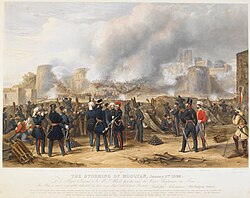
The walls of the fort were built by the Mughal prince Murad Bakhsh in the 17th century.3 The fort was notable for both its effectiveness as a defence installation and for its architecture.2 The famed Multan Sun Temple was located within the fort premises. Contemporary reports put the walls of the fort at 40 to 70 feet (21 m) high3 and 6,800 feet (2 km) in circumference. The fort had 46 bastions which included two flanking towers at each of the four gates (the De, Sikki, Hareri and Khizri Gates).2 A ditch 25 feet (7.6 m) deep and 40 feet (12 m) wide and an 18-foot (5.5 m) glacis protected the fort from intruders.

Within the fort stood a citadel flanked by 30 towers, enclosing a Hindu temple and a governor's palace. The citadel was severely damaged by the battering it got from the guns during the siege in 1818.3

See also
See also
References
References
- "MULTAN: TMA-Archaeology row over Multan heritage". Dawn. 10 January 2004. Retrieved 1 June 2026.
- "Important Places". Hamara Multan. Archived from the original on 19 July 2006. Retrieved 1 June 2026.
- "Multan Fort". www.tdcp.gop.pk. TDCP (Tourism Development Corporation of Punjab). Archived from the original on 30 July 2010. Retrieved 1 June 2026.