Mathura, 100 BCE
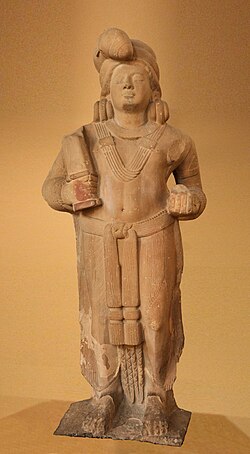
A mudgar (Sanskrit: मुद्गर, romanized: mudgara) or mudgara3 is a type of gada (mace) from India, and it is generally considered to be made of wood, but can also be made of iron.4
Usage
The mudgar appears is ancient Indian sculptures, where it is commonly held by Yaksha deities, known as mudgarpani (mudgarapāṇi; mudgar-holders).5
An ancient Jain story named the Antagadadasao tell the story of a man named Ajjunaka who was worshipping the image of the "Yaksa who held a mace", when he was attacked by five bandits, an event which shook his devotion to the Yashka. Afterwards the Yaksa possessed Ajjunaka, giving him the strength to kill the five bandits.6
Nowadays, for training purposes when using Indian clubs, one or two wooden gada ("mudgar"), reaching up to 70 kilograms in weight, can be used: they can be swung behind the back in several different ways; this is particularly useful for building grip strength and shoulder endurance.78
Examples
-
![Yaksha holding mudgar and child. Art of Mathura, 100 BCE.[9]](/weird-wikipedia/img/c/99/992afb4dd12dc1f1.jpg) Yaksha holding mudgar and child. Art of Mathura, 100 BCE.9
Yaksha holding mudgar and child. Art of Mathura, 100 BCE.9
References
References
- Dated 100 BCE in Fig.88 in Quintanilla, Sonya Rhie (2007). History of Early Stone Sculpture at Mathura: Ca. 150 BCE - 100 CE. BRILL. p. 368, Fig. 88. ISBN 9789004155374.
- Fig. 85 in Quintanilla, Sonya Rhie (2007). History of Early Stone Sculpture at Mathura: Ca. 150 BCE - 100 CE. BRILL. p. Fig.85, p.365. ISBN 9789004155374.
- Books, Kausiki (2021-10-24). Skanda Purana: Brahma Khanda: Dharmottara Khanda: English Translation only without Slokas. Kausiki Books. p. 169.
- Bulletin of the Victoria Memorial. Trustees of the Victoria Memorial. 1973. p. 49.
- Handa, Devendra; Agrawal, Ashvini (1989). Ratna-chandrikā: Panorama of Oriental Studies : Shri R.C. Agrawala Festschrift. Harman Publishing House. p. 90. ISBN 978-81-85151-29-8.
- Sharma, Ramesh Chandra (1994). The Splendour of Mathurā Art and Museum. D.K. Printworld. p. 76. ISBN 978-81-246-0015-3.
- Kasulis, Thomas P.; Aimes, Roger T.; Dissanayake, Wimal (1993). Self as Body in Asian Theory and Practice. SUNY Press. ISBN 9780791410806.
- "Mudgar exercise-club". British Museum. Retrieved 2019-02-01.
- Dated 100 BCE in Fig. 85 Quintanilla, Sonya Rhie (2007). History of Early Stone Sculpture at Mathura: Ca. 150 BCE - 100 CE. BRILL. p. Fig.85, p.365. ISBN 9789004155374.