  | |
| Observation data Epoch J2000.0 Equinox J2000.0 (ICRS) | |
|---|---|
| Constellation | Libra |
| Right ascension | 14h 49m 19.05130s1 |
| Declination | −14° 08′ 56.4766″1 |
| Apparent magnitude (V) | 5.322 (5.69 + 6.723 + 14.704) |
| Characteristics | |
| Spectral type | A1pSrCrEu + A6m3 |
| B−V color index | +0.072 |
| Astrometry | |
| Radial velocity (Rv) | −3.2±1.45 km/s |
| Proper motion (μ) | RA: −65.951 mas/yr Dec.: −14.541 mas/yr |
| Parallax (π) | 13.71±0.69 mas1 |
| Distance | 240 ± 10 ly (73 ± 4 pc) |
| Absolute magnitude (MV) | 1.32±0.206 |
| Details | |
| μ Lib A | |
| Mass | 2.31±0.127 M☉ |
| Radius | 2.598 R☉ |
| Luminosity | 41.77 L☉ |
| Temperature | 9,592±2607 K |
| Rotational velocity (v sin i) | 29.0±1.77 km/s |
| Age | 4176 Myr |
| μ Lib B | |
| Radius | 2.598 R☉ |
| Rotational velocity (v sin i) | 32.0±68 km/s |
| Other designations | |
| μ Lib, BD−13°3986, HD 130559, HIP 72489, HR 5523, SAO 1588219 | |
| Database references | |
| SIMBAD | data |
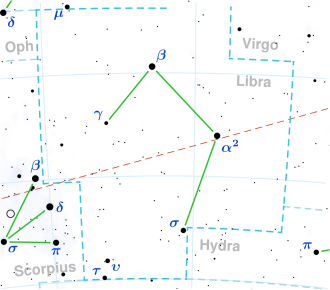
μ Librae (Latinised as Mu Librae) is a probable triple star3 system in the zodiac constellation of Libra. They have a combined apparent visual magnitude of 5.32,2 which is bright enough to be faintly visible to the naked eye. With an annual parallax shift of 13.71 mas,1 the system is located at an estimated distance of around 240 light years.
The inner pair consists of two A-type stars that, as of 2006, had an angular separation of 1.79 arc seconds along a position angle of 5.5°.10 They have an estimated physical separation of 139 AU.8 The primary, component A, is a visual magnitude 5.693 magnetic Ap star showing overabundances of the elements aluminum, strontium, chromium, and europium.7 Hence, it has a stellar classification of A1pSrEuCr.3 It is a photometric variable with periods of 25.3992±0.1970 d and 1.8871±0.0008 d. The surface magnetic field strength is 1,375 Gauss.7
The secondary, component B, is an Am star with a stellar classification of A6m.3 It has a visual magnitude of 6.72.3 The tertiary member, component C, is a magnitude 14.70 star at an angular separation of 12.90 arc seconds along a position angle of 294°, as of 2000.4
References
References
- van Leeuwen, F. (2007), "Validation of the new Hipparcos reduction", Astronomy and Astrophysics, 474 (2): 653–664, arXiv:0708.1752, Bibcode:2007A&A...474..653V, doi:10.1051/0004-6361:20078357, S2CID 18759600.
- Corben, P. M.; Stoy, R. H. (1968), "Photoelectric Magnitudes and Colours for Bright Southern Stars", Monthly Notes of the Astronomical Society of Southern Africa, 27: 11, Bibcode:1968MNSSA..27...11C.
- Eggleton, P. P.; Tokovinin, A. A. (September 2008), "A catalogue of multiplicity among bright stellar systems", Monthly Notices of the Royal Astronomical Society, 389 (2): 869–879, arXiv:0806.2878, Bibcode:2008MNRAS.389..869E, doi:10.1111/j.1365-2966.2008.13596.x, S2CID 14878976.
- Mason, B. D.; et al. (2014), "The Washington Visual Double Star Catalog", The Astronomical Journal, 122 (6): 3466, Bibcode:2001AJ....122.3466M, doi:10.1086/323920, retrieved 2015-07-22.
- de Bruijne, J. H. J.; Eilers, A.-C. (October 2012), "Radial velocities for the HIPPARCOS-Gaia Hundred-Thousand-Proper-Motion project", Astronomy & Astrophysics, 546: 14, arXiv:1208.3048, Bibcode:2012A&A...546A..61D, doi:10.1051/0004-6361/201219219, S2CID 59451347, A61.
- Kochukhov, O.; Bagnulo, S. (2006), "Evolutionary state of magnetic chemically peculiar stars", Astronomy and Astrophysics, 450 (2): 763, arXiv:astro-ph/0601461, Bibcode:2006A&A...450..763K, doi:10.1051/0004-6361:20054596, S2CID 18596834.
- Wraight, K. T.; et al. (February 2012), "A photometric study of chemically peculiar stars with the STEREO satellites - I. Magnetic chemically peculiar stars", Monthly Notices of the Royal Astronomical Society, 420 (1): 757–772, arXiv:1110.6283, Bibcode:2012MNRAS.420..757W, doi:10.1111/j.1365-2966.2011.20090.x, S2CID 14811051.
- Howe, K. S.; Clarke, C. J. (January 2009), "An analysis of v sin (i) correlations in early-type binaries", Monthly Notices of the Royal Astronomical Society, 392 (1): 448–454, Bibcode:2009MNRAS.392..448H, doi:10.1111/j.1365-2966.2008.14073.x.
- "mu. Lib". SIMBAD. Centre de données astronomiques de Strasbourg. Retrieved 2017-01-24.
{{cite web}}: CS1 maint: postscript (link) - Mason, Brian D.; et al. (October 2007), "Speckle Interferometry at the US Naval Observatory. XIII.", The Astronomical Journal, 134 (4): 1671–1678, Bibcode:2007AJ....134.1671M, doi:10.1086/521555, S2CID 250820656.