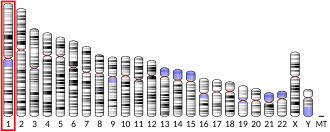



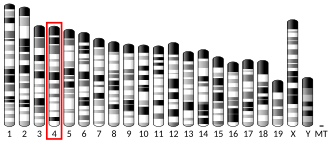



Metal regulatory transcription factor 1 is a protein that in humans is encoded by the MTF1 gene.56
Function
This gene encodes a transcription factor that induces expression of metallothioneins and other genes involved in metal homeostasis in response to heavy metals such as cadmium, zinc, copper, and silver. The protein is a nucleocytoplasmic shuttling protein that accumulates in the nucleus upon heavy metal exposure and binds to promoters containing a metal-responsive element (MRE).6
References
References
- GRCh38: Ensembl release 89: ENSG00000188786 – Ensembl, May 2017
- GRCm38: Ensembl release 89: ENSMUSG00000028890 – Ensembl, May 2017
- "Human PubMed Reference:". National Center for Biotechnology Information, U.S. National Library of Medicine.
- "Mouse PubMed Reference:". National Center for Biotechnology Information, U.S. National Library of Medicine.
- Brugnera E, Georgiev O, Radtke F, Heuchel R, Baker E, Sutherland GR, Schaffner W (Aug 1994). "Cloning, chromosomal mapping and characterization of the human metal-regulatory transcription factor MTF-1". Nucleic Acids Research. 22 (15): 3167–73. doi:10.1093/nar/22.15.3167. PMC 310292. PMID 8065932.
- "Entrez Gene: MTF1 metal-regulatory transcription factor 1".
Further reading
Further reading
- Westin G, Schaffner W (Dec 1988). "A zinc-responsive factor interacts with a metal-regulated enhancer element (MRE) of the mouse metallothionein-I gene". The EMBO Journal. 7 (12): 3763–70. doi:10.1002/j.1460-2075.1988.tb03260.x. PMC 454951. PMID 3208749.
- Maruyama K, Sugano S (Jan 1994). "Oligo-capping: a simple method to replace the cap structure of eukaryotic mRNAs with oligoribonucleotides". Gene. 138 (1–2): 171–4. doi:10.1016/0378-1119(94)90802-8. PMID 8125298.
- Suzuki Y, Yoshitomo-Nakagawa K, Maruyama K, Suyama A, Sugano S (Oct 1997). "Construction and characterization of a full length-enriched and a 5'-end-enriched cDNA library". Gene. 200 (1–2): 149–56. doi:10.1016/S0378-1119(97)00411-3. PMID 9373149.
- Chen X, Chu M, Giedroc DP (Sep 1999). "MRE-Binding transcription factor-1: weak zinc-binding finger domains 5 and 6 modulate the structure, affinity, and specificity of the metal-response element complex". Biochemistry. 38 (39): 12915–25. doi:10.1021/bi9913000. PMID 10504263.
- Otsuka F, Okugaito I, Ohsawa M, Iwamatsu A, Suzuki K, Koizumi S (Jul 2000). "Novel responses of ZRF, a variant of human MTF-1, to in vivo treatment with heavy metals". Biochimica et Biophysica Acta (BBA) - Gene Structure and Expression. 1492 (2–3): 330–40. doi:10.1016/s0167-4781(00)00110-x. PMID 11004505.
- Saydam N, Georgiev O, Nakano MY, Greber UF, Schaffner W (Jul 2001). "Nucleo-cytoplasmic trafficking of metal-regulatory transcription factor 1 is regulated by diverse stress signals". The Journal of Biological Chemistry. 276 (27): 25487–95. doi:10.1074/jbc.M009154200. PMID 11306562.
- Saydam N, Adams TK, Steiner F, Schaffner W, Freedman JH (Jun 2002). "Regulation of metallothionein transcription by the metal-responsive transcription factor MTF-1: identification of signal transduction cascades that control metal-inducible transcription". The Journal of Biological Chemistry. 277 (23): 20438–45. doi:10.1074/jbc.M110631200. PMID 11923282.
- Majumder S, Ghoshal K, Summers D, Bai S, Datta J, Jacob ST (Jul 2003). "Chromium(VI) down-regulates heavy metal-induced metallothionein gene transcription by modifying transactivation potential of the key transcription factor, metal-responsive transcription factor 1". The Journal of Biological Chemistry. 278 (28): 26216–26. doi:10.1074/jbc.M302887200. PMC 2365495. PMID 12716893.
- Saydam N, Steiner F, Georgiev O, Schaffner W (Aug 2003). "Heat and heavy metal stress synergize to mediate transcriptional hyperactivation by metal-responsive transcription factor MTF-1". The Journal of Biological Chemistry. 278 (34): 31879–83. doi:10.1074/jbc.M302138200. PMID 12805380.
- Chen X, Zhang B, Harmon PM, Schaffner W, Peterson DO, Giedroc DP (Feb 2004). "A novel cysteine cluster in human metal-responsive transcription factor 1 is required for heavy metal-induced transcriptional activation in vivo". The Journal of Biological Chemistry. 279 (6): 4515–22. doi:10.1074/jbc.M308924200. PMID 14610091.
- Balamurugan K, Egli D, Selvaraj A, Zhang B, Georgiev O, Schaffner W (Jul 2004). "Metal-responsive transcription factor (MTF-1) and heavy metal stress response in Drosophila and mammalian cells: a functional comparison". Biological Chemistry. 385 (7): 597–603. doi:10.1515/BC.2004.074. PMID 15318808. S2CID 34611525.
- Joshi B, Ordonez-Ercan D, Dasgupta P, Chellappan S (Mar 2005). "Induction of human metallothionein 1G promoter by VEGF and heavy metals: differential involvement of E2F and metal transcription factors". Oncogene. 24 (13): 2204–17. doi:10.1038/sj.onc.1208206. PMID 15735762. S2CID 25970893.
- Rual JF, Venkatesan K, Hao T, Hirozane-Kishikawa T, Dricot A, Li N, Berriz GF, Gibbons FD, Dreze M, Ayivi-Guedehoussou N, Klitgord N, Simon C, Boxem M, Milstein S, Rosenberg J, Goldberg DS, Zhang LV, Wong SL, Franklin G, Li S, Albala JS, Lim J, Fraughton C, Llamosas E, Cevik S, Bex C, Lamesch P, Sikorski RS, Vandenhaute J, Zoghbi HY, Smolyar A, Bosak S, Sequerra R, Doucette-Stamm L, Cusick ME, Hill DE, Roth FP, Vidal M (Oct 2005). "Towards a proteome-scale map of the human protein-protein interaction network". Nature. 437 (7062): 1173–8. Bibcode:2005Natur.437.1173R. doi:10.1038/nature04209. PMID 16189514. S2CID 4427026.
External links
External links
- MTF1+protein,+human at the U.S. National Library of Medicine Medical Subject Headings (MeSH)
This article incorporates text from the United States National Library of Medicine, which is in the public domain.