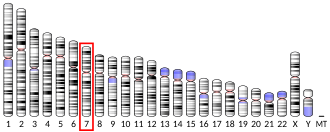
M-phase-specific PLK1-interacting protein (TTD non-photosensitive 1 protein) is a protein that in humans is encoded by the MPLKIP gene (previously known as C7orf11).56 Patients with an inherited defect in both alleles of the gene suffer from trichothiodystrophy (TTD), a disease hallmarked by brittle hair and nails and usually by developmental difficulties as well. One patient carries a homozygous deletion of the whole gene area, which indicates that the gene is not essential for embryonic development. TTD can be diagnosed by the presence of tigertail-striped patterns in hair visible under polarised light microscopy, or biochemically by a reduced Cys content of the hairs. Only a minority of the TTD cases carry a MPLKIP defect: more frequently, the gene ERCC2 is mutated, which encodes a subunit of the protein complex TFIIH that is required for general transcription and for nucleotide excision repair of DNA damage.
References
References
- GRCh38: Ensembl release 89: ENSG00000168303 – Ensembl, May 2017
- GRCm38: Ensembl release 89: ENSMUSG00000012429 – Ensembl, May 2017
- "Human PubMed Reference:". National Center for Biotechnology Information, U.S. National Library of Medicine.
- "Mouse PubMed Reference:". National Center for Biotechnology Information, U.S. National Library of Medicine.
- Nakabayashi K, Fernandez BA, Teshima I, Shuman C, Proud VK, Curry CJ, Chitayat D, Grebe T, Ming J, Oshimura M, Meguro M, Mitsuya K, Deb-Rinker P, Herbrick JA, Weksberg R, Scherer SW (Feb 2002). "Molecular genetic studies of human chromosome 7 in Russell-Silver syndrome". Genomics. 79 (2): 186–96. doi:10.1006/geno.2002.6695. PMID 11829489.
- "Entrez Gene: C7orf11 chromosome 7 open reading frame 11".
Further reading
Further reading
- Strausberg RL, Feingold EA, Grouse LH, et al. (2003). "Generation and initial analysis of more than 15,000 full-length human and mouse cDNA sequences". Proc. Natl. Acad. Sci. U.S.A. 99 (26): 16899–903. Bibcode:2002PNAS...9916899M. doi:10.1073/pnas.242603899. PMC 139241. PMID 12477932.
- Scherer SW, Cheung J, MacDonald JR, et al. (2003). "Human chromosome 7: DNA sequence and biology". Science. 300 (5620): 767–72. Bibcode:2003Sci...300..767S. doi:10.1126/science.1083423. PMC 2882961. PMID 12690205.
- Gerhard DS, Wagner L, Feingold EA, et al. (2004). "The status, quality, and expansion of the NIH full-length cDNA project: the Mammalian Gene Collection (MGC)". Genome Res. 14 (10B): 2121–7. doi:10.1101/gr.2596504. PMC 528928. PMID 15489334.
- Nakabayashi K, Amann D, Ren Y, et al. (2005). "Identification of C7orf11 (TTDN1) gene mutations and genetic heterogeneity in nonphotosensitive trichothiodystrophy". Am. J. Hum. Genet. 76 (3): 510–6. doi:10.1086/428141. PMC 1196401. PMID 15645389.
- Beausoleil SA, Villén J, Gerber SA, et al. (2006). "A probability-based approach for high-throughput protein phosphorylation analysis and site localization". Nat. Biotechnol. 24 (10): 1285–92. doi:10.1038/nbt1240. PMID 16964243. S2CID 14294292.
- Botta E, Offman J, Nardo T, et al. (2007). "Mutations in the C7orf11 (TTDN1) gene in six nonphotosensitive trichothiodystrophy patients: no obvious genotype-phenotype relationships". Hum. Mutat. 28 (1): 92–6. doi:10.1002/humu.20419. PMID 16977596. S2CID 11256506.
- Olsen JV, Blagoev B, Gnad F, et al. (2006). "Global, in vivo, and site-specific phosphorylation dynamics in signaling networks". Cell. 127 (3): 635–48. doi:10.1016/j.cell.2006.09.026. PMID 17081983. S2CID 7827573.
- Zhang Y, Tian Y, Chen Q, et al. (2007). "TTDN1 is a Plk1-interacting protein involved in maintenance of cell cycle integrity". Cell. Mol. Life Sci. 64 (5): 632–40. doi:10.1007/s00018-007-6501-8. PMC 11138413. PMID 17310276. S2CID 7761307.