| Mosylon | |
|---|---|
 | |
Location of Mosylon in Somalia Show map of SomaliaMosylon (Horn of Africa) Show map of Horn of Africa | |
| 11°17′N 49°11′E / 11.283°N 49.183°E / 11.283; 49.183 | |
| Type | Trading port |
| Periods | Classical antiquity – Late antiquity |
| Cultures | Proto-Somali |
| Location | Bosaso, Bari, Puntland, Somalia |
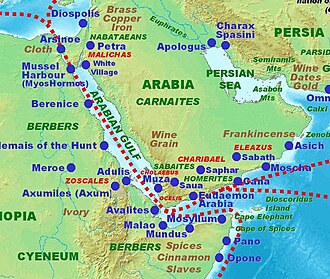
Mosylon a (Ancient Greek: Μοσυλλόν and Μόσυλον),1 was an emporium and seaport situated in northern Somalia along the coast of the Gulf of Aden during Classical and Late Antiquity. According to Greco-Roman authors, it lay on a cape or promontory bearing the same name as the entrepôt. Mosylon was a major commercial hub of the lucrative spice trade, famous for its high-quality cinnamon known as Mosyllitic. This cinnamon was exported throughout the ancient world, and for this reason large ships were required at the port of Mosylon to carry it. Its origin and early history are unknown, although Mosylon is first attested in the 1st-century Periplus of the Erythraean Sea, Pliny the Elder’s Natural History, and Dioscorides’ De Materia Medica. However, its existence may predate these accounts, as it formed part of the Punt kingdom prior to its appearance in Greco-Roman sources.
The exact location of Mosylon has been a matter of dispute among historians and archaeologists. majority of scholars place it at the site that later became the city of Bosaso or its vicinity, 2 while Georges Révoil identified it with Salweyn.
Origin

Mosylon was part of the ancient land of Punt, which flourished in the 3rd and 1st millennium BCE in the northern Somali Peninsula. During the reign of Pharaoh Thutmose III various places and settlements within Punt are recorded in an inscription at the Karnak temple. Among those topony is Ammessu, which according to the French Egyptologist Auguste Mariette corresponds to the promontory of Mosyllon/Mosylon or Moullou of antiquity.34

Pliny in his Natural history reports that Sesostris’ furthest reach was Cape Mosyllum. 5 When Mersa Gawasis was excavated a small stela with hieroglyphic inscription bearing the cartouches of Pharaoh Senusret I was discovered. The other inscription records an expedition to Punt or Bia/Bia-n-Punt.6 Sesostris is likely to be identified with Senusret I. The expedition to Punt was apparently an ideological mission intended to bring back Puntite products. Herodotus also records a similar account of Pharaoh Necho II (c. 600 BCE), who supposedly sent a non-military expedition down the Indian Ocean.7Queen Hatshepsut’s voyage to Punt brought back spices, particularly cinnamon 8, along with goods such as fragrant gums, aromatic and incense resins (frankincense and myrrh). It was after the decline of the Punt civilization in the 1st century BCE (the last known reference to Punt dates to the reign of Ptolemy X Alexander I), that Mosylon emerged as an independent trading port at the beginning of the early 1st century CE.
Greco-Roman sources
Classical era
Mosylon is first mentioned by Pedanius Dioscorides, author of De Materia Medica. Dioscorides notes that the best cinnamon (κιννάμωμον) comes from Mosylum/Mosylon, a port in Ethiopia (not to be confused with the modern nation). He also lists six varieties of cassia (κασσία), identifying the best for medicinal purposes as γίζιρ, while the others—such as ἄξυ (called δαφνῖτις by Alexandrian merchants), Μοσυλῖτις, ἀσύφη, κιττώ, and δάρκα—were of lower quality.9 Similarly, Pliny and Galen collectively confirm that the best cinnamon was called Mosyllum by the natives, which was also the name of the locality where it was obtained. There were several varieties of cinnamon, all named after their localities, with the yellow or mountain variety being particularly prized. For cassia, they distinguished multiple types and preserved their native names, including xylocassia (daphnitis), gizir, Mosyllitic bud (nasitos mosyllitikos), and the cheaper varieties kitto, moto, asyphe, and duaka. The detailed distinction between the different types of cinnamon and cassia suggests that the trade in these spices had been established for a long time (e.g. between the kingdom of Punt and ancient Egypt). From the accounts of classical authors, it is clear that all the varieties were believed to originate from the same region (today’s northeastern Somalia and not imported from anywhere else), with Mosyllum serving as the main marketplace for their collection and distribution. 10
The extreme rarity and high value of cinnamon meant that it was typically stored in the imperial Roman treasury. Cinnamon was among the most precious treasures of Queen Cleopatra of Ptolemaic Egypt. 11 Galen distinguished several types of cinnamon and incorporated them into compound medicinal preparations used for treating and preventing illness in its early stages. He was also carrying out research into the therapeutic properties of Somali cinnamon when his medical storage facility in the Horrea Piperataria was destroyed by fire.12
Description of Mosylon Cinnamon
Mosylitic cinnamon is considered the finest variety, either because of its resemblance to a type of cassia called Mosylitis or due to its association with that name.The best quality is described as fresh, dark, wine-coloured with an ash-grey tint, composed of slender branches with many knots and a strong, pleasant fragrance. Its quality is primarily determined by its aroma. The finest cinnamon has a scent similar to rue or cardamom. It is also regarded as superior when it has a strong, slightly pungent taste with warmth and mild saltiness. When handled, it should not feel rough, should not crumble into dust when broken, and should remain smooth between the knots.To test its quality, a small twig should be taken from the root, where evaluation is easiest. Since cinnamon is often found in mixed bundles of different grades, the strongest-smelling pieces are used as the standard of comparison, as their fragrance can overpower and mask the weaker varieties. 13
Periplus of the Erythraean Sea
The most detailed account of Mosyllum comes from the 1st-century Periplus of the Erythraean Sea, which describes it as follows:
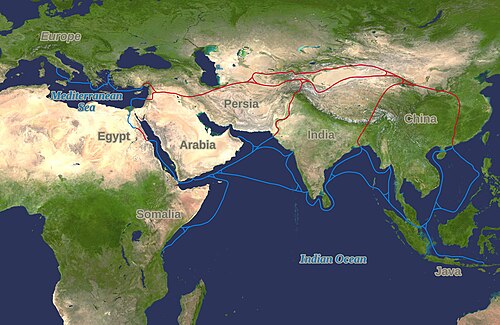
§10 Beyond Mundus, sailing eastward for two or three days, one reaches Mosyllum, a market-town on a beach with a poor anchorage. Imported goods include items previously mentioned, along with silver plate, small amounts of iron, and glass. Exports from Mosyllum consist of a large quantity of cinnamon—requiring larger ships—fragrant gums, various spices, a small amount of tortoise shell, mocrotu incense (of lesser quality than that from Mundus), “far-side” frankincense, ivory, and small quantities of myrrh.14
Other variations in the account note:
From Mundus, heading east for two to three days, Mosyllum lies on a beach with a poor harbor. The market here handles the same imported goods, plus silverware, iron (in small quantity), and precious stones. Exported items include large quantities of cassia (necessitating bigger ships), other spices and aromatics, a small amount of low-quality tortoise shell, mocrotu incense (poorer than that from Mundus), “far-side” frankincense, ivory, and myrrh, though these last are rare. 15
In Natural History of Pliny, Mosylon is describes as a port or harbour situated on a promontory or cape, and he identifies it as a place from which cinnamon was exported. 16 A town called Baragaza was located along the coast beyond this point. King Juba II of Numidia believed Cape Mossylites as marking the beginning of the Atlantic Ocean, which could be navigated with north-west winds along the coast of Mauretania up to Gades.17
Geography (Ptolemy)
Claudius Ptolemy refers to Mosyllum in Geography as a promontory and marketplace, giving its approximate coordinates as 79°00′ longitude and 9°00′ latitude. He situates it on the Bay of Avalites ( the modern Gulf of Aden). 18
Late antiquity
Gaius Julius Solinus, in De mirabilibus mundi (“On the Wonders of the World”), writes that the Azanian Sea (named after Azania) extends as far as the shores of the Ethiopians, while the Ethiopian Sea reaches the Mossylic promontory, from which the Atlantic Ocean begins. 19 Stephanus of Byzantium in his Ethnica likewise mentions Mosyllum as either a cape and trading port of Ethiopia, or as a promontory and market of Ethiopia. 20
Trade
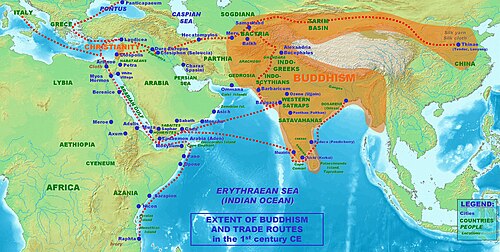
Mosylon connected both Roman Egypt and neighboring Arabia Felix with northern Somalia along the trade route of spices and incense, which passed through the Gulf of Aden onward to the Far East, the Indian subcontinent and Persia, and northward to Egypt, the Levant, Mesopotamia, Arabia and the Mediterranean world. The important known exports from Mosylon were cinnamon, the quantity of which was so great that larger vessels were required for its transport, according to the anonymous author of the Periplus, than at other ports in Africa. Fragrant gums, medicinal drugs (aromatics), tortoiseshell, incense and frankincense (brought from the interior), ivory, and small quantities of myrrh were among other commodities exported from Mosylon. Imports into Mosylon included flint glass and glass vessels from Egypt, unripe grapes from Diospolis (used in the production of grape products), unmilled cloths for the local market, corn, wine, tin (likely from Britain or Spain), tunics and finely made cloth from Arsinoe, iron, and small quantities of coinage. 21
Location and Identification of Mosylon
The area of Bosaso is thought to be the probable location of ancient Mosylon.22 Excavations conducted in the late 19th century by the French explorer Georges Révoil at the site of Salweyn suggested that this location could be identified with Mosylon. 23
Notes
Notes
- Also known as Mosullon, Mosul, and Mosyllum/Mossylite.
References
References
- "Μόσυλλον". Wiktionary (in Greek). Wikimedia Foundation. Retrieved 9 March 2026.
- The Long Millennium. Retrieved 27 May 2026 – via Google Books.
Mosylon was somewhere in the vicinity of Bosaso, Somalia, no one knows where.
- Mariette, Auguste (1875). Les listes géographiques des pylônes de Karnak: comprenant la Palestine, l’Éthiopie, le pays des Somâl …. J. C. Hinrichs. p. 62. Retrieved 2026-03-12.
- "Zeitschrift der Deutschen Morgenländischen Gesellschaft". Zeitschrift der Deutschen Morgenländischen Gesellschaft. 32. Deutsche Morgenländische Gesellschaft: 150. 1878. Retrieved 31 May 2026.
- Hussein, Said M-Shidad. "The Ancient Kingdom of Punt and its Factor in Egyptian History Part IV" (PDF). WardheerNews. Archived from the original (PDF) on 29 November 2014. Retrieved 22 September 2014.
- "Book excerpt". Brill. p. 63. Retrieved 27 May 2026.
- "Developments of External Trade". IntechOpen. Retrieved 27 May 2026.
see section 6, "Developments of external trade"
- Nirmal Babu, K.; Sivaraman, K.; Ravindran, P. N.; Devasahayam, S., eds. (2024). Handbook of Spices in India: 75 Years of Research and Development. Springer Nature Singapore. p. 24. ISBN 9789811937286.
- Marlia Mundell Mango, ed. (2009). Byzantine Trade, 4th–12th Centuries: The Archaeology of Local, Regional and International Exchange. Routledge. p. 278.
- Cooley, W. Desborough (1849). "On the Regio Cinnamomifera of the Ancients". The Journal of the Royal Geographical Society of London. 19: 174. doi:10.2307/1798092. Retrieved 9 March 2026.
- Peter, William. An Appeal to the British Government, in Behalf of the British Colony and Province of Ceylon: With an Appendix Containing Various Notices of the Island by Authors and Travellers of the Early and Middle Ages (PDF). p. 136. Retrieved 30 May 2026.
- Raoul McLaughlin. "The Roman Empire and the Indian Ocean: The Ancient World Economy and the Development of Trade Networks" (PDF). p. 36. Retrieved 30 May 2026.
- Mattioli, Pietro Andrea (1572). Commentaires de M. Pierre André Matthiole sur les six livres de Pedanius Dioscoride Anazarbeen de la matière médicale (in French). Lyon: Guillaume Rouillé. p. 35. (Digitized copy: Bibliothèque interuniversitaire de santé, Paris, BIUSante_00824)
- "Periplus of the Erythraean Sea". ToposText. Retrieved 9 March 2026.
- Casson, Lionel (1989). "The Periplus Maris Erythraei: Text with Introduction, Translation, and Commentary" (PDF). University of Warwick. Princeton University Press. p. 57. Retrieved 9 March 2026.
- Pliny, the Elder. Pliny's Natural History in Thirty-Seven Books. p. 155. Retrieved 27 May 2026.
- Pliny the Elder. "Natural History, Book VI, Chapter 34". Attalus (translation hosted at attalus.org). Retrieved 9 March 2026.
- Claudius Ptolemy. "Ptolemy, Geography, Book VI, Chapter 7". LacusCurtius (University of Chicago). Retrieved 9 March 2026.
- Gaius Julius Solinus. "Collectanea Rerum Memorabilium, Chapter LVII". The Latin Library. p. 57. Retrieved 9 March 2026.
- Stephanus of Byzantium. "Ethnica" (in Greek). Poesia Latina. p. 457. Retrieved 2026-03-12.
- James Bell (1832). A System of Geography, Popular and Scientific: Or A Physical, Political, and Statistical Account of the World and Its Various Divisions. Vol. 6. A. Fullarton and Company. p. 434.
- Hussein, Said M-Shidad. "The Ancient Kingdom of Punt and its Factor in Egyptian History Part IV" (PDF). WardheerNews. Archived from the original (PDF) on 29 November 2014. Retrieved 22 September 2014.
- Neville H. Chittick (1976). "An Archaeological Reconnaissance in the Horn: The British‑Somali Expedition, 1975–1976" (PDF). Ancient Ports & Harbours (PDF). The British Institute in Eastern Africa. p. 119. Retrieved 9 March 2026.