| Moreno Formation | |
|---|---|
| Stratigraphic range: | |
| Type | Geological formation |
| Unit of | Chico Group |
| Underlies | Unconformity with the Martinez Formation and Tejon Formation |
| Overlies | Panoche Formation |
| Thickness | 1,600–2,000 ft (487.68–609.60 m) |
| Lithology | |
| Primary | Shale |
| Other | Sandstone |
| Location | |
| Region | San Joaquin Valley, California |
| Country | United States |
The Moreno Formation is a Mesozoic geologic formation located in San Joaquin Valley (California).
Dinosaur remains diagnostic to the genus level are among the fossils that have been recovered from the formation.1
Paleofauna
Color key
|
Notes Uncertain or tentative taxa are in small text; |
Cartilaginous fish
| Cartilaginous fishes reported from the Moreno Formation | ||||||
|---|---|---|---|---|---|---|
| Genus | Species | Location | Member | Material | Notes | Images |
| Heptranchias2 | H. sp | |||||
Ray-finned fish
| Ray-finned fishes reported from the Moreno Formation | ||||||
|---|---|---|---|---|---|---|
| Genus | Species | Location | Member | Material | Notes | Images |
|
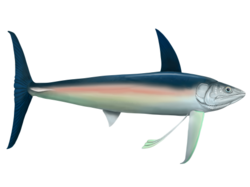
B. gladius |
A large, filter-feeding pachycormid. |
 | ||||
|
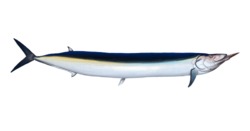
S. sp. |
An ichthyodectid. |
 | ||||
Dinosaurs
| Dinosaurs reported from the Moreno Formation | ||||||
|---|---|---|---|---|---|---|
| Genus | Species | Location | Member | Material | Notes | Images |
|
A. morrisi4 |
saurolophine.4 | 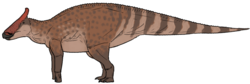 | ||||
| Saurolophus4 |
S. morrisi4 |
Reclassified as Augustynolophus morrisi.4 | ||||
Mosasaurs
| Mosasaurs reported from the Moreno Formation | ||||||
|---|---|---|---|---|---|---|
| Genus | Species | Location | Member | Material | Notes | Images |
|
K. bennisoni5 |
The name Kolposaurus was preoccupied and its two constituent species moved to the new genus Plotosaurus.5 |
|||||
|
K. tuckeri5 |
||||||
|
P. crassidens6 |
 | |||||
|
P. bennisoni5 |
 | |||||
| P. tuckeri5 | A junior synonym of P. bennisoni. | |||||
|
P. cf. waiparaensis |
||||||
|
cf. Mosasaurus7 |
cf. M. sp. |
|||||
|
H. sp. |
||||||
Plesiosaurs
| Plesiosaurs reported from the Moreno Formation | ||||||
|---|---|---|---|---|---|---|
| Genus | Species | Location | Member | Material | Notes | Images |
|
A. furlongi8 |
 | |||||
|
F. drescheri9 |
 | |||||
|
H. alexandrae8 |
 | |||||
|
M. stocki9 |
 | |||||
Turtles
| Testudines reported from the Moreno Formation | ||||||
|---|---|---|---|---|---|---|
| Genus | Species | Location | Member | Material | Notes | Images |
|
J. Howard Hutchison later referred the specimen originally identified as Adocus by to the genus Basilemys.10 |
||||||
Foraminifera
| Forams reported from the Moreno Formation | ||||||
|---|---|---|---|---|---|---|
| Genus | Species | Location | Member | Material | Notes | Images |
| Anomalina2 | A. pseudopopillosa | Tierra Loma Shale Member | ||||
| Bulimina | B. obtusa | Tierra Loma Shale Member | 99% of the foraminifera sampled at the Tierra Loma Shale Member belonged to B. obtusa.1112 | |||
| Dentalina2 | D. legumen | Tierra Loma Shale Member | ||||
| Frondicularia2 | F. undulosa | Tierra Loma Shale Member | ||||
| Gyroidina2 | G. depressa | Tierra Loma Shale Member | ||||
| Nodosaria2 | N. monile | Tierra Loma Shale Member | ||||
| N. pomuligera | ||||||
| N. spinifera | ||||||
| N. sp | ||||||
| Nodosarella12 | N. sp | Tierra Loma Shale Member | ||||
See also
See also
Footnotes
Footnotes
- Weishampel, et al. (2004). "Dinosaur distribution." Pp. 517-607.
- "PBDB Collection". paleobiodb.org. Retrieved 2025-03-06.
- Friedman, Matt; Shimada, Kenshu; Everhart, Michael J.; Irwin, Kelly J.; Grandstaff, Barbara S.; Stewart, J. D. (8 January 2013). "Geographic and stratigraphic distribution of the Late Cretaceous suspension-feeding bony fish Bonnerichthys gladius (Teleostei, Pachycormiformes)". Journal of Vertebrate Paleontology. 33 (1): 35–47. doi:10.1080/02724634.2012.713059. S2CID 128958842.
- Prieto-Márquez, Albert; Wagner, Jonathan R.; Bell, Phil R.; Chiappe, Luis M. (2014). "The late-surviving 'duck-billed' dinosaur Augustynolophus from the upper Maastrichtian of western North America and crest evolution in Saurolophini". Geological Magazine. 152 (2): 225–241. doi:10.1017/S0016756814000284. S2CID 131049979.
- "4: The Marine Reptiles; Mosasaurs," in Hilton (2003) p. 107-110
- "Appendix: Summary of the Mesozoic Reptilian Fossils of California," in Hilton (2003) p. 273
- Lindgren, Johan; Schulp, Anne (15 September 2010). "New material of Prognathodon (Squamata: Mosasauridae), and the mosasaur assemblage of the Maastrichtian of California, U.S.A.". Journal of Vertebrate Paleontology. 30 (5): 1632–1636. doi:10.1080/02724634.2010.501444. S2CID 131124198.
- "Appendix: Summary of the Mesozoic Reptilian Fossils of California," in Hilton (2003) p. 276
- "Appendix: Summary of the Mesozoic Reptilian Fossils of California," in Hilton (2003) p. 277
- "4: The Marine Reptiles; Turtles," in Hilton (2003) p. 114
- "Panoche Hills 5, UCMP V3735 (Cretaceous of the United States)". PBDB.org.
- Welles, S. P. (1943). "Elasmosaurid plesiosaurs with description of new material from California and Colorado" (PDF). Memoirs of the University of California. 13.
References
References
- Hilton, Richard P. 2003. Dinosaurs and Other Mesozoic Reptiles of California. Berkeley: University of California Press. 318 pp.
- Weishampel, David B.; Dodson, Peter; and Osmólska, Halszka (eds.): The Dinosauria, 2nd, Berkeley: University of California Press. 861 pp. ISBN 0-520-24209-2.