| Monotropa | |
|---|---|
| |
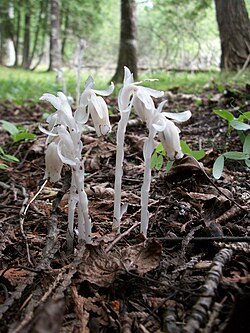
| Monotropa uniflora, northeastern Ohio | |
Scientific classification 
| |
| Kingdom: | Plantae |
| Clade: | Embryophytes |
| Clade: | Tracheophytes |
| Clade: | Spermatophytes |
| Clade: | Angiosperms |
| Clade: | Eudicots |
| Clade: | Asterids |
| Order: | Ericales |
| Family: | Ericaceae |
| Subfamily: | Monotropoideae |
| Tribe: | Monotropeae |
| Genus: | Monotropa L. |
| Species1 | |
| |
| Synonyms1 | |
| |
Monotropa is a genus of five species of herbaceous perennial flowering plants.1 The genus was formerly classified in the family Monotropaceae and presently classified in Ericaceae. They are native to temperate regions of the Northern Hemisphere and are generally rare. Unlike most plants, they do not have chlorophyll and therefore are non-photosynthetic; they are myco-heterotrophs that obtain food through parasitism on subterranean fungi. Because they do not need any sunlight to live, they can live in very dark sites such as the floor of deep forest. The name "Monotropa" is Greek for "one turn" as every plant has one large turn near the top of the plant to a drooping tip when the plants are in flower. The type species is Monotropa uniflora.2
Species
The genus currently consists of the following five species:134
| Image | Species | Distribution1 | Notes |
|---|---|---|---|
|
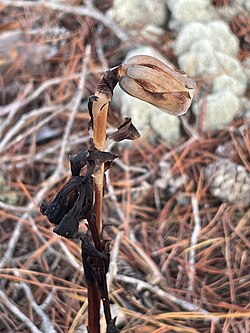
Monotropa brittonii Small | Southeastern United States (North Carolina to Florida) | Formerly included in M. uniflora, but differs in dryland ecology and parasitism of Lactifluus deceptivus and a few other Lactifluus species.5 Flowers single per stem, creamy white to salmon-toned.6 |
|
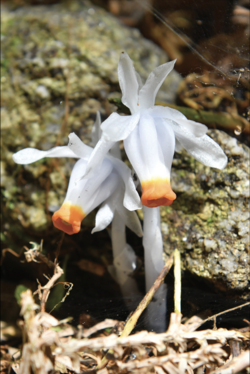
Monotropa callistoma Wei et al. | Hunan Province, China | Characterised by its glabrous, bicoloured petals that are orange at the tip, along with glabrous staminal filaments and a nodding berry at maturity. Only collected from a single documented site in China, suspected to occur elsewhere. Described in 2026.4 |

|
Monotropa coccinea Zucc. | Mexico south through Central America to Colombia | Formerly often treated as a subspecies of M. uniflora. Flowers single per stem, bright red. |

|
Monotropa hypopitys L. | Temperate Holarctic | Flowers multiple per stem, pale yellow to pink. |

|
Monotropa uniflora L. | Temperate North America and Eastern Asia | Flowers single per stem, white. |
Some genetic evidence however suggests that this circumscription is paraphyletic with respect to the related genera Allotropa, Hemitomes, Monotropsis, and Pityopus,7 and that M. hypopitys should be split out in its own genus; when this is done, its name becomes Hypopitys monotropa Crantz. It differs conspicuously from the other species in the genus in having multiple flowers on each stem, rather than one flower per stem.8910
External links
External links
- Media related to Monotropa at Wikimedia Commons
- Data related to Monotropa at Wikispecies
- Flora of China: Monotropa
References
References
- "Monotropa L." Plants of the World Online. Royal Botanic Gardens, Kew. Retrieved 22 March 2025.
- "Monotropa". International Plant Names Index. Retrieved 2025-09-15.
- Keesling, Ashley R.; Broe, Michael B.; Freudenstein, John V. (2021-12-21). "Reevaluating the Species Status of the Southern Ghost Pipe, Monotropa brittonii (Ericaceae)". www.ingentaconnect.com. Retrieved 2022-01-13.
- Wei, Ze; Liu, Li-Jia; Xuan, Jing; Mo, Zhi-Qiong; Ou Yang, Wen-Xiang; Liu, Bing; Li, Min; Wang, Qiang (2025). "Monotropa callistoma (Ericaceae), a new species based on morphological and molecular evidence from Hunan, China". PhytoKeys. 271: 1–?. doi:10.3897/phytokeys.271.177609.
- Keesling, Ashley Rose (2020). "Reevaluating the species status of the Southern Ghost Pipe, Monotropa brittonii". OhioLINK Electronic Theses & Dissertations (ETD) Center. Retrieved 2025-09-15.
- Small, J. K. (1927). "Monotropa Brittonii". Journal of the New York Botanical Garden. 28: 7. Retrieved 17 September 2025.
- Bidartondo, M. I.; Bruns, T. D. (2001). "Extreme specificity in epiparasitic Monotropoideae (Ericaceae): widespread phylogenetic and geographical structure". Molecular Ecology. 10 (9): 2285–2295. Bibcode:2001MolEc..10.2285B. doi:10.1046/j.1365-294X.2001.01358.x. ISSN 0962-1083. Retrieved 2025-09-13.
- Liu, Zhen-Wen; Zhao, Qian-Ru; Peng, Hua; Zhou, Jing (2017). "(2545) Proposal to conserve the name Hypopitys (Ericaceae) with a conserved type". Taxon. 66 (4): 987–988. Bibcode:2017Taxon..66..987L. doi:10.12705/664.20. hdl:11336/84412. ISSN 0040-0262.
- "Yellow Bird's-nest Hypopitys monotropa Crantz". PlantAtlas. Retrieved 2025-09-13.
- "Hypopitys monotropa Crantz". Database of Vascular Plants of Canada (VASCAN). Retrieved 2025-09-13.