| Mobulidae Temporal range: Possible Late Cretaceous record1
| |
|---|---|
| |
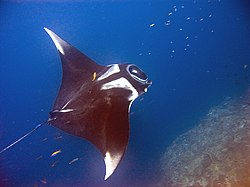
| Mobula birostris at Hin Daeng, Thailand | |
Scientific classification 
| |
| Kingdom: | Animalia |
| Phylum: | Chordata |
| Class: | Chondrichthyes |
| Subclass: | Elasmobranchii |
| Division: | Batomorphi |
| Order: | Myliobatiformes |
| Family: | Mobulidae Gill, 18932 |
| Genera | |
The Mobulidae are a family of rays (manta rays and devilfishes) consisting mostly of large species living in the open ocean rather than on the sea bottom.
Taxonomy
The Mobulidae have been variously considered a subfamily of the Myliobatidae by some authors,34 and a distinct family by others, but recent work favors the latter.5 Two genera have been traditionally recognized, Manta and Mobula, but recent DNA analysis shows that Mobula as traditionally recognized is paraphyletic to manta rays, making Manta a junior synonym of Mobula and Mobula the only extant genus of the family.6
Fossil record
Several genera of fossil mobulids are known from teeth, including Archaeomanta, Burnhamia, Eomobula, and Paramobula.789 The earliest records of mobulids are of Archaeomanta from the Early Paleocene.1 A potentially earlier record may be Cretomanta from the mid-Cretaceous, but this genus may represent a planktivorous shark potentially related to Aquilolamna.1011
References
References
- "PBDB Taxon". paleobiodb.org. Archived from the original on 2025-08-12. Retrieved 2026-02-07.
- Theodore Gill (1893). "Families and Subfamilies of Fishes". Memoirs of the National Academy of Sciences. 6 (6): 130.
- Nelson, Joseph S. (2006). "Subfamily Mobulinae (devil rays)". Fishes of the World (4th ed.). Hoboken: Wiley. p. 82. ISBN 9780471756446.
- Nelson, Joseph S.; Grande, Terry C.; Wilson, Mark V. H. (2016). "Subfamily Mobulinae (devil rays)". Fishes of the World (5th ed.). Hoboken: Wiley. pp. 94–95. doi:10.1002/9781119174844.ch2.
- White, W. T.; Last, P. R. (2016). "Devilrays: Family Mobulidae". In Last, Peter R.; White, William T.; de Carvalho, Marceo R.; Séret, Bernard; Stehmann, Matthias F. W.; Naylor, Gavin J. P. (eds.). Rays of the World. Ithaca: Cornell University Press. pp. 741–749. ISBN 9781501705328.
- White, William T.; Corrigan, Shannon; Yang, Lei; Henderson, Aaron C.; Bazinet, Adam L.; Swofford, David L.; Naylor, Gavin J. P. (2017). "Phylogeny of the manta and devilrays (Chondrichthyes: mobulidae), with an updated taxonomic arrangement for the family". Zoological Journal of the Linnean Society. zlx018: 50–75. doi:10.1093/zoolinnean/zlx018.
- Cappetta, H. (1987). Chondrichthyes II Mesozoic and Cenozoic Elasmobranchii. Handbook of Paleoichthyology. Vol. 3B. Stuttgart: Gustav Fischer Verlag.
- Herman, J.; Hovestadt-Euller, M.; Hovestadt, D. C. (1989). "Additions to the Eocene fish fauna of Belgium. 9. Discovery of Eomobula gen. et. sp. nov. (Mobulidae, Chondrichthyes) from the Ypresian". Tertiary Research. 10 (4). Leiden: 175–178.
- Cicimurri, David J.; Knight, James L. (2009). "Late Oligocene Sharks and Rays from the Chandler Bridge Formation, Dorchester County, South Carolina, USA". Acta Palaeontologica Polonica. 54 (4): 627–647. doi:10.4202/app.2008.0077.
- Nagrodski, Matthew; Shimada, Kenshu; Schumacher, Bruce A. (2012-10-01). "Marine vertebrates from the Hartland Shale (Upper Cretaceous: Upper Cenomanian) in southeastern Colorado, USA". Cretaceous Research. 37: 76–88. doi:10.1016/j.cretres.2012.03.007. ISSN 0195-6671.
- Vullo, Romain; Frey, Eberhard; Ifrim, Christina; González González, Margarito A.; Stinnesbeck, Eva S.; Stinnesbeck, Wolfgang (2021-03-19). "Manta-like planktivorous sharks in Late Cretaceous oceans". Science. 371 (6535): 1253–1256. doi:10.1126/science.abc1490.