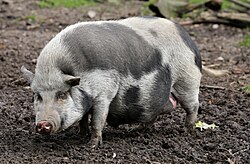
A miniature pig, minipig or micro-pig is a domestic pig characterised by its unusually small size when fully grown. Some breeds of miniature pig – such as the Cerdo Cuino of Mexico, the Lon I of Vietnam, the Ras-n-Lansa of Guam in the Marianas Islands and the Wuzhishan of Hainan Island in China – are traditional breeds of those areas.1: 238 2: 714 Many others have been selectively bred since the mid-twentieth century specifically for laboratory use in biomedical research; among these are the Clawn and the Ohmini of Japan, the Czech Minipig, the German Göttingen Minipig, the Lee-Sung of Taiwan, the Russian Minisib, the extinct Minnesota Miniature of the United States and the Westran of Australia.3: 7 Some minipigs have been bred to be marketed as companion animals.2: 652
Miniature pigs generally reach their full size in about four years, and may live for up to fifteen. Some may reach a height of 50 cm (20 in) at the shoulder and a body length of 100 cm (40 in).4
History
Domestic pigs of very small size have traditionally been reared in many countries in Asia – among them China, Laos, Taiwan, Tibet and Vietnam – in Central and South America, and in West Africa. Some oceanic islands have populations of small pig, which in some cases are feral.2: 650
In the mid-twentieth century, researchers began selective breeding of pigs for small size with the aim of creating animals suitable for laboratory use.2: 650
From about 1942 various strains of small pig were imported from Manchuria to Japan; from 1945 Hiroshi Ohmi selected these for small size, leading to the creation of the Ohmini, which was used both as a laboratory animal and for meat.2: 665 5: 685
The Minnesota Miniature was bred at the Hormel Institute of the University of Minnesota from 1949, from a stock of Piney Woods, Guinea Hog and wild boar from the United States and Ras-n-lansa from Guam.67
In the 1960s some pigs of the traditional Vietnamese Lon I breed were imported to western Europe for exhibition in zoos; some of these were later taken to North America, where they contributed to the development of the Vietnamese Pot-bellied type.8: 68
From the late 1960s, researchers at the Institut für Tierzucht und Haustiergenetik or Institute of Animal Breeding and Genetics of the University of Göttingen in Lower Saxony cross-bred these Vietnamese pigs with Minnesota Miniature and German Landrace stock to produce the Göttingen Minipig.9
Pigs of this kind were later used for medical research in the fields of toxicology, pharmacology, pulmonology, cardiology, aging, and as a source of organs for organ transplantation.10
Use
Miniature pigs have been used for medical research, including toxicology, pharmacology, experimental surgery, pulmonology, cardiology, xenotransplantation, orthopedic procedures11 and aging studies. Mini pigs are mainly used for biochemical, anatomical, and physiological similarities to humans. They are also quick to develop, making it easier to breed and have more genomic background compared to other animal models of toxicology. Today, more than 60,000 pigs are used for scientific research.121314 For example, scientists are working on studying the possibility of utilizing pig hearts for human heart organ transplants, and work has been done to genetically modify the tissues of pigs to be accepted by the human immune system.15
Miniature pigs are occasionally kept as companion animals, and some have been bred specifically to be marketed for this purpose.2: 652 They may also find use in animal-assisted therapy.16: 469
Breeds
Among the traditional breeds of very small pig are the following:
| Local name(s) | English name if used | Country | . Notes | . Image |
|---|---|---|---|---|
| Ashanti Dwarf1: 206 | Ghana | |||
| Bakosi1: 206 | Cameroon | |||
| Bamaxiang1: 181 | Guangxi, China | |||
| Chin1: 189 | Myanmar | |||
| Cuino | Mexico | possibly extinct1: 239 | ||
| Diqing | Tibet | Diqing Prefecture 2: 703 | ||
| Ghori1: 173 |
|
|||
| Hezuo | Tibet | Gannan Prefecture2: 703 | ||
| Lanyu | Taiwan | Orchid Island2: 634 | ||
| Lon Co | Vietnam | central Vietnam1: 188 | ||
| Lon I | "Vietnamese Pot-bellied" | Vietnam | traditional breed, formerly numerous, now gravely endangered | 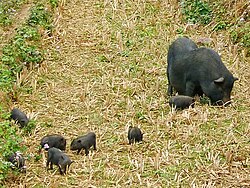
|
| Mou Chid2: 636 | Laos | |||
| Mou Lat2: 636 | Laos | |||
| Ras-n-las | Guam2: 606 | |||
| Zàngzhu2: 636 | Tibetan | Tibet |
Among the modern breeds created specifically for laboratory use are the following:
| Name(s) | Country | Notes | Image |
|---|---|---|---|
| Clawn | Japan | bred from 1978 at Kagoshima University from Landrace x Large White, Göttingen Miniature and Ohmini3: 7 2: 580 1: 193 | |
|
Czechoslovakia | from the 1980s5: 685 | |
| Froxfield Pygmy | United Kingdom1: 115 | ||
|
Germany | bred in the early 1960s at Göttingen University from small Vietnamese pigs and Minnesota Miniature; white variant developed by crossing with German Landrace1: 151 | 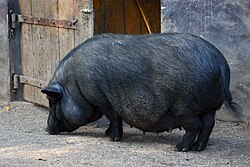
|
| Hanford Miniature1: 151 | United States | ||
| Lee Sung Miniature Pig5: 686 | Taiwan | ||
| Mini-Lewe | Czechoslovakia | 1970s5: 684 | |
|
United States | bred from 1949 at the Hormel Institute of the University of Minnesota in St Paul, from feral Guinea Hogs from Alabama, feral pigs from Santa Catalina Island, Pineywoods Rooter feral pigs from Louisiana and Ras-n-Lansa pigs from Guam; extinct.2: 652 | |
| Munich Miniature1: 151 | Germany | ||
| Ohmini | Japan | bred from the 1940s from Manchurian pigs and Minnesota Miniature1: 193 | |
| Westran | Australia | 1976 1: 238 | |
| Yucatan Micropig1: 238 | |||
| Yucatan Miniature1: 238 |
References
References
- Valerie Porter, Jake Tebbit (illustrator) (1993). Pigs: A Handbook to the Breeds of the World. Ithaca, New York: Comstock Publishing Associates. ISBN 1873403178.
- Valerie Porter, Lawrence Alderson, Stephen J.G. Hall, D. Phillip Sponenberg (2016). Mason's World Encyclopedia of Livestock Breeds and Breeding (sixth edition). Wallingford: CABI. ISBN 9781780647944.
- Friederike Köhn (2011). History and Development of Miniature, Micro- and Minipigs. In: Peter A. McAnulty, Anthony D. Dayan, Niels-Christian Ganderup, Kenneth L. Hastings (editors) (2011). The Minipig in Biomedical Research. Boca Raton; London; New York: CRC Press (Taylor & Francis Group). ISBN 9781439811191.
- [s.n.] (2012). Der kleine Ratgeber Das Minischwein (in German). Vienna: Veterinärmedizinische Universität Wien. Accessed January 2025.
- Linda M. Panepinto (1996). Miniature Swine Breeds Used Worldwide in Research. In: Mike E. Tumbleson, Lawrence B. Schook (editors). Advances in Swine in Biomedical Research, volume 2. New York: Plenum Press. ISBN 9781461376996, pages 681–692.
- Almut E. Dettmers, W. E. Rempel, R. E. Comstock (1965). Selection for Small Size in Swine. Journal of Animal Science. 24 (1): 216–220. doi:10.2527/jas1971.3361212x. (subscription required).
- Almut E. Dettmers, W. E. Rempel, D. E. Hacker (1971). Response to Recurrent Mass Selection for Small Size in Swine. Journal of Animal Science. 33 (6): 1212–1215. doi:10.2527/jas1965.241216x. (subscription required).
- John Pukite (2002). A Field Guide to Pigs. New York, New York: Penguin Books. ISBN 9781560448778.
- Peter J.A. Bollen, Lars Ellegaard (1996). Developments in Breeding Göttingen Minipigs. In: Mike E. Tumbleson, Lawrence B. Schook (editors). Advances in Swine in Biomedical Research, volume 1. New York: Plenum Press. ISBN 9780306454950, pages 59–66.
- David H. Sachs, Cesare Galli (2009). Genetic Manipulation in Pigs. Current Opinion in Organ Transplantation. 14 (2): 148–153. doi:10.1097/mot.0b013e3283292549. (subscription required).
- Høy-Petersen, J.; Smith, J. S.; Merkatoris, P. T.; Black, K. E.; Faivre, C. M.; Miles, K. G.; Tatarniuk, D. M.; Kraus, K. H. (2020). "Trochlear wedge sulcoplasty, tibial tuberosity transposition, and lateral imbrication for correction of a traumatic patellar luxation in a miniature companion pig: A case report and visual description". Frontiers in Veterinary Science. 7 567886. doi:10.3389/fvets.2020.567886. PMC 7838352. PMID 33521073.
- Bode, G., Clausing P., Gervais, F., Loegsted, J., Luft, J., Nogues, V., & Sims, J. (2010) The utility of the minipigs as an animal model in regulatory toxicology. Journal of Pharmacological and toxicological methods, 62(3), 196-220.
- Svendensen, O. (2006). The minipig in toxicology. Experimental and Toxicologic Pathology, 57(5), 335-339.
- Dolgin, E. (2010). Minipig, Minipig, let me in. Nature Medicine, 16(12), 1349.
- Cooper, David K. C. (2017-03-08). "A brief history of cross-species organ transplantation". Proceedings (Baylor University. Medical Center). 25 (1): 49–57. doi:10.1080/08998280.2012.11928783. ISSN 0899-8280. PMC 3246856. PMID 22275786.
- Karin Hediger (2025). Snapshot Seven: Integrating Animals Into Neurorehabilitation. In: Aubrey H. Fine, Megan K. Mueller, Zenithson Y. Ng, Taylor Chastain Griffin, Philip Tedeschi (2025). Handbook on Animal-Assisted Therapy, sixth edition. London; San Diego; Cambridge, Massachusetts: Elsevier Science & Technology. ISBN 9780443223471, pages 467–471.