| Minhe Formation | |
|---|---|
| Stratigraphic range: Late Cretaceous,1 | |
| Type | Geological formation |
| Overlies | Unconformity: Hekou Group |
| Lithology | |
| Primary | Red or variegated clastic rock |
| Location | |
| Region | Gansu, Inner Mongolia |
| Country |  China China |
The Minhe Formation (simplified Chinese: 民和组; traditional Chinese: 民和組; pinyin: Mínhé Zǔ) is a geological formation in northwestern China, whose strata date back to the Late Cretaceous period.
Dinosaur remains are among the fossils that have been recovered from the formation.2
Vertebrate paleofauna
Dinosaurs
A tyrannosaur tooth with a split carina has been recovered from the Minhe Formation in China.3
Color key
|
Notes Uncertain or tentative taxa are in small text; |
| Dinosaurs reported from the Minhe Formation | ||||||
|---|---|---|---|---|---|---|
| Genus | Species | Location | Stratigraphic position | Material | Notes | Images |
|
H. pachycephalus4 |
|
"Badly preserved cranial and postcranial fragments."5 |
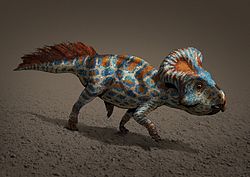  | |||
|
M. gobiensis4 |
|
"Teeth, fragmentary jaws and postcrania."6 |
||||
|
M. sulcidens4 |
|
"Tooth."6 |
||||
|
P. philemys4 |
|
"Very fragmentary jaw with [one] tooth."7 |
||||
|
P. andrewsi8 |
||||||
|
T. bexelli9 |
Inner Mongolia9 |
Reclassified as a new genus of pachycephalosaur,Sinocephale and reidentified as provenant from the Ulansuhai Formation | ||||
|
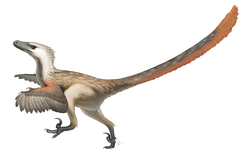
V. mongoliensis10 |
|
|||||
References
References
- Xi, D.; Wan, X.; Li, G.; Li, G. (2018). "Cretaceous integrative stratigraphy and timescale of China". Science China Earth Sciences. 61: 1–31. doi:10.1007/s11430-017-9262-y.
- Weishampel, David B; et al. (2004). "Dinosaur distribution (Late Cretaceous, Asia)." In: Weishampel, David B.; Dodson, Peter; and Osmólska, Halszka (eds.): The Dinosauria, 2nd, Berkeley: University of California Press. Pp. 593-600. ISBN 0-520-24209-2.
- "Tyrannosauridae," in Molnar (2001); page 347.
- "3.3 Gansu, People's Republic of China; 1. Minhe Formation," in Weishampel, et al. (2004). Page 598.
- "Table 21.1," in Weishampel, et al. (2004). Page 466.
- "Table 22.1," in Weishampel, et al. (2004). Page 480.
- "Table 17.1," in Weishampel, et al. (2004). Page 368.
- "3.3 Gansu, People's Republic of China; 1. Minhe Formation" and "3.3 Nei Mongol Zizhiqu, People's Republic of China; 3. Minhe Formation," in Weishampel, et al. (2004). Pages 598-599.
- "3.3 Nei Mongol Zizhiqu, People's Republic of China; 3. Minhe Formation," in Weishampel, et al. (2004). Pages 598-599.
- Listed as "cf. Velociraptor mongoliensis" in "3.3 Nei Mongol Zizhiqu, People's Republic of China; 3. Minhe Formation," in Weishampel, et al. (2004). Pages 598-599.
Bibliography
- Molnar, R. E., 2001, Theropod paleopathology: a literature survey: In: Mesozoic Vertebrate Life, edited by Tanke, D. H., and Carpenter, K., Indiana University Press, p. 337-363.
- Weishampel, David B.; Dodson, Peter; and Osmólska, Halszka (eds.): The Dinosauria, 2nd, Berkeley: University of California Press. 861 pp. ISBN 0-520-24209-2.